Full Text (PDF)
Indian Journal of Forensic Medicine and Pathology 11(2):p 101-105, April-June 2018. | DOI: 10.21088/ijfmp.0974.3383.11218.10
Original Article
The Study of Styloid Process: A Morphometric Analysis with Clinical Implications
Sachendra Kumar Mittal, Nishat Ahmed Sheikh1 null, Sachendra Kumar Mittal2 null
Author Information
Licence:
Attribution-Non-commercial 4.0 International (CC BY-NC 4.0)This license enables reusers to distribute, remix, adapt, and build upon the material in any medium or format for noncommercial purposes only, and only so long as attribution is given to the creator.
Indian Journal of Forensic Medicine and Pathology 11(2):p 101-105, April-June 2018. | DOI: 10.21088/ijfmp.0974.3383.11218.10
How Cite This Article:
Timeline
Received : March 06, 2018
Accepted : April 11, 2018
Published : May 30, 2018
Abstract
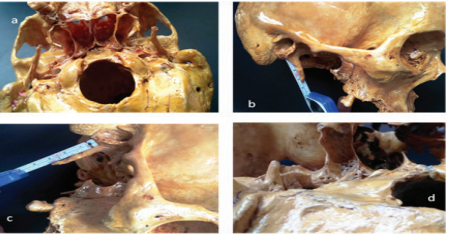
Eagle syndrome represents symptoms manifested by compression of regional structures by elongation of the styloid process or ossification of the stylohyoid membrane. The aim of the study is to assess the distribution of SP length and its correlation with side asymmetry. Present study was conducted in collaboration with department of Anatomy and department of Forensic Medicine at Jaipur National University Institute for Medical Sciences and research Center, Jaipur. A total of 38 dry skulls held by the Department of Anatomy were analyzed. The measures were synthesized in one mean measure. Descriptive statistics involved the calculation of central tendency and dispersion measures for each side of the styloid process and for each anatomic position. The length of the SP ranged from 5 mm to 43 mm and from 10 mm to 46 mm, based on the lateral view of the left and right styloid, respectively. From the posterior view, the values for the left and right sides of the skulls, respectively, ranged from 10 mm to 54 mm and from 15mm to 58 mm. This morpho-metric data of the styloid process is important to the physicians, neurosurgeons, otorhino-laryngologist and dentists for accurate diagnosis and treatment of dysphagia and chronic neck pain. The mere presence of an elongated styloid process does not automatically confirm a case of Eagle syndrome. The knowledge of SP variability apart from its anatomic value is of special interest for clinicians when managing atypical pain in the head and neck area as well as for forensic medicine and medico legal cases.
References
- 1. Goss CM. Osteology. In: Gray’s anatomy. 29th ed. Philadelphia: Lea and Febiger; 1973. p. 173.
- 2. Vesalius A. De humani corporis fabrica. Basel: Johannes Oporinus; 1543. Liber Septum.
- 3. Marchetti D. Anatomia. Padua; 1652.
- 4. Eagle W. Elongated styloid process: report of two cases. Arch Otolaryngol. 1937;25:584-7.
- 5. Eagle W. Sphenopalatine ganglion neuralgia. Arch Otolaryngol. 1942;35:66-84.
- 6. Eagle W. Symptomatic elongated styloid process: report of two cases of styloid process-carotid artery syndrome with operation. Arch Otolaryngol. 1949;49:490-503.
- 7. Fritz M. Elongated styloid process: cause of obscure throat symptoms. Arch Otolaryngol. 1940;31:911-4.
- 8. Caliceti G, Manara E, Castellini G. Sindrome da processo stilodeo anomalo. L’oto-rino-laringol Ital. 1958;26:118-28.
- 9. Pereliò J. La apofisis estiloides. Acta Orl Iber Am. 1953;4:325-46.
- 10. Boedts D. Styloid process syndrome or stylohyoid syndrome? Acta Otorhinolaryngol Belg. 1978;32:273-8.
- 11. Moffat DA, Ramsden RT, Shaw HJ. The styloid process syndrome: aetiological factors and surgical management. J Laryngol Otol. 1977;91:279–94.
- 12. Eagle WW. Elongated styloid process: symptoms and treatment. AMA Arch Otolaryngol. 1958;67:172–6.
- 13. Piagkou M, Anagnostopoulou S, Kouladouros K, Piagkos G. Eagle’s syndrome: a review of the literature. Clin Anat. 2009;22:545–58.
- 14. Balbuena L, Hayes D, Ramirez SG, Johnson R. Eagle’s syndrome (elongated styloid process). South Med J. 1997;90(3):331–4.
- 15. Murtagh RD, Caracciolo JT, Fernandez G. CT findings associated with Eagle syndrome. AJNR Am J Neuroradiol. 2001;22(7):1401–2.
- 16. Jung T, Tschernitschek H, Hippen H, Schneider B, Borchers L. Elongated styloid process: when is it really elongated? Dentomaxillofac Radiol. 2004;33(2):119–24.
- 17. Vadgaonkar R, Murlimanju BV, Prabhu LV, et al. Morphological study of styloid process of the temporal bone and its clinical implications. Anat Cell Biol. 2015;48(3):155-9.
- 18. Başekim CC, Mutlu H, Güngör A, et al. Evaluation of styloid process by three-dimensional computed tomography. Eur Radiol. 2005;15(1):134–9.
- 19. Rechtweg JS, Wax MK. Eagle’s syndrome: a review. Am J Otolaryngol. 1998;19:316–21.
- 20. Natsis K, Piagkou M, Skotsimara G, et al. The ossified pterygoalar ligament: an anatomical study with pathological and surgical implications. J Craniomaxillofac Surg. 2014;42(5):e266-70.
- 21. Sisman Y, Gokce C, Tarim Ertas E, et al. Investigation of elongated styloid process prevalence in patients with torus palatinus. Clin Oral Investig. 2009;13:269–72.
- 22. Guo B, Jaovisidha S, Sartoris DJ, et al. Correlation between ossification of the stylohyoid ligament and osteophytes of the cervical spine. J Rheumatol. 1997;24:1575–81.
- 23. Moffat DA, Ramsden RT, Shaw HJ. The styloid process syndrome: aetiological factors and surgical management. J Laryngol Otol. 1977;91(4):279–94.
- 24. Kaufman SM, Elzay RP, Irish EF. Styloid process variation: radiologic and clinical study. Arch Otolaryngol. 1970;91(5):460–3.
- 25. Lindeman P. The elongated styloid process as a cause of throat discomfort: four case reports. J Laryngol Otol. 1985;99(5):505–8.
- 26. Langlais RP, Miles DA, Van Dis ML. Elongated and mineralized stylohyoid ligament complex: a proposed classification and report of a case of Eagle’s syndrome. Oral Surg Oral Med Oral Pathol. 1986;61(5):527–32.
- 27. Winkler S, Sammartino FJ Sr, Sammartino FJ Jr, Monari JH. Stylohyoid syndrome: report of a case. Oral Surg Oral Med Oral Pathol. 1981;51(2):215–7.
- 28. Kawai T, Shimozato K, Ochiai S. Elongated styloid process as a cause of difficult intubation. J Oral Maxillofac Surg. 1990;48(11):1225–8.
- 29. Rathva A, Kubavat DM, Nagar SK. Study of styloid process: anatomical variations in length, angulation and distance between the two styloid processes. Int J Recent Trends Sci Technol. 2013;8:109–12.
- 30. Dao A, Karnezis S, Lane JS 3rd, Fujitani RM, Saremi F. Eagle syndrome presenting with external carotid artery pseudoaneurysm. Emerg Radiol. 2011;18:263–5.
- 31. Vougiouklakis T. Overview of the ossified styloid ligament based in more than 1200 forensic autopsies. J Clin Forensic Med. 2006;13:268–70.
Data Sharing Statement
There are no additional data available. All raw data and code are available upon request.
Funding
This research received no funding.
Author Contributions
Whether all authors contributed significantly to the work and approve its publication.
Ethics Declaration
This article does not involve any human or animal subjects, and therefore does not require ethics approval.
Acknowledgements
We would like to express our gratitude to the patients, their families, and all those who have contributed to this study.
Conflicts of Interest
The authors report no conflicts of interest in this work.
About this article

Cite this article
Licence:
Attribution-Non-commercial 4.0 International (CC BY-NC 4.0)This license enables reusers to distribute, remix, adapt, and build upon the material in any medium or format for noncommercial purposes only, and only so long as attribution is given to the creator.
| Received | Accepted | Published |
|---|---|---|
| March 06, 2018 | April 11, 2018 | May 30, 2018 |
DOI: 10.21088/ijfmp.0974.3383.11218.10
Keywords
Eagle’s SyndromeStyloid ProcesElongated Styloid ProcessSearch for Similar Articles
Similar Articles
- Diatom Analysis in Thermophilic water bodies: A Study on Hot Water Springs of Ma...
- Morphometric Study of Supra-meatal Triangle and Mastoid process in the Adult dry...
- Histopathological Spectrum of Autopsy Cases: A One Year Retrospective Observatio...
- Forensic Differentiation of Manner of Death in Railway Fatalities: A FourCase Se...
- Understanding assault Patterns: A Cross-sectional study of Cases at Chri, Kelamb...
Article Level Metrics
Last UpdatedSunday 18 October 2026, 10:56:38 (IST)
16257
Accesses
12
3205
00
Citations
NA
NA
NA
Download citation
Article Keywords
Keyword Highlighting
Highlight selected keywords in the article text.
Timeline
| Received | March 06, 2018 |
| Accepted | April 11, 2018 |
| Published | May 30, 2018 |
licence
Attribution-Non-commercial 4.0 International (CC BY-NC 4.0)
This license enables reusers to distribute, remix, adapt, and build upon the material in any medium or format for noncommercial purposes only, and only so long as attribution is given to the creator.