Full Text (PDF)
Indian Journal of Forensic Medicine and Pathology 19(3):p 376-380, July -Sept. 2026. | DOI: https://doi.org/10.21088/ijfmp.0974.3383.19326.13
Original Article
Understanding assault Patterns: A Cross-sectional study of Cases at Chri, Kelambakkam, Chennai
Author Information
Licence:
Attribution-Non-commercial 4.0 International (CC BY-NC 4.0)This license enables reusers to distribute, remix, adapt, and build upon the material in any medium or format for noncommercial purposes only, and only so long as attribution is given to the creator.
Indian Journal of Forensic Medicine and Pathology 19(3):p 376-380, July -Sept. 2026. | DOI: https://doi.org/10.21088/ijfmp.0974.3383.19326.13
How Cite This Article:
Sherley Alwin A, R Monisha. Understanding assault Patterns: A Cross-sectional study of Cases at Chri, Kelambakkam, Chennai. Indian J Forensic Med Pathol. 2026; 19(3): 376-380.Timeline
Received : May 29, 2026
Accepted : August 01, 2026
Published : September 30, 2026
Abstract
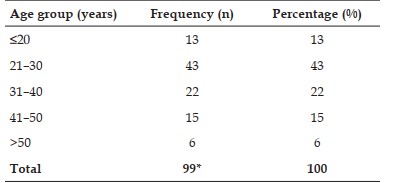
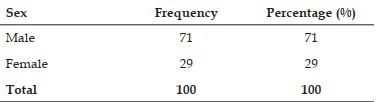
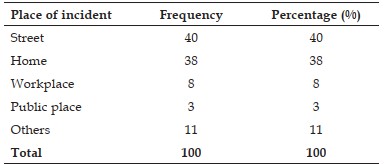
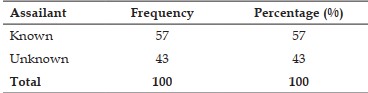
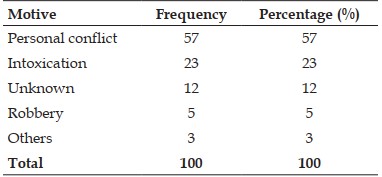
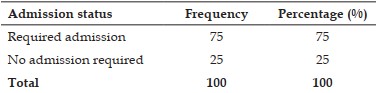
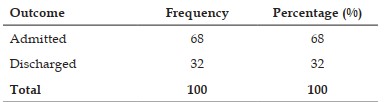
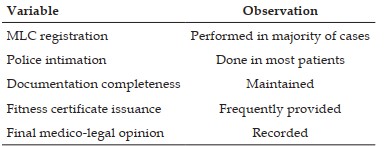
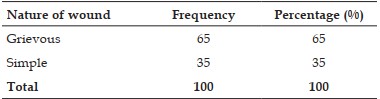
This prospective descriptive cross-sectional study analysed 100 assault victims presenting to the casualty department of Chettinad Hospital and Research Institute (CHRI), Kelambakkam, Tamil Nadu, over a one-year period. The study aimed to describe the demographic profile, incident characteristics, injury patterns, treatment requirements, and medico-legal aspects of assault cases. Young adults were predominantly affected, with the highest proportion in the 21–30 years age group (43%), and males constituted 71% of victims. Street-related assaults (40%) and home-based assaults (38%) were the most common settings, while 57% of victims identified the assailant as a known person. Personal conflict emerged as the leading motive (57%), followed by intoxication-related violence (23%). Blunt force trauma was the predominant mechanism of injury, and grievous injuries accounted for 65% of cases, with the head and neck region frequently involved. Hospital admission was required in 75% of patients, reflecting the significant clinical burden of assault-related trauma. Medico-legal procedures, including MLC registration and police intimation, were appropriately followed in most cases. The findings highlight the substantial healthcare and forensic burden of assault injuries and emphasise the need for targeted violence prevention strategies, public awareness, and strengthened coordination between healthcare and law enforcement systems.
References
- 1. Sharma BR, Harish D, Singh VP. Pattern of assault cases in Northern India. J Indian Acad Forensic Med. 2005;27(2):84–88.
- 2. Mohanty MK, Panigrahi MK, Mohanty S. Pattern of injuries in assault cases. J Forensic Leg Med. 2007;14(2):71–74.
- 3. Kumar V, Li AK, Pathania A. Epidemiological profile of assault victims in tertiary care centres. Indian J Forensic Med Toxicol. 2018;12(3): 56–61.
- 4. World Health Organization. World Report on Violence and Health. Geneva: WHO; 2002.
- 5. The Essentials of Forensic Medicine and Toxicology. Reddy KSN, Murty OP. 35th ed. New Delhi: Jaypee Brothers; 2022.
- 6. Kellermann AL, Mercy JA. Men, women and violence epidemiology. JAMA. 1992;267(17):2423–2428.
- 7. Butchart A, Mikton C. Global status report on violence prevention. Geneva: WHO; 2014.
- 8. Krug EG, Dahlberg LL, Mercy JA, Zwi AB, Lozano R. Violence: a global public health problem. Geneva: WHO; 2002.
- 9. Shepherd JP. Violence in healthcare settings and trauma burden. Lancet. 1998;352: 1291–1292.
- 10. World Health Organization. Global Status Report on Violence Prevention 2014. Geneva: WHO; 2014.
- 11. Textbook of Medical Jurisprudence, Forensic Medicine and Toxicology. Parikh CK. 8th ed. New Delhi: CBS Publishers; 2019.
- 12. Textbook of Forensic Medicine and Toxicology. Aggrawal A. New Delhi: Avichal Publishing; 2022.
- 13. Saukko P, Knight B. Knight’s Forensic Pathology. 4th ed. CRC Press; 2015.
- 14. Textbook of Forensic Medicine and Toxicology: Principles and Practice. Vij K. 7th ed. Elsevier; 2021.
- 15. Subrahmanyam BV. Modi’s Medical Jurisprudence and Toxicology. 27th ed. New Delhi: LexisNexis; 2021.
- 16. World Health Organization. Injury and Violence Prevention Report. Geneva: WHO; 2015.
- 17. Mercy JA, Rosenberg ML, Powell KE. Public health policy for violence prevention. Health Aff. 1993;12(4):7–29.
- 18. Dahlberg LL, Krug EG. Violence: a global public health problem. World Health Report. 2002;5:1–56.
- 19. Rosenberg ML, Fenley MA. Violence in America: A Public Health Approach. Oxford University Press; 1991.
- 20. World Health Organization. Global Status Report on Violence Prevention 2020. Geneva: WHO; 2020.
Data Sharing Statement
There are no additional data available. All raw data and code are available upon request.
Funding
This research received no funding.
Author Contributions
All authors contributed significantly to the work and approve its publication.
Ethics Declaration
This article does not involve any human or animal subjects, and therefore does not require ethics approval.
Acknowledgements
We would like to express our gratitude to the patients, their families, and all those who have contributed to this study.
Conflicts of Interest
No conflicts of interest in this work.
About this article

Cite this article
Sherley Alwin A, R Monisha. Understanding assault Patterns: A Cross-sectional study of Cases at Chri, Kelambakkam, Chennai. Indian J Forensic Med Pathol. 2026; 19(3): 376-380.
Licence:
Attribution-Non-commercial 4.0 International (CC BY-NC 4.0)This license enables reusers to distribute, remix, adapt, and build upon the material in any medium or format for noncommercial purposes only, and only so long as attribution is given to the creator.
| Received | Accepted | Published |
|---|---|---|
| May 29, 2026 | August 01, 2026 | September 30, 2026 |
DOI: https://doi.org/10.21088/ijfmp.0974.3383.19326.13
Keywords
AssaultMedico-Legal CasesCross-Sectional Studylunt Force TraumaBlunt Force TraumaGrievous InjuryViolence PreventionForensic MedicineEmergency CareSearch for Similar Articles
Similar Articles
- Diatom Analysis in Thermophilic water bodies: A Study on Hot Water Springs of Ma...
- Morphometric Study of Supra-meatal Triangle and Mastoid process in the Adult dry...
- Histopathological Spectrum of Autopsy Cases: A One Year Retrospective Observatio...
- Forensic Differentiation of Manner of Death in Railway Fatalities: A FourCase Se...
- Assessing Response Awareness to a Snake Bite in Population of Pune Region
Article Level Metrics
Last UpdatedSaturday 17 October 2026, 00:58:21 (IST)
16152
Accesses
33
3203
00
Citations
NA
NA
NA
Download citation
Article Keywords
Keyword Highlighting
Highlight selected keywords in the article text.
Timeline
| Received | May 29, 2026 |
| Accepted | August 01, 2026 |
| Published | September 30, 2026 |
licence
Attribution-Non-commercial 4.0 International (CC BY-NC 4.0)
This license enables reusers to distribute, remix, adapt, and build upon the material in any medium or format for noncommercial purposes only, and only so long as attribution is given to the creator.