Full Text (PDF)
Indian Journal of Forensic Medicine and Pathology 19(3):p 368-375, July -Sept. 2026. | DOI: https://doi.org/10.21088/ijfmp.0974.3383.19326.12
Original Article
Assessing Response Awareness to a Snake Bite in Population of Pune Region
Sadhana V. Lakhute, Rahul M. Band, Ajay L. Ghangale, Madhusudan R. Petkar, Ashwinikumar B. Sapate
Author Information
Licence:
Attribution-Non-commercial 4.0 International (CC BY-NC 4.0)This license enables reusers to distribute, remix, adapt, and build upon the material in any medium or format for noncommercial purposes only, and only so long as attribution is given to the creator.
Indian Journal of Forensic Medicine and Pathology 19(3):p 368-375, July -Sept. 2026. | DOI: https://doi.org/10.21088/ijfmp.0974.3383.19326.12
How Cite This Article:
Rahul M. Band, Sadhana V. Lakhute, Ajay L. Ghangale et. al, Assessing Response Awareness to a Snake Bite in Population of Pune Region. Indian J Forensic Med Pathol. 2026; 19(3): 368-375Timeline
Received : May 25, 2026
Accepted : July 29, 2026
Published : September 30, 2026
Abstract
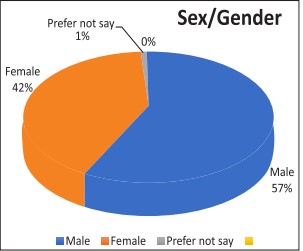
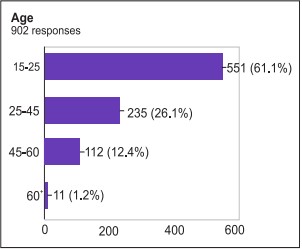
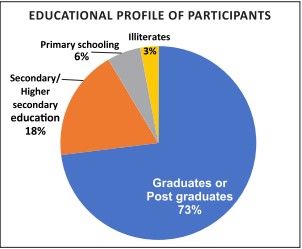
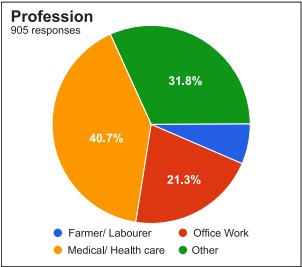
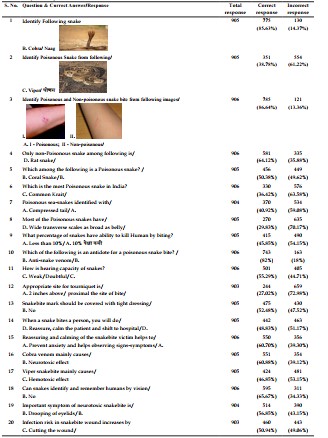
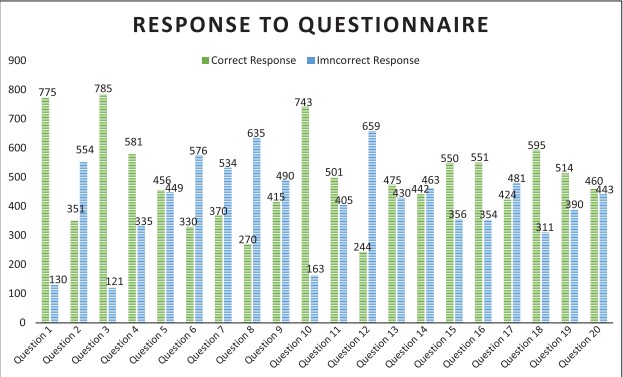
Introduction: Snake bite is a preventable public hazard of the country. Community awareness & empowering healthcare workers can reduce snakebite associated mortality. A well-timed first aid is always decisive in the management of snake bite. Material and Methods: An observational cross-sectional study based on questionnaire of 20 questions done, data tabulated, analysed and compared in order to determine the awareness in study group about the identification of type of snakes, first aid, management, traditional practices performed in case of snake bites. Results: A total of 906 persons participated in survey. Most of them answered to all of the 20 questions with very few skipping 1-2 questions. Snake bite mark identification is important for early and effective treatment. 785 (86.64%) persons identified poisonous and non-poisonous snake bite from two images. Identifying important early symptom of neurotoxic snakebite is paramount for quick life saving measures. 514 (56.85%) identified drooping of eyelids as early warning sign. Reassuring and calming of the snakebite victim helps to prevent anxiety and helps correctly observing signs-symptom; 550 (60.70%) participants agreed to this reasoning. Conclusion & Recommendations: Although most of the participants were able to identify commonly known snakes like cobra, venomous bite mark and common treatment methods, but many were unaware about features of uncommon sea snakes, misconceptions regarding treatment and complications. Inclusion of snakebite first aid measures in educational curriculum at early level might help to improve outcomes.
References
- 1. Williams D, Gutiérrez JM, Harrison R, Warrell DA, White J, Winkel KD, Gopalakrishnan P. The global snakebite initiative: an antidote for snake bite. Lancet. 2010;375(9708):89–91.
- 2. Viramani SK, Dutt OP. A profile of snakebite poisoning in Jammu Region. J Indian Med Associat. 1987;185:132-4.
- 3. Pathak I, Metgud C. Knowledge, attitude and practice regarding snakes and snake bite among rural adult of Belagavi, Karnataka. Int J Community Med Public Health. 2017;4(12):4527-31.
- 4. Sharma SK, Bovier P, Jha N, Alirol E, Loutan L, Chappuis F. Effectiveness of Rapid Transport of Victims and Community Health Education on Snake Bite Fatalities in Rural Nepal. Am J Trop Med Hyg. 2013;89(1):145–50.
- 5. Chincholikar SV, Patniak B, Raje S. Awareness of Snake bite and its first aid management in rural areas of Maharashtra. Indian J Community Health. 2014;26(3):311-5.
- 6. Bhargava S, Kumari K, Sarin RK and Singh R. First-hand knowledge about snakes and snakebite management: an urgent need. Nagoya J. Med. Sci. 82; 2020. 763–774, doi:10.18999/ nagjms.82.4.763
- 7. Russell JJ, Schoenbrunner A, Janis JE. Snake Bite Management: A Scoping Review of the Literature. Plast Reconstr Surg Glob Open 2021; 9:e3506.
Data Sharing Statement
There are no additional data available. All raw data and code are available upon request.
Funding
This research received no funding.
Author Contributions
All authors contributed significantly to the work and approve its publication.
Ethics Declaration
This article does not involve any human or animal subjects, and therefore does not require ethics approval.
Acknowledgements
We would like to express our gratitude to the patients, their families, and all those who have contributed to this study.
Conflicts of Interest
No conflicts of interest in this work.
About this article

Cite this article
Rahul M. Band, Sadhana V. Lakhute, Ajay L. Ghangale et. al, Assessing Response Awareness to a Snake Bite in Population of Pune Region. Indian J Forensic Med Pathol. 2026; 19(3): 368-375
Licence:
Attribution-Non-commercial 4.0 International (CC BY-NC 4.0)This license enables reusers to distribute, remix, adapt, and build upon the material in any medium or format for noncommercial purposes only, and only so long as attribution is given to the creator.
| Received | Accepted | Published |
|---|---|---|
| May 25, 2026 | July 29, 2026 | September 30, 2026 |
DOI: https://doi.org/10.21088/ijfmp.0974.3383.19326.12
Keywords
AwarenessResponseSnakebiteSearch for Similar Articles
Similar Articles
- Diatom Analysis in Thermophilic water bodies: A Study on Hot Water Springs of Ma...
- Morphometric Study of Supra-meatal Triangle and Mastoid process in the Adult dry...
- Histopathological Spectrum of Autopsy Cases: A One Year Retrospective Observatio...
- Forensic Differentiation of Manner of Death in Railway Fatalities: A FourCase Se...
- Understanding assault Patterns: A Cross-sectional study of Cases at Chri, Kelamb...
Article Level Metrics
Last UpdatedSaturday 17 October 2026, 01:50:54 (IST)
16154
Accesses
57
3203
00
Citations
NA
NA
NA
Download citation
Article Keywords
Keyword Highlighting
Highlight selected keywords in the article text.
Timeline
| Received | May 25, 2026 |
| Accepted | July 29, 2026 |
| Published | September 30, 2026 |
licence
Attribution-Non-commercial 4.0 International (CC BY-NC 4.0)
This license enables reusers to distribute, remix, adapt, and build upon the material in any medium or format for noncommercial purposes only, and only so long as attribution is given to the creator.