Full Text (PDF)
Indian Journal of Forensic Medicine and Pathology 11(2):p 75-78, April-June 2018. | DOI: 10.21088/ijfmp.0974.3383.11218.5
Original Article
Profile of Fatal Head Injury Cases Due to RTA in and Around Bijapur
Ramesh C. Patil, , Ashok Kumar Rajaput, Anand Mugadlimath
Author Information
Licence:
Attribution-Non-commercial 4.0 International (CC BY-NC 4.0)This license enables reusers to distribute, remix, adapt, and build upon the material in any medium or format for noncommercial purposes only, and only so long as attribution is given to the creator
Indian Journal of Forensic Medicine and Pathology 11(2):p 75-78, April-June 2018. | DOI: 10.21088/ijfmp.0974.3383.11218.5
How Cite This Article:
Timeline
Received : January 31, 2018
Accepted : February 26, 2018
Published : March 30, 2018
Abstract
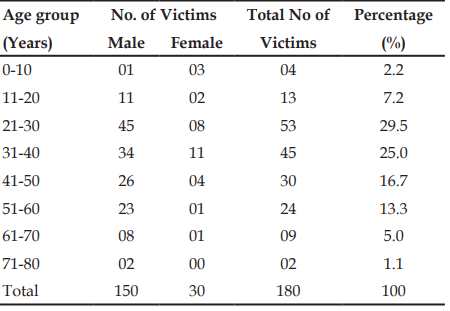
Introduction: Deaths due to road traffic accident are one of the common forms of unnatural death and its history is old as the invention of the wheel. The head is the most prominent of the exposed parts of human body by virtue of its situation, choice in great majority of situations involving blunt trauma which may be accidental, suicidal or homicidal. Materials & methods: The present study was undertaken on fatal head injury cases of road traffic accidents brought by the police to the mortuary of Al-Ameen Medical College and District Hospital, Bijapur for medico-legal autopsy between Oct 2003 Sep 2005, a total of 180 cases were studied. Results: In the present stud of 180 cases, 150 (83.3%) were males and 30 (16.7%) females. Male, female ratio of 5:1 was observed. The maximum number of cases, 53 cases (29.5%) were seen in the age group of 21-30 years. The next in frequency was 25 cases (25.0%) seen in the age group of 31-40 years between 71-80 years 2 cases (1.1%) were seen. Most of the accident (20.0%) occurred between 3pm to 6pm and between 9am to 12noon and 6pm to 9pm 27 (15.0%) cases occurred. In 2 (1.1%) cases the time of accident was not known. In the study most of the victims 137 (76.1%) died on the spot. The maximum time of survival was up to 6 hrs. Lorry and Truck was the commonest offending vehicle. Next in order was bus and unknown case was 7 (3.9%). Conclusions: The male preponderance may be due males are more exposed to outdoor activities traveling. The reason for young adults most affected because they are the prime breads earners of the family, remains outdoor. The reason for the peak incidence of the accidents at 3-6hrs is multifold and includes hurry to reach home from place of work timed people after hectic work, rush traffic hours, in-adequate traffic control and fatigue to drive. Most victims died on the spot, this may be due to the severity of injuries sustained, lack of knowledge of first aid, delay in shifting the patient to trauma center etc.
References
- 1. Rowbotham GF. Analysis of 1,400 cases of acute injury to the head. Br Med J. 1954;1(4864):726-30.
- 2. Gissane W, Bull J. A study of 183 road deaths in and around Birmingham in 1960. Br Med J. 1961;1(5241):1716-20.
- 3. Freytag E. Autopsy findings in head injuries from blunt forces: statistical evaluation of 1,367 cases. Arch Pathol. 1963;75:402-13.
- 4. Solheim K. Pedestrian deaths in Oslo traffic accidents. Br Med J. 1964;1(5375):81-3.
- 5. Sevitt S. Fatal road accidents. Br J Surg. 1968;55(7):481-505.
- 6. Polson CJ, Gee DJ. The essentials of forensic medicine. London: Pergamon Press; 1973. p. 156-203.
- 7. Patel NS. Traffic fatalities in Lusaka, Zambia. Med Sci Law. 1979;19(1):61-5.
- 8. Tirpude BH, et al. A study of the pattern of the cranio-cerebral injuries in road traffic accidents. J Indian Acad Forensic Sci. 1998;20(1):9-12.
- 9. Agarwal S, Agarwal SN. Fatal road accidents: an analysis of sixty four autopsied cases. J Indian Acad Forensic Sci. 1967;6(1):26-32.
- 10. Chandulal R, Bhaskar GR. Some observations on fatal cases of run over automobile accidents. J Indian Acad Forensic Sci. 1969;8(2):81-8.
- 11. Tonge JI, O'Reilly MJ, Davison A, Johnston NG. Traffic-crash fatalities: injury patterns and other factors. Med Sci Law. 1977;17(1):9-14.
- 12. Shrivastava KP, Sinha MK, Lala JK. Fatal road accidents: an analysis of one hundred cases. J Indian Acad Forensic Sci. 1978;17(1):51-6.
- 13. Srivastava AK, Gupta RK. A study of fatal road accidents in Kanpur. J Indian Acad Forensic Sci. 1989;11(1):24-8.
- 14. Chandra J, Dogra TD, Dikshit PC. Pattern of cranio-intracranial injuries in fatal vehicular accidents in Delhi, 1966-76. Med Sci Law. 1979;19(3):186-94
Data Sharing Statement
There are no additional data available. All raw data and code are available upon request.
Funding
This research received no funding.
Author Contributions
Whether all authors contributed significantly to the work and approve its publication.
Ethics Declaration
This article does not involve any human or animal subjects, and therefore does not require ethics approval.
Acknowledgements
We would like to express our gratitude to the patients, their families, and all those who have contributed to this study.
Conflicts of Interest
The authors report no conflicts of interest in this work.
About this article

Cite this article
Licence:
Attribution-Non-commercial 4.0 International (CC BY-NC 4.0)This license enables reusers to distribute, remix, adapt, and build upon the material in any medium or format for noncommercial purposes only, and only so long as attribution is given to the creator
| Received | Accepted | Published |
|---|---|---|
| January 31, 2018 | February 26, 2018 | March 30, 2018 |
DOI: 10.21088/ijfmp.0974.3383.11218.5
Keywords
Road Traffic accidentHead injuryAutopsyDemographicsSearch for Similar Articles
Similar Articles
- Diatom Analysis in Thermophilic water bodies: A Study on Hot Water Springs of Ma...
- Morphometric Study of Supra-meatal Triangle and Mastoid process in the Adult dry...
- Histopathological Spectrum of Autopsy Cases: A One Year Retrospective Observatio...
- Forensic Differentiation of Manner of Death in Railway Fatalities: A FourCase Se...
- Understanding assault Patterns: A Cross-sectional study of Cases at Chri, Kelamb...
Article Level Metrics
Last UpdatedSunday 18 October 2026, 15:40:14 (IST)
16277
Accesses
22
3209
00
Citations
NA
NA
NA
Download citation
Article Keywords
Keyword Highlighting
Highlight selected keywords in the article text.
Timeline
| Received | January 31, 2018 |
| Accepted | February 26, 2018 |
| Published | March 30, 2018 |
licence
Attribution-Non-commercial 4.0 International (CC BY-NC 4.0)
This license enables reusers to distribute, remix, adapt, and build upon the material in any medium or format for noncommercial purposes only, and only so long as attribution is given to the creator