Full Text (PDF)
Indian Journal of Forensic Medicine and Pathology 11(2):p 71-74, April-June 2018. | DOI: 10.21088/ijfmp.0974.3383.11218.4
Original Article
Profile of Blunt Injuries over Chest: An Autopsy Study
Rahul A. Mehta, Alpesh B. Bambhaniya
Author Information
Licence:
Attribution-Non-commercial 4.0 International (CC BY-NC 4.0)This license enables reusers to distribute, remix, adapt, and build upon the material in any medium or format for noncommercial purposes only, and only so long as attribution is given to the creator
Indian Journal of Forensic Medicine and Pathology 11(2):p 71-74, April-June 2018. | DOI: 10.21088/ijfmp.0974.3383.11218.4
How Cite This Article:
Timeline
Received : March 19, 2018
Accepted : April 11, 2018
Published : May 30, 2018
Abstract
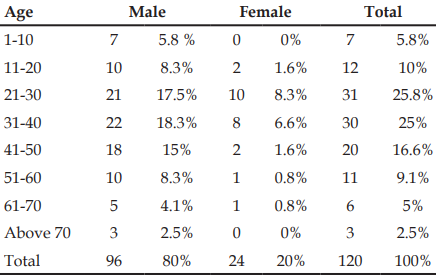
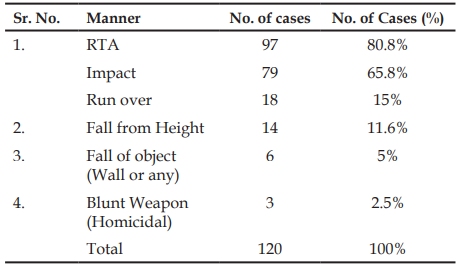
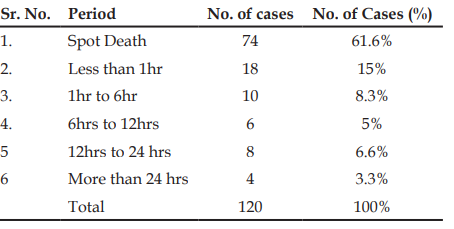
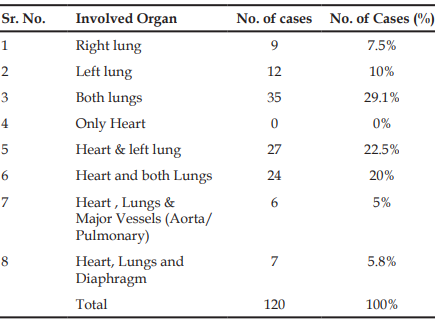
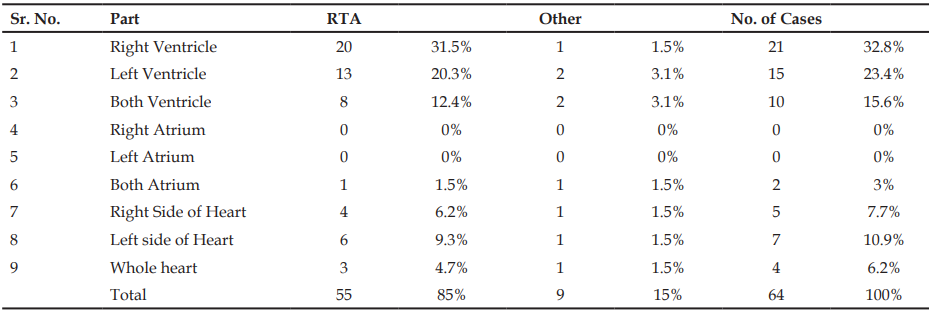
Background: Out of three vital organ two (Heart and Lung ) are in the thoracic cavity. So injuries to chest cavity are mostly fatal in the form of haemorrhagic shock or neurogenic shock. Blunt or sharp objects may causes these type of injuries. Aims: To study the epidemiological aspect of fatal blunt chest injuries. Material And Method: In this study 120 cases of chest injuries by blunt objects are studied for their various aspect. Results: Most cases are of road traffic accident (RTA). Most of them are young male between 20-40 years of age. Though majority of them died within in 1hrs, on the spot or on the way. Nature of injuries are correlated with the history and incident. Involvement od lung shows multiple rib fractures. Heart, major vessels and diaphragm were also involved in significant number of cases. Conclusion: Most of the fatal blunt chest injuries were of road traffic accidents majority of them have lungs and ribs injuries and hemorrhagic shock is the cause of death in almost all cases.
References
- 1. Reddy KSN. The essentials of forensic medicine and toxicology. 29th ed. Hyderabad: K. Suguna Devi; 2010. p. 101-3, 136.
- 2. Saukko P, Knight B. Knight’s forensic pathology. 3rd ed. London: Arnold; 2004. p. 229.
- 3. Modi JP. Modi’s medical jurisprudence & toxicology. 22nd ed. New Delhi: LexisNexis Butterworths; 2004. p. 424-35.
- 4. Park K. Park’s textbook of preventive and social medicine. 17th ed. Jabalpur: Banarsidas Bhanot; 2002. p. 273-82.
- 5. Meera Th, Nabachandra H. A study of pattern and injury severity score in blunt thoraco-abdominal trauma cases in Manipal. Medico-Leg Update. 2005;5(2):47-52.
- 6. Polson CJ, Gee DJ, Knight B. The essentials of forensic medicine. 4th ed. Oxford: Pergamon Press; 1995. p. 462-70.
- 7. Dikshit PC. Textbook of forensic medicine & toxicology. 1st ed. New Delhi: Peepee Publishers & Distributors; 2007. p. 215-18.
- 8. Banerjee KK, Agarwal BBL, Kohli A. Study of thoraco-abdominal injuries in fatal road traffic accidents in North East Delhi. J Indian Acad Forensic Med. 1997;4(1):40-3.
- 9. Adelson L. The pathology of homicide. 1st ed. Springfield: Charles C Thomas; 1974. p. 437.
- 10. Umadethan B. Forensic medicine. 1st ed. New Delhi: CBS Publishers & Distributors; 2011. p. 183.
- 11. Pathak A. Profile of road traffic accidents & head injury in Jaipur (Rajasthan). J Indian Acad Forensic Med. 2007;30(1):6-9.
- 12. Shetty BSK, Kanchan T, Menezes RG, Bakkannavar SM, Nayak VC, Yoganarasimha K. Victim profile and pattern of thoraco-abdominal injuries sustained in fatal road traffic accident. J Indian Acad Forensic Med. 2012;34(1):16-9.
- 13. Ghangale AL. Blunt thoracic trauma in vehicular road accidents. J Forensic Med Toxicol. 2003;20(2):45-8.
- 14. Singh PK, Slong D, Devi M. Pattern of road traffic accidents in Imphal. J Indian Acad Forensic Med. 2012;34(4):301-3.
Data Sharing Statement
There are no additional data available. All raw data and code are available upon request.
Funding
This research received no funding.
Author Contributions
Whether all authors contributed significantly to the work and approve its publication.
Ethics Declaration
This article does not involve any human or animal subjects, and therefore does not require ethics approval.
Acknowledgements
We would like to express our gratitude to the patients, their families, and all those who have contributed to this study.
Conflicts of Interest
The authors report no conflicts of interest in this work.
About this article

Cite this article
Licence:
Attribution-Non-commercial 4.0 International (CC BY-NC 4.0)This license enables reusers to distribute, remix, adapt, and build upon the material in any medium or format for noncommercial purposes only, and only so long as attribution is given to the creator
| Received | Accepted | Published |
|---|---|---|
| March 19, 2018 | April 11, 2018 | May 30, 2018 |
DOI: 10.21088/ijfmp.0974.3383.11218.4
Keywords
RTAFractureSpot DeathHaemorrhagic ShockSearch for Similar Articles
Similar Articles
- Diatom Analysis in Thermophilic water bodies: A Study on Hot Water Springs of Ma...
- Morphometric Study of Supra-meatal Triangle and Mastoid process in the Adult dry...
- Histopathological Spectrum of Autopsy Cases: A One Year Retrospective Observatio...
- Forensic Differentiation of Manner of Death in Railway Fatalities: A FourCase Se...
- Understanding assault Patterns: A Cross-sectional study of Cases at Chri, Kelamb...
Article Level Metrics
Last UpdatedMonday 19 October 2026, 11:57:49 (IST)
16330
Accesses
9
3216
00
Citations
NA
NA
NA
Download citation
Article Keywords
Keyword Highlighting
Highlight selected keywords in the article text.
Timeline
| Received | March 19, 2018 |
| Accepted | April 11, 2018 |
| Published | May 30, 2018 |
licence
Attribution-Non-commercial 4.0 International (CC BY-NC 4.0)
This license enables reusers to distribute, remix, adapt, and build upon the material in any medium or format for noncommercial purposes only, and only so long as attribution is given to the creator