Full Text (PDF)
Indian Journal of Forensic Medicine and Pathology 11(2):p 65-69, April-June 2018. | DOI: 10.21088/ijfmp.0974.3383.11218.3
Original Article
A study to Evaluate Knowledge of Handling Medico-Legal Cases among Interns in a Teaching Institution
A.D. Ropmay , Bhattacharyya H. , Slong D. , Marak A.R. , Patowary A.J.
Author Information
Licence:
Attribution-Non-commercial 4.0 International (CC BY-NC 4.0)This license enables reusers to distribute, remix, adapt, and build upon the material in any medium or format for noncommercial purposes only, and only so long as attribution is given to the creator
Indian Journal of Forensic Medicine and Pathology 11(2):p 65-69, April-June 2018. | DOI: 10.21088/ijfmp.0974.3383.11218.3
How Cite This Article:
Timeline
Received : May 18, 2018
Accepted : June 09, 2018
Published : January 03, 2018
Abstract
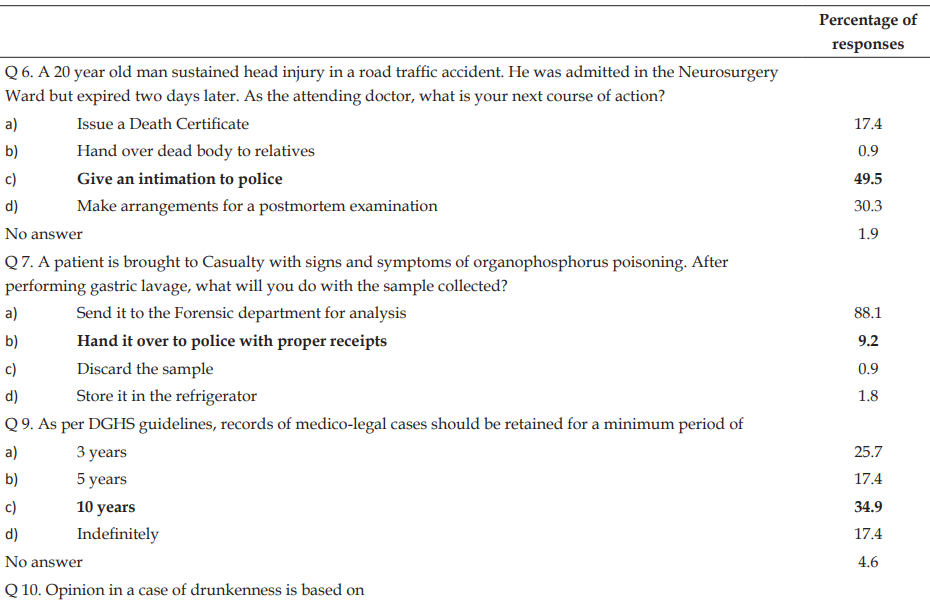
Background: The rising trend of medico-legal cases reporting to our hospital emphasizes the need to have physicians who are trained in Forensic Medicine to equip them to deal with such situations. In an era of escalating crime, litigation and eroding doctor-patient relationship, ignorance of the law could lead to pitfalls in practice. Hence, the present study was conducted to evaluate the knowledge of our interns on handling routine medico-legal cases in the wards and Casualty. Material and Methods: A total of 109 interns posted in various departments of the institute during the period from May 2016 to April 2018 participated in this research. Data was collected in the form of a self-administered questionnaire comprising close-ended multiple choice questions related to the topic of the study. It was then analyzed using SPSS version 11 by descriptive analysis. Results: The majority of participants were able to identify a medico-legal case and classify an injury as simple or grievous. However, there was uncertainty regarding giving opinion in a case of drunkenness and custody of forensic samples in poisoning. Conclusion: Overall, interns had good knowledge of handling medico-legal cases. The knowledge gaps identified through this study on particular topics have to be revised at regular intervals during internship and residency.
References
- 1. Wilks M. Medical ethics and the forensic physician. In: Payne-James J, Dean P, Wall I, editors. Medicolegal essentials in healthcare. 2nd ed. London: Greenwich Medical Media Ltd.; 2004. p. 21-7.
- 2. Khandekar IL, Tirpude BC, Murkey P, Pawar V. Development of clinical forensic medicine in India: a need of time. J Indian Acad Forensic Med. 2010;32(1):85-90.
- 3. Pt. Parmanand Katara v. Union of India. AIR 1989 SC 2039• The Indian Penal Code. 1860.
- 4. Geetha O. Awareness of common medico-legal issues: a study among practicing doctors. Indian J Forensic Med Toxicol. 2011;5(2):22-4.
- 5. Mardikar PA, Kasulkar AA. To assess the need of medicolegal education in interns and residents in medical institution. J Evol Med Dent Sci. 2015 Feb;4(17):2885-9.
- 6. Rai JJ, Acharya RV, Dave D. Knowledge and awareness among interns and residents about medical law and negligence in a medical college in Vadodara: a questionnaire study. IOSR J Dent Med Sci. 2013;3(4):32-8.
- 7. Evans A, Renfrow-Rutala D. Medico-legal education: a pilot curriculum to fill the identified knowledge gap. J Grad Med Educ [Internet]. 2010
- 8. Dash SK. Medical ethics, duties & medical negligence awareness among the practitioners in a teaching medical college hospital: a survey. J Indian Acad Forensic Med. 2010;32(2):153-6.
- 9. Barnie BA, Forson PK, Opare-Addo MN, Appiah-Poku J, Rhule GP, Oduro G, et al. Knowledge and perceptions of health workers’ training on ethics, confidentiality and medico-legal issues. J Clin Res Bioeth [Internet]. 2015 Feb
Data Sharing Statement
There are no additional data available. All raw data and code are available upon request.
Funding
This research received no funding.
Author Contributions
Whether all authors contributed significantly to the work and approve its publication.
Ethics Declaration
This article does not involve any human or animal subjects, and therefore does not require ethics approval.
Acknowledgements
We would like to express our gratitude to the patients, their families, and all those who have contributed to this study.
Conflicts of Interest
The authors report no conflicts of interest in this work.
About this article

Cite this article
Licence:
Attribution-Non-commercial 4.0 International (CC BY-NC 4.0)This license enables reusers to distribute, remix, adapt, and build upon the material in any medium or format for noncommercial purposes only, and only so long as attribution is given to the creator
| Received | Accepted | Published |
|---|---|---|
| May 18, 2018 | June 09, 2018 | January 03, 2018 |
DOI: 10.21088/ijfmp.0974.3383.11218.3
Keywords
Medico-LegalForensic MedicinInternsWardsCasualtySearch for Similar Articles
Similar Articles
- Diatom Analysis in Thermophilic water bodies: A Study on Hot Water Springs of Ma...
- Morphometric Study of Supra-meatal Triangle and Mastoid process in the Adult dry...
- Histopathological Spectrum of Autopsy Cases: A One Year Retrospective Observatio...
- Forensic Differentiation of Manner of Death in Railway Fatalities: A FourCase Se...
- Understanding assault Patterns: A Cross-sectional study of Cases at Chri, Kelamb...
Article Level Metrics
Last UpdatedMonday 19 October 2026, 15:56:37 (IST)
16344
Accesses
12
3216
00
Citations
NA
NA
NA
Download citation
Article Keywords
Keyword Highlighting
Highlight selected keywords in the article text.
Timeline
| Received | May 18, 2018 |
| Accepted | June 09, 2018 |
| Published | January 03, 2018 |
licence
Attribution-Non-commercial 4.0 International (CC BY-NC 4.0)
This license enables reusers to distribute, remix, adapt, and build upon the material in any medium or format for noncommercial purposes only, and only so long as attribution is given to the creator