Full Text (PDF)
Indian Journal of Forensic Medicine and Pathology 19(2):p 121-127, April - June 2026. | DOI: https://doi.org/10.21088/ijfmp.0974.3383.19226.1
Original Article
Knowledge and Attitude of MBBS Students Regarding Post Mortem Examination: A Cross-sectional Study in Chennai Region
Author Information
Licence:
Attribution-Non-commercial-Share Alike 4.0 International (CC BY-NC-SA 4.0)This license enables reusers to distribute, remix, adapt, and build upon the material in any medium or format for noncommercial purposes only, and only so long as attribution is given to the creator.
Indian Journal of Forensic Medicine and Pathology 19(2):p 121-127, April - June 2026. | DOI: https://doi.org/10.21088/ijfmp.0974.3383.19226.1
How Cite This Article:
Karthika J., R. Monisha. Knowledge and Attitude of MBBS Students Regarding Post Mortem Examination: A Cross-sectional Study in Chennai Region. Indian J Forensic Med Pathol. 2026; 19(2): 121-127.Timeline
Received : February 17, 2026
Accepted : April 19, 2026
Published : June 30, 2026
Abstract
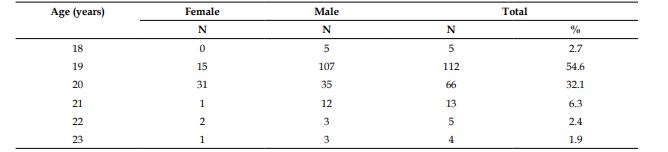
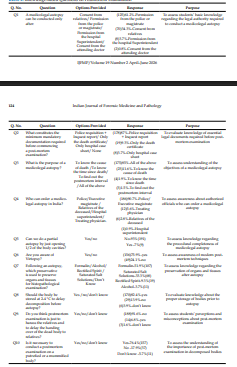
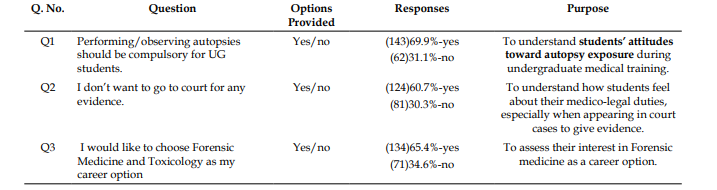
Background: An autopsy is a systematic examination of a dead body for medical, legal, or scientific purposes. A medicolegal autopsy is conducted to determine the cause, time, and manner of death, establish identity, and decide whether the death is natural or unnatural. In India, all unnatural deaths must undergo a medicolegal autopsy to ensure justice. For MBBS students, attending autopsy postings is essential for understanding real-life postmortem procedures and preparing them for future responsibilities as medical officers. However, many students hesitate to attend autopsies due to fear, misconceptions, or lack of exposure. This study aimed to assess students’ knowledge, attitudes, and barriers related to medicolegal and clinical autopsies. Objectives: The primary objective was to evaluate medical students’ knowledge and attitudes toward postmortem examination and their interest in forensic medicine as a career. Secondary objectives included identifying associations with demographic factors (age, gender, prior exposure) and exploring misconceptions and barriers to attending autopsy postings. Methods: A cross-sectional questionnaire-based study was conducted among Phase II to Phase IV MBBS students and interns at Chettinad Hospital and Research Institute, Chennai. A structured and validated questionnaire was administered to 205 participants. It assessed demographic details, knowledge, attitudes, practices, and perceptions regarding postmortem examination. Data were analysed descriptively. Results: Most participants were Phase II students aged 19-20 years (mean age 19.6 years). Overall knowledge was satisfactory. About 87% knew that police or Magistrate requisition and an inquest report are required before medicolegal autopsy. Around 85% understood its purpose, and 93% knew partial autopsy is not allowed. Knowledge about organ preservation was limited (51.9%). Most students were aware of proper body storage (82.4%) and virtopsy (75.9%). Regarding attitude, 69.9% supported compulsory autopsy exposure. While 78.5% were willing to handle a dead body, 60.7% were hesitant to appear in court. Interest in forensic medicine as a career was expressed by 65.4%. Conclusion: Students showed good basic knowledge and a positive attitude, but practical skills and confidence, especially regarding court duties needs improvement through increased hands-on training and mock court sessions.
References
- 1. Aggarwal A. Textbook of forensic medicine and toxicology. 1st ed. New Delhi: Avichal Publishing Company; p. 77.
- 2. Biswas G. Forensic medicine and toxicology. 6th ed. New Delhi: Jaypee Brothers Medical Publishers; 2025. p. 120.127 IJFMP/Volume 19 Number 2 April–June 2026
- 3. Patil A., Tasgaonkar V.N. Knowledge, attitude, and awareness of medical students towards medico-legal autopsy in Sangli, Maharashtra. Med Leg Update. 2021; 21(2): 1315-8.
- 4. Bagga I.S., Goyal V., Singh A., Chawla H., Goel S., Sharma S. Knowledge towards postmortem examination and reasons for not specialising in morbid anatomy: Study among medical undergraduate students. Int J Res Med Sci. 2016; 4: 2792-5.
- 5. Ali D., Mal S., Magsi I. Assessment of students’ knowledge, attitude and perceptions about autopsy. Pak J Med Health Sci. 2021; 15(10): 2853.
- 6. Kakkeri S.R. Knowledge and attitude of medical students toward medicolegal autopsy. Int J Forensic Med Toxicol Sci. 2018; 3(1): 8-11.
- 7. Haricharan A., Meera Devi T. Knowledge and attitude towards post-mortem examination amongst the residents of Imphal West. Indian J Forensic Med Toxicol. 2024; 18(1): 58-62.
- 8. Ahmad M., Rahman M.F. Knowledge and attitude of 3rd year medical students regarding post-mortem examination. J Armed Forces Med Coll Bangladesh. 2016; 12(2): 9-14.
- 9. Sreenivasan M., Nawaz Ahmed S.K. Prediction of stature in males of the Tamil population from measurements of percutaneous tibial length. Med Leg Update. 2021; 21(2): 139-43.
- 10. Biswas G. Review of Forensic Medicine & Toxicology. 2nd ed. New Delhi: Jaypee 2012: 83-5.
- 11. Ravi Rautji. Attitudes of medical students towards medico-legal/clinical autopsy. Journal of Indian Academy of Forensic Medicine. 2013 Oct-Dec; 35(4): 358-361.
- 12. Kumar A. Attitude of undergraduate medical students towards medico-legal autopsies. Int J Med Res Prof. 2018 Nov; 4(6): 132-35.
- 13. Sachdeva. Knowledge, attitude and practices studies conducted amongst medical students of India, Int J Community Med Public Health. 2018 Sep; 5(9): 3913-3918. 14. Saukko P., Knight B. Knight’s forensic pathology. 5th ed. Boca Raton: CRC Press; 2026: p. 2.
Data Sharing Statement
There are no additional data available. All raw data and code are available upon request.
Funding
This research received no funding.
Author Contributions
All authors contributed significantly to the work and approve its publication.
Ethics Declaration
This article does not involve any human or animal subjects, and therefore does not require ethics approval.
Acknowledgements
We would like to express our gratitude to the patients, their families, and all those who have contributed to this study.
Conflicts of Interest
No conflicts of interest in this work.
About this article

Cite this article
Karthika J., R. Monisha. Knowledge and Attitude of MBBS Students Regarding Post Mortem Examination: A Cross-sectional Study in Chennai Region. Indian J Forensic Med Pathol. 2026; 19(2): 121-127.
Licence:
Attribution-Non-commercial-Share Alike 4.0 International (CC BY-NC-SA 4.0)This license enables reusers to distribute, remix, adapt, and build upon the material in any medium or format for noncommercial purposes only, and only so long as attribution is given to the creator.
| Received | Accepted | Published |
|---|---|---|
| February 17, 2026 | April 19, 2026 | June 30, 2026 |
DOI: https://doi.org/10.21088/ijfmp.0974.3383.19226.1
Keywords
Medical students •Medical education and Forensic medicineMedico-legal autopsySearch for Similar Articles
Similar Articles
- Diatom Analysis in Thermophilic water bodies: A Study on Hot Water Springs of Ma...
- Morphometric Study of Supra-meatal Triangle and Mastoid process in the Adult dry...
- Histopathological Spectrum of Autopsy Cases: A One Year Retrospective Observatio...
- Forensic Differentiation of Manner of Death in Railway Fatalities: A FourCase Se...
- Understanding assault Patterns: A Cross-sectional study of Cases at Chri, Kelamb...
Article Level Metrics
Last UpdatedWednesday 21 October 2026, 16:35:00 (IST)
16521
Accesses
63
3227
00
Citations
NA
NA
NA
Download citation
Article Keywords
Keyword Highlighting
Highlight selected keywords in the article text.
Timeline
| Received | February 17, 2026 |
| Accepted | April 19, 2026 |
| Published | June 30, 2026 |
licence
Attribution-Non-commercial-Share Alike 4.0 International (CC BY-NC-SA 4.0)
This license enables reusers to distribute, remix, adapt, and build upon the material in any medium or format for noncommercial purposes only, and only so long as attribution is given to the creator.