Full Text (PDF)
Indian Journal of Forensic Medicine and Pathology 19(2):p 214-222, April - June 2026. | DOI: https://doi.org/10.21088/ijfmp.0974.3383.19226.14
Original Article
Pesticide Contamination in Indian Agricultural and Residential Areas: A Comparative Assessment of Health Risks and Environmental Impacts
Riya Raj C.A, Nandini Katare, Don Caeiro, Mayank David Raiborde
Author Information
Licence:
Attribution-Non-commercial 4.0 International (CC BY-NC 4.0)This license enables reusers to distribute, remix, adapt, and build upon the material in any medium or format for noncommercial purposes only, and only so long as attribution is given to the creator.
Indian Journal of Forensic Medicine and Pathology 19(2):p 214-222, April - June 2026. | DOI: https://doi.org/10.21088/ijfmp.0974.3383.19226.14
How Cite This Article:
Riya Raj C.A., Nandini Katare, Don Caeiro, et al. Pesticide Contamination in Indian Agricultural and Residential Areas: A Comparative Assessment of Health Risks and Environmental Impacts. Indian J Forensic Med Pathol. 2026; 19(2): 214-222.Timeline
Received : March 02, 2026
Accepted : May 10, 2026
Published : June 30, 2026
Abstract
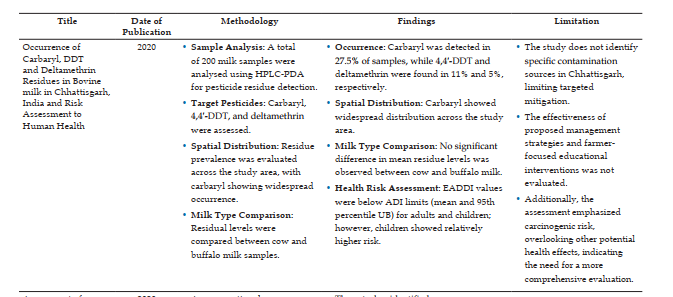
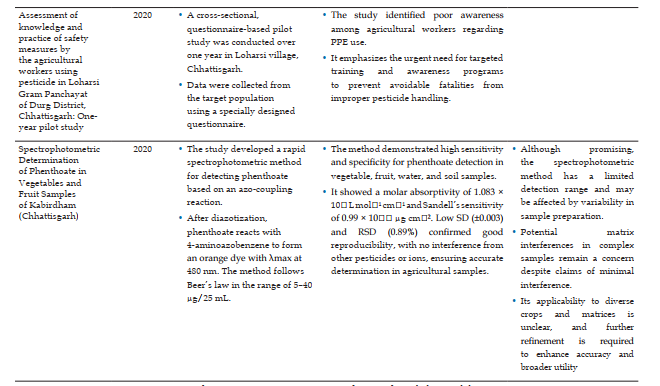
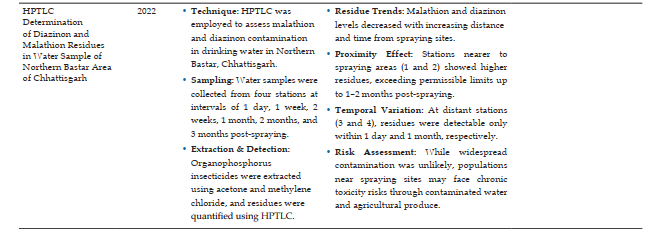
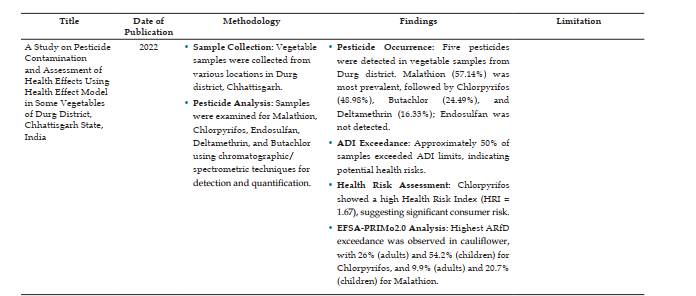
The extensive use of pesticides in India, particularly in agriculturally intensive regions, has raised significant concerns regarding environmental contamination and associated human health risks. This review synthesizes recent evidence on pesticide residue occurrence in water, milk, vegetables, and soil, with special emphasis on high-risk agricultural districts of Chhattisgarh and comparable regions. Data were compiled from government databases, peer-reviewed literature, and empirical field-based analytical studies employing standardized protocols (APHA, AOAC) and advanced instrumental techniques such as GC–MS, GC– MS/MS, HPLC-PDA, AAS, ICP–MS, and HPTLC. Findings indicate widespread detection of organophosphates, organochlorines, and pyrethroids—including carbaryl, chlorpyrifos, malathion, diazinon, deltamethrin, quinalphos, and 4,4′- DDT—in environmental and food matrices. Several studies reported exceedance of acceptable daily intake (ADI) and acute reference dose (ARfD) values, particularly among children, highlighting elevated vulnerability. Health risk assessments utilizing Hazard Quotient (HQ), Hazard Index (HI), Target Hazard Quotient (THQ), and Lifetime Cancer Risk (LCR) models revealed potential noncarcinogenic and carcinogenic risks in areas proximal to pesticide application sites.These compounds exert toxicity primarily through mechanisms such as acetylcholinesterase inhibition, endocrine disruption, oxidative stress induction, and bioaccumulation, contributing to both acute and chronic health effects. Spatial analyses further demonstrated contamination hotspots near agricultural spraying zones, while seasonal variation influenced physicochemical water quality and pollutant persistence. Despite regulatory efforts, critical research gaps remain, including limited longitudinal monitoring, inadequate evaluation of cumulative and mixture toxicity, insufficient exploration of non-agricultural contamination sources, and weak implementation strategies for sustainable alternatives.The review underscores the urgent need for integrated surveillance systems, farmer education on safe pesticide handling, improved regulatory enforcement, and adoption of sustainable pest management strategies. Strengthening evidence-based policymaking is essential to safeguard environmental integrity, public health, and long-term agricultural sustainability.
References
- 1. Aktar, M.W., Sengupta, D., & Chowdhury, A. (2009). Impact of pesticides use in agriculture: Their benefits and hazards. Interdisciplinary Toxicology, 2(1), 1–12.
- 2. European Food Safety Authority (EFSA). (2021). The 2019 European Union report on pesticide residues in food. EFSA Journal, 19(4), e06491.
- 3. Food and Agriculture Organization. (2022). FAOSTAT statistical database. FAO.
- 4. Food and Agriculture Organization & World Health Organization. (2014). The international code of conduct on pesticide management. FAO.
- 5. Government of India. (2023). Agricultural statistics at a glance. Ministry of Agriculture222 Indian Journal of Forensic Medicine and Pathology IJFMP/Volume 19 Number 2 April–June 2026 and Farmers Welfare.
- 6. Kim, K.H., Kabir, E., & Jahan, S.A. (2017). Exposure to pesticides and the associated human health effects. Science of the Total Environment, 575, 525–535.
- 7. Matthews, G. (2008). Pesticide application methods (3rd ed.). Wiley-Blackwell.
- 8. Mostafalou, S., & Abdollahi, M. (2013). Pesticides and human chronic diseases: Evidences, mechanisms, and perspectives. Toxicology and Applied Pharmacology, 268(2), 157–177.
- 9. Pingali, P.L. (2012). Green Revolution: Impacts, limits, and the path ahead. Proceedings of the National Academy of Sciences, 109(31), 12302– 12308.
- 10. Pimentel, D., & Burgess, M. (2014). Environmental and economic costs of pesticide use. In D. Pimentel & R. Peshin (Eds.), Integrated pest management (pp. 47–71). Springer.
- 11. Sánchez-Bayo, F., & Wyckhuys, K.A.G. (2019). Worldwide decline of the entomofauna: A review of its drivers. Biological Conservation, 232, 8–27.
- 12. Sharma, A., Kumar, V., Shahzad, B., et al. (2019). Worldwide pesticide usage and its impacts on ecosystem. SN Applied Sciences, 1, 1446.
- 13. Stehle, S., & Schulz, R. (2015). Agricultural insecticides threaten surface waters. Proceedings of the National Academy of Sciences, 112(18), 5750–5755.
- 14. Tilman, D., Cassman, K.G., Matson, P.A., Naylor, R., & Polasky, S. (2002). Agricultural sustainability and intensive production practices. Nature, 418, 671–677.
- 15. United Nations Environment Programme. (2019). Global chemicals outlook II. UNEP.
- 16. Wilson, C., & Tisdell, C. (2001). Why farmers continue to use pesticides despite environmental, health and sustainability costs. Ecological Economics, 39(3), 449–462.
- 17. World Health Organization. (2020). Public health impact of pesticides used in agriculture. WHO.
- 18. Yadav, I.C., Devi, N.L., Li, J., et al. (2015). Pesticides in surface water and groundwater in India: Distribution and human health risk assessment. Ecotoxicology and Environmental Safety, 115, 1–9.
Data Sharing Statement
There are no additional data available. All raw data and code are available upon request.
Funding
This research received no funding.
Author Contributions
All authors contributed significantly to the work and approve its publication.
Ethics Declaration
This article does not involve any human or animal subjects and therefore does not require ethics approval.
Acknowledgements
We would like to express our gratitude to the patients, their families, and all those who have contributed to this study.
Conflicts of Interest
No conflicts of interest in this work.
About this article

Cite this article
Riya Raj C.A., Nandini Katare, Don Caeiro, et al. Pesticide Contamination in Indian Agricultural and Residential Areas: A Comparative Assessment of Health Risks and Environmental Impacts. Indian J Forensic Med Pathol. 2026; 19(2): 214-222.
Licence:
Attribution-Non-commercial 4.0 International (CC BY-NC 4.0)This license enables reusers to distribute, remix, adapt, and build upon the material in any medium or format for noncommercial purposes only, and only so long as attribution is given to the creator.
| Received | Accepted | Published |
|---|---|---|
| March 02, 2026 | May 10, 2026 | June 30, 2026 |
DOI: https://doi.org/10.21088/ijfmp.0974.3383.19226.14
Keywords
Pesticide residuesToxicokineticsNeurotoxicityEndocrine disruptionForensic toxicologyFood safetySustainable agricultureGC–MSHPLCHeavy metalsSpatial analysisIntegrated pest managementSearch for Similar Articles
Similar Articles
- Diatom Analysis in Thermophilic water bodies: A Study on Hot Water Springs of Ma...
- Morphometric Study of Supra-meatal Triangle and Mastoid process in the Adult dry...
- Histopathological Spectrum of Autopsy Cases: A One Year Retrospective Observatio...
- Forensic Differentiation of Manner of Death in Railway Fatalities: A FourCase Se...
- Understanding assault Patterns: A Cross-sectional study of Cases at Chri, Kelamb...
Article Level Metrics
Last UpdatedWednesday 21 October 2026, 13:17:57 (IST)
16509
Accesses
88
3226
00
Citations
NA
NA
NA
Download citation
Article Keywords
Keyword Highlighting
Highlight selected keywords in the article text.
Timeline
| Received | March 02, 2026 |
| Accepted | May 10, 2026 |
| Published | June 30, 2026 |
licence
Attribution-Non-commercial 4.0 International (CC BY-NC 4.0)
This license enables reusers to distribute, remix, adapt, and build upon the material in any medium or format for noncommercial purposes only, and only so long as attribution is given to the creator.