Full Text (PDF)
Indian Journal of Forensic Medicine and Pathology 11(2):p 79-85, April-June 2018. | DOI: 10.21088/ijfmp.0974.3383.11218.6
Original Article
Association of Primary Tooth Metrics and Body Mass Index Among Chennai Children
Deepa , Gurunathan, Ashwini Shenai1
Author Information
Licence:
Attribution-Non-commercial 4.0 International (CC BY-NC 4.0)This license enables reusers to distribute, remix, adapt, and build upon the material in any medium or format for noncommercial purposes only, and only so long as attribution is given to the creator
Indian Journal of Forensic Medicine and Pathology 11(2):p 79-85, April-June 2018. | DOI: 10.21088/ijfmp.0974.3383.11218.6
How Cite This Article:
Timeline
Received : January 31, 2018
Accepted : February 26, 2018
Published : March 30, 2018
Abstract
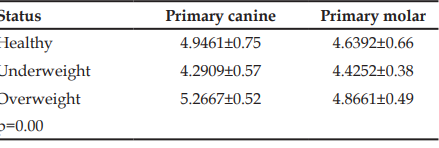
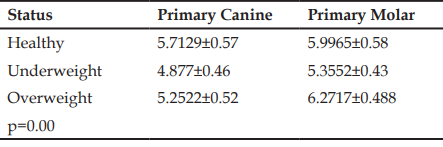
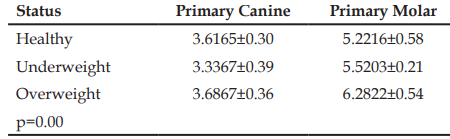
Introduction: Tooth morphometrics show variations across gender, phenotypes, race, age and populations. These variations are evolutionarily determined but maybe modified by environmental factors such as socioeconomic conditions, nutrition, childhood health, maternal effects such as gestation and systemic conditions. Despite strong genetic contribution, the tooth may fail to reach its maximum potential size due to the role of environmental influences. A relation between tooth size and body size would compound the notion that teeth size, though dependent on genetic contribution, are not insulated from external influences. Previously attempts to corelate tooth size and body size by other authors have shown differing results. There is also a dearth of information regarding the same on deciduous dentition. Hence this study aims to corelate Body Mass Index (BMI) and clinical crown length (CL), mesiodistal width (MDW) and buccolingual width (BLW) of primary maxillary canines and first molars, among Chennai children. Materials and methods: A cross-sectional study was conducted among 100 school going children, of both genders, in the age group of 3-6 years. Weight and height were calculated by metric standards and BMI was obtained. The participants were grouped as healthy, underweight and overweight. The different groups were measured intraorally, with a digital Vernier caliper for crown lengths, mesiodistal and buccolingual widths of primary upper canines and molars. Data was statistically analyzed. Results: Total of 49,22,18 belong to healthy, underweight and overweight. Comparison of the mean (SD) of CL, MDW, BLW of upper primary canine and first molar among participants of different body size using one-way ANOVA test was found to be statistically significant (P<0.05). Conclusion: A positive correlation exists a between body mass index and tooth metrics. Evident deciduous crown size variations of individuals of different BMI belonging to the same population should be taken into consideration while studying population comparisons of different odontometric standards.
References
- 1. Puri N, Pradhan KL, Chandna A, Sehgal V, Gupta R. Biometric study of tooth size in normal, crowded, and spaced permanent dentitions. Am J Orthod Dentofacial Orthop. 2007;132(3):279.e7-14.
- 2. Eswara K, Avula JS, Mallela GK, Enuganti S, Margana JG, Kakarla P. Deciduous molar sizes and sexual dimorphism: South Indian study. J Pediatr Dent. 2014;2:13-7.
- 3. Jembulingam S, Nithya J. Mesiodistal and labiolingual index of maxillary permanent canines in gender determination: a forensic analysis. Int J Med Res Pharm Sci. 2016;3(10):32-5.
- 4. Ashwini S, Nithya J. Assessment of tooth metrics in gender determination-a cross sectional study. J Forensic Investig. 2015;3(1):1-3.
- 5. Lewis DW, Grainger RM. Sex-linked inheritance of tooth size: a family study. Arch Oral Biol. 1967;12(4):539-44.
- 6. Garn SM, Osborne RH, McCabe KD. The effect of prenatal factors on crown dimensions. Am J Phys Anthropol. 1979;51(4):665-78.
- 7. Guagliardo MF. Tooth crown size differences between age groups: a possible new indicator of stress in skeletal samples. Am J Phys Anthropol. 1982;58(4):383-9.
- 8. Zameer M, Basheer SN, Anwar NG, Mudassar M, Reddy A, Quadri H. A study on nutritional status and tooth crown size among 6–9-year-old children: an observational cross-sectional study. J Forensic Dent Sci. 2016;8(3):135-8.
- 9. Banerjee A, Kamath VV, Satelur K, Rajkumar K, Sundaram L. Sexual dimorphism in tooth morphometrics: an evaluation of the parameters. J Forensic Dent Sci. 2016;8(1):22-7.
- 10. Amit Z, Swati B, Yogita K, Rahul D, Kiran H, Swapnil S. Prediction of body weight and body mass index from tooth crown area: a preliminary study. J Int Oral Health. 2016;8(2):272-5.
- 11. Creighton GK. Static allometry of mammalian teeth and the correlation of tooth size and body size in contemporary mammals. J Zool. 1980;191(4):435-43.
- 12. Smith RJ. On the definition of variables in studies of primate dental allometry. Am J Phys Anthropol. 1981;55(3):323-9.
- 13. Rabelo RD, Araújo CGS. Body Mass Index: a scientific evidence-based inquiry. Arq Bras Cardiol [Internet]. 2002 [cited 2018 Mar 30];79(1):70-8.
- 14. Brace CL. Environment, tooth form, and size in the Pleistocene. J Dent Res. 1967;46(5 Suppl):809-16.
- 15. Yuen KK, So LL, Tang EL. Mesiodistal crown diameters of the primary and permanent teeth in southern Chinese--a longitudinal study. Eur J Orthod. 1997;19(6):721-31.
- 16. Jayawardena CK, Abesundara AP, Nanayakkara DC, Chandrasekara MS. Age-related changes in crown and root length in Sri Lankan Sinhalese. J Oral Sci. 2009;51(4):587-92.
- 17. Sterrett JD, Oliver T, Robinson F, Fortson W, Knaak B, Russell CM. Width/length ratios of normal clinical crowns of the maxillary anterior dentition in man. J Clin Periodontol. 1999;26(3):153-7.
- 18. Prabhu S, Acharya AB, Muddapur MV. Are teeth useful in estimating stature? J Forensic Leg Med. 2013;20(5):460-4.
- 19. Ramanna C, Kamath VV, Sharada C, Srikanth N. Determination of physical height from crown dimensions of deciduous tooth: a dental morphometric study. J Indian Soc Pedod Prev Dent. 2016;34(3):262-8.
- 20. Sridhar K, Arun AV, Karthikswamy, Kiran Kumar P, Sudheer Kumar CH, Pratap Verma KVV. Morphometrics of permanent dentition in Chennai population. J Indian Orthod Soc. 2011;45(3):110-8.
- 21. Moss ML. The functional matrix hypothesis revisited. 4. The epigenetic antithesis and the resolving synthesis. Am J Orthod Dentofacial Orthop. 1997;112(4):410-7.
- 22. Townsend G, Brook A. Genetic, epigenetic and environmental influences on dental development. Orthod Trib. 2008;3(2):3-6.
- 23. Logan WHG, Kronfeld R. Development of the human jaws and surrounding structures from birth to the age of fifteen years. J Am Dent Assoc. 1933;20(3):379-427.
- 24. Whittaker DK, MacDonald DG. A colour atlas of forensic dentistry. 1st ed. London: Wolfe Medical Publications Ltd; 1989. p. 58-66.
- 25. Işcan MY, Kedici PS. Sexual variation in bucco-lingual dimensions in Turkish dentition. Forensic Sci Int. 2003;137(2-3):160-4.
- 26. Moorrees CFA, Reed RB. Biometrics of crowding and spacing of the teeth in the mandible. Am J Phys Anthropol. 1954;12(1):77-88.
- 27. Hunter WS, Priest WR. Errors and discrepancies in measurement of tooth size. J Dent Res. 1960;39(2):405-14.
- 28. Anderson AA. Dentition and occlusion development in African American children: mesiodistal crown diameters and tooth-size ratios of primary teeth. Pediatr Dent. 2005;27(3):121-8.
- 29. Visha MG, Deepa G. Relationship of BMI and dental caries among children in Chennai. Biomedicine. 2016;36(1):57-61.
- 30. Mokshi J, Gowri S. Dental caries and obesity in children of age groups 5-9 years: a preliminary study. Res J Pharm Tech. 2015;10(8):1353-6.
- 31. Varshitha A. Comparison of blood pressure and BMI in college students. J Pharm Sci Res. 2015;7(10):849-51.
Data Sharing Statement
There are no additional data available. All raw data and code are available upon request.
Funding
This research received no funding.
Author Contributions
Whether all authors contributed significantly to the work and approve its publication.
Ethics Declaration
This article does not involve any human or animal subjects, and therefore does not require ethics approval.
Acknowledgements
We would like to express our gratitude to the patients, their families, and all those who have contributed to this study.
Conflicts of Interest
The authors report no conflicts of interest in this work.
About this article

Cite this article
Licence:
Attribution-Non-commercial 4.0 International (CC BY-NC 4.0)This license enables reusers to distribute, remix, adapt, and build upon the material in any medium or format for noncommercial purposes only, and only so long as attribution is given to the creator
| Received | Accepted | Published |
|---|---|---|
| January 31, 2018 | February 26, 2018 | March 30, 2018 |
DOI: 10.21088/ijfmp.0974.3383.11218.6
Keywords
MorphometricsBody Mass IndexCrown lengthMesiodistal widthBuccolingual widthSearch for Similar Articles
Similar Articles
- Diatom Analysis in Thermophilic water bodies: A Study on Hot Water Springs of Ma...
- Morphometric Study of Supra-meatal Triangle and Mastoid process in the Adult dry...
- Histopathological Spectrum of Autopsy Cases: A One Year Retrospective Observatio...
- Forensic Differentiation of Manner of Death in Railway Fatalities: A FourCase Se...
- Understanding assault Patterns: A Cross-sectional study of Cases at Chri, Kelamb...
Article Level Metrics
Last UpdatedSunday 18 October 2026, 08:52:18 (IST)
16253
Accesses
12
3204
00
Citations
NA
NA
NA
Download citation
Article Keywords
Keyword Highlighting
Highlight selected keywords in the article text.
Timeline
| Received | January 31, 2018 |
| Accepted | February 26, 2018 |
| Published | March 30, 2018 |
licence
Attribution-Non-commercial 4.0 International (CC BY-NC 4.0)
This license enables reusers to distribute, remix, adapt, and build upon the material in any medium or format for noncommercial purposes only, and only so long as attribution is given to the creator