Full Text (PDF)
Indian Journal of Forensic Medicine and Pathology 11(2):p 86-88, April-June 2018. | DOI: 10.21088/ijfmp.0974.3383.11218.7
Original Article
Pattern of Hanging Deaths in Raichur Region
Aravind , Ajid, Lohit Naik, Rajesh Sangram
Author Information
Licence:
Attribution-Non-commercial 4.0 International (CC BY-NC 4.0)This license enables reusers to distribute, remix, adapt, and build upon the material in any medium or format for noncommercial purposes only, and only so long as attribution is given to the creator.
Indian Journal of Forensic Medicine and Pathology 11(2):p 86-88, April-June 2018. | DOI: 10.21088/ijfmp.0974.3383.11218.7
How Cite This Article:
Timeline
Received : May 10, 2018
Accepted : May 22, 2018
Published : June 30, 2018
Abstract
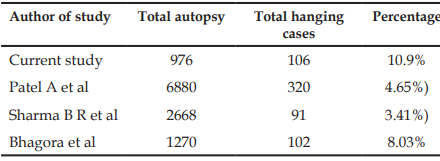
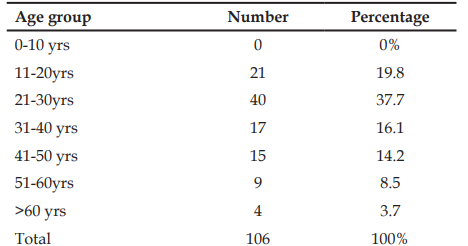
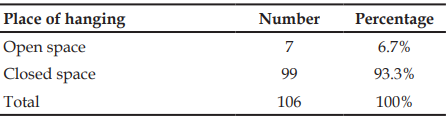
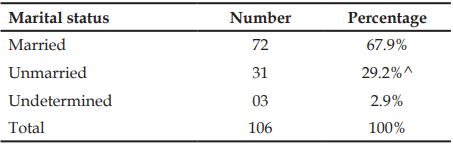
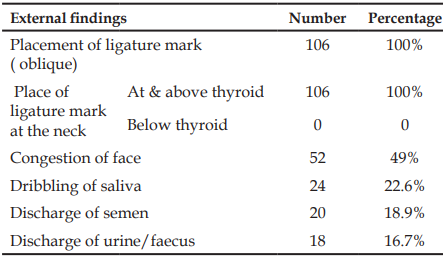
Background: Violent asphyxial deaths are one of the important causes of death nowadays. Hanging is one of the preferred mode of committing suicide. Pattern of suicidal death is a reflection of the prevailing social set up and mental health status of region. Material & Methods: A Prospective study was conducted from Jan 2013 to December 2013 in which 106 autopsy cases of hanging deaths were taken out of 976 autopsies conducted in the mortuary of Raichur institute of medical sciences, Raichur. Results: The maximum incidences of hanging deaths were in 21- 30 years age group (37.7%). Majority of the victims were married (67.9%). The most common place of hanging was closed space (93.3%). On external examination the ligature mark was at or above the thyroid cartilage in all the cases with no fracture of thyroid cartilage or hyoid bone. Conclusion: Hanging is the most commonly observed mechanical asphyxial death. The cause of death profile is an important set of public health information and forms the cornerstone of the health information system
References
- 1. World Health Organization. Figures and facts about suicide. Geneva: WHO; • Behera A, Balabantray JK, Nayak SR. Review of suicidal cases: A retrospective study. J Indian Acad Forensic Med. 2005;27(2):100-2.
- 2. Mohanty S, Sahu G, Mohanty MK, Patnaik M. Suicide in India: A four year retrospective study. J Forensic Leg Med. 2007;14(2):185-9.
- 3. Gunnell D, Bennewith O, Hawton K, Simkin S, Kapur N. The epidemiology and prevention of suicide by hanging: a systematic review. Int J Epidemiol. 2005;34(2):433-42.
- 4. Modi JP. Medical Jurisprudence and Toxicology. Mathiharan K, Patnaik AK, editors. 23rd ed. New Delhi: LexisNexis; 2008. p. 565–614.
- 5. Sharma BR. A study of ligature mark on neck: how informative? J Indian Acad Forensic Med. 2005;27(1):10–5.
- 6. Patel AP, Bansal A, Shah JV, Shah KA. Study of hanging cases in Ahmedabad region. J Indian Acad Forensic Med. 2012;34(4):342-5.
- 7. Bhagora L, Patel T, Parmar A, Suvera K. An epidemiological study of hanging cases at Bhavnagar region. Natl J Integr Res Med. 2015;6(3):40-3.
- 8. Singh A. A study of demographic variables of violent asphyxial death. J Punjab Acad Forensic Med Toxicol. 2003;3:32–4.
- 9. Azmak D. Asphyxial deaths: A retrospective study and review of the literature. Am J Forensic Med Pathol. 2006;27(2):134–44.
- 10. Sharija S, Sreekumari K, Geetha O. Epidemiological profile of suicide by hanging in southern parts of Kerala: an autopsy based study. J Indian Acad Forensic Med. 2011;33(3):237-40.
- 11. Gargi J, Gorea RK, Chanana A, Rai H. Violent asphyxial deaths - a six years study. J Indian Acad Forensic Med. 1992;14(4):171-6.
- 12. Waghmare PB, Chikhalkar BG, Nanandkar SD. Analysis of asphyxial deaths due to hanging. J Indian Acad Forensic Med. 2014;36(4):343-5.
Data Sharing Statement
There are no additional data available. All raw data and code are available upon request.
Funding
This research received no funding.
Author Contributions
Whether all authors contributed significantly to the work and approve its publication.
Ethics Declaration
This article does not involve any human or animal subjects, and therefore does not require ethics approval.
Acknowledgements
We would like to express our gratitude to the patients, their families, and all those who have contributed to this study.
Conflicts of Interest
The authors report no conflicts of interest in this work.
About this article

Cite this article
Licence:
Attribution-Non-commercial 4.0 International (CC BY-NC 4.0)This license enables reusers to distribute, remix, adapt, and build upon the material in any medium or format for noncommercial purposes only, and only so long as attribution is given to the creator.
| Received | Accepted | Published |
|---|---|---|
| May 10, 2018 | May 22, 2018 | June 30, 2018 |
DOI: 10.21088/ijfmp.0974.3383.11218.7
Keywords
HangingAsphyxial DeathsLigature MarkSearch for Similar Articles
Similar Articles
- Diatom Analysis in Thermophilic water bodies: A Study on Hot Water Springs of Ma...
- Morphometric Study of Supra-meatal Triangle and Mastoid process in the Adult dry...
- Histopathological Spectrum of Autopsy Cases: A One Year Retrospective Observatio...
- Forensic Differentiation of Manner of Death in Railway Fatalities: A FourCase Se...
- Understanding assault Patterns: A Cross-sectional study of Cases at Chri, Kelamb...
Article Level Metrics
Last UpdatedSunday 18 October 2026, 12:28:10 (IST)
16263
Accesses
10
3205
00
Citations
NA
NA
NA
Download citation
Article Keywords
Keyword Highlighting
Highlight selected keywords in the article text.
Timeline
| Received | May 10, 2018 |
| Accepted | May 22, 2018 |
| Published | June 30, 2018 |
licence
Attribution-Non-commercial 4.0 International (CC BY-NC 4.0)
This license enables reusers to distribute, remix, adapt, and build upon the material in any medium or format for noncommercial purposes only, and only so long as attribution is given to the creator.