Full Text (PDF)
Indian Journal of Forensic Medicine and Pathology 13(1):p 47-52, January-March 2020. | DOI: https://doi.org/10.21088/ijfmp.0974.3383.13120.6
Original Article
Mesiodistal Width of Permanent Anterior Teeth: A Tool for Sex Determination
Arun Pinchu Xavier, Karen Prajwal Castelino, Francis NP Monteiro, Bharath Shetty, M Deepak null
Author Information
Licence:
Attribution-Non-commercial 4.0 International (CC BY-NC 4.0)This license enables reusers to distribute, remix, adapt, and build upon the material in any medium or format for noncommercial purposes only, and only so long as attribution is given to the creat
Indian Journal of Forensic Medicine and Pathology 13(1):p 47-52, January-March 2020. | DOI: https://doi.org/10.21088/ijfmp.0974.3383.13120.6
How Cite This Article:
Karen Prajwal Castelino, Arun Pinchu Xavier, Francis NP. Monteiro et al. Mesiodistal Width of Permanent Anterior Teeth: A Tool for Sex Determination. Indian J. Forensic Med Pathol. 2020;13(1):47–52.Timeline
Received : October 05, 2019
Accepted : November 13, 2019
Published : December 30, 2019
Abstract
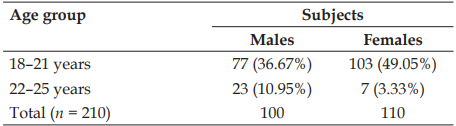
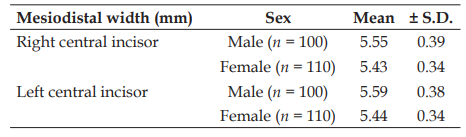
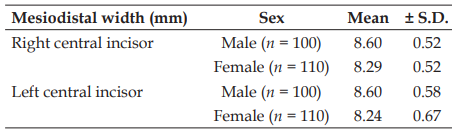
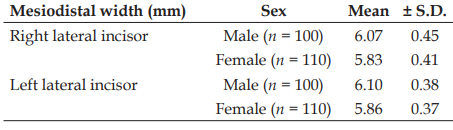
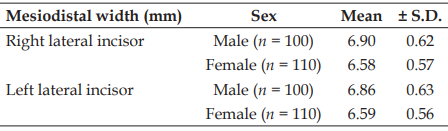
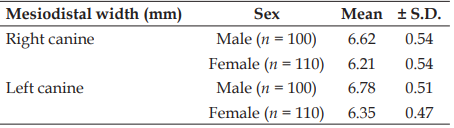
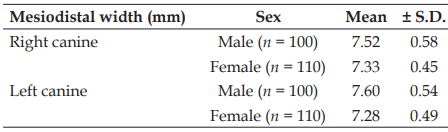
Background: Metric and non-metric analysis of the human dentition have played an important role in human biological research and have formed a central focus in the field of dental anthropology for over a century. This study intends assess the degree of sexual dimorphism in permanent anterior teeth in south Indian origin student population. Aim: The purpose of this study is to analyze the mesiodistal crown width of permanent anterior teeth and assess the degree of sexual dimorphism in permanent anterior teeth in south Indian origin student population. Materials and methods: Materials for this cross-sectional study consisted of 210 students belonging to various parts of South India (Karnataka, Kerala, Tamil Nadu, Andhra Pradesh, and; union territories of Lakshadweep and Pondicherry) comprising of 100 males and 110 females in the age group of 18–25 years studying at A. J. Institute of Medical Sciences and Research Centre, Mangalore, Karnataka who are willing to participate in the study. Methods for the study consisted of measuring the maxillary and mandibular incisor and canine widths of these students using a digital caliper with a resolution of 0.01mm with the provision to fix it in position to the desired position so as to avoid any errors in recording the exact measurements of canines. Results: 100 males and 110 female students in the age group of 18–25 years, from various parts of South India were examined to predict the sex from the mesiodistal widths of permanent anterior teeth for both the arches. The mean mesiodistal width of mandibular central incisor was greater in males (Right: 5.55 ± 0.39 mm; Left: 5.59 ± 0.38 mm) than females (Right: 5.43 ± 0.34 mm; Left: 5.44 ± 0.34 mm). The mean Mesiodistal width of maxillary central incisor was greater in males (Right: 8.60 ± 0.52 mm; Left: 8.60 ± 0.58 mm) than females (Right: 8.29 ± 0.52 mm; Left: 8.24 ± 0.67 mm). The mean Mesiodistal width of mandibular lateral incisor was greater in males (Right: 6.07 ± 0.45 mm; Left: 6.10 ± 0.38 mm) than females (Right: 5.83 ± 0.41 mm; Left:
References
No records found.
Data Sharing Statement
There are no additional data available. All raw data and code are available upon request.
Funding
This research received no funding.
Author Contributions
Whether all authors contributed significantly to the work and approve its publication.
Ethics Declaration
This article does not involve any human or animal subjects, and therefore does not require ethics approval.
Acknowledgements
We would like to express our gratitude to the patients, their families, and all those who have contributed to this study.
Conflicts of Interest
The authors report no conflicts of interest in this work.
About this article

Cite this article
Karen Prajwal Castelino, Arun Pinchu Xavier, Francis NP. Monteiro et al. Mesiodistal Width of Permanent Anterior Teeth: A Tool for Sex Determination. Indian J. Forensic Med Pathol. 2020;13(1):47–52.
Licence:
Attribution-Non-commercial 4.0 International (CC BY-NC 4.0)This license enables reusers to distribute, remix, adapt, and build upon the material in any medium or format for noncommercial purposes only, and only so long as attribution is given to the creat
| Received | Accepted | Published |
|---|---|---|
| October 05, 2019 | November 13, 2019 | December 30, 2019 |
DOI: https://doi.org/10.21088/ijfmp.0974.3383.13120.6
Keywords
DentitionMesiodistal crown widthMetricnon-metric analysisPermanent anterior teethSexual dimorphismSearch for Similar Articles
Similar Articles
- Diatom Analysis in Thermophilic water bodies: A Study on Hot Water Springs of Ma...
- Morphometric Study of Supra-meatal Triangle and Mastoid process in the Adult dry...
- Histopathological Spectrum of Autopsy Cases: A One Year Retrospective Observatio...
- Forensic Differentiation of Manner of Death in Railway Fatalities: A FourCase Se...
- Understanding assault Patterns: A Cross-sectional study of Cases at Chri, Kelamb...
Article Level Metrics
Last UpdatedSunday 18 October 2026, 14:48:13 (IST)
16275
Accesses
19
3209
00
Citations
NA
NA
NA
Download citation
Article Keywords
Keyword Highlighting
Highlight selected keywords in the article text.
Timeline
| Received | October 05, 2019 |
| Accepted | November 13, 2019 |
| Published | December 30, 2019 |
licence
Attribution-Non-commercial 4.0 International (CC BY-NC 4.0)
This license enables reusers to distribute, remix, adapt, and build upon the material in any medium or format for noncommercial purposes only, and only so long as attribution is given to the creat