Full Text (PDF)
Indian Journal of Forensic Medicine and Pathology 17(3):p 177-183, July- September 2024. | DOI: https://doi.org/10.21088/ijfmp.0974.3383.17324.4
Original Article
Insights into Fatal Head Trauma from Road Traffic Incidents
Author Information
Licence:
Attribution-Non-commercial 4.0 International (CC BY-NC 4.0)This license enables reusers to distribute, remix, adapt, and build upon the material in any medium or format for noncommercial purposes only, and only so long as attribution is given to the creator.
Indian Journal of Forensic Medicine and Pathology 17(3):p 177-183, July- September 2024. | DOI: https://doi.org/10.21088/ijfmp.0974.3383.17324.4
How Cite This Article:
Kumar P, Wahab A. Insights into Fatal Head Trauma from Road Traffic Incidents. Indian J Forensic Med Pathol. 2024;17(3):177-183.Timeline
Received : July 06, 2024
Accepted : September 24, 2024
Published : September 30, 2024
Abstract
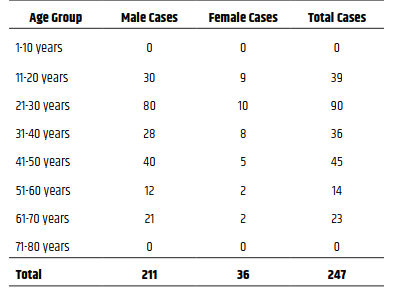
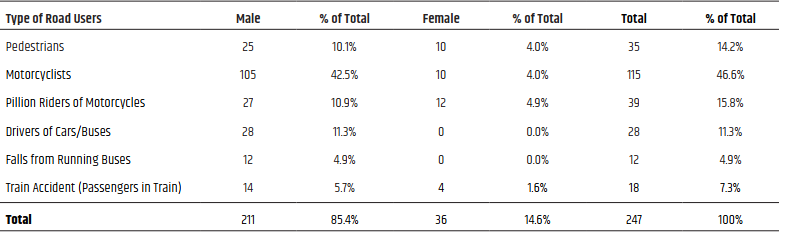
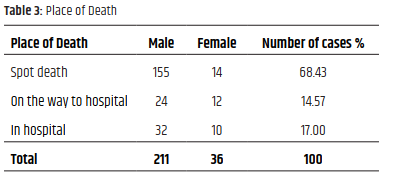
Background: Road traffic accidents (RTAs) are a major global health concern, causing significant morbidity and mortality. Head injuries, particularly fatal ones, are a critical outcome of RTAs, necessitating detailed analysis to inform preventive strategies and improve trauma care protocols. Objective: This study aims to analyse fatal head injuries resulting from RTAs, focusing on demographic characteristics, types of injuries, causes of death, and circumstances of these incidents. Material and Methods: A retrospective study was conducted at the Department of Forensic Medicine & Toxicology, GMCH Purnea, Bihar, covering the period from January 2023 to December 2023. The study included confirmed cases of fatal head injuries from RTAs with complete records. Data were analyzed using SPSS software, employing descriptive statistics, cross-tabulation, and chi-square tests to identify significant associations. Results: Out of 247 cases, 85.4% were males and 14.6% were females. The 21-30 years age group was most affected (36.4%), followed by 41-50 years (18.2%) and 11-20 years (15.8%). Motorcyclists were the most common victims (46.6%), followed by pedestrians (14.2%). Most fatalities occurred at the accident scene (68.43%). The majority of skull fractures were comminuted (38.85%), with fissure + depressed fractures being significant (29.14%). The anterior cranial fossa (ACF) was the most commonly affected skull region (57.09%). Intracerebral haemorrhage (34.85%) and extradural haemorrhage (21.66%) were the most prevalent types of intracranial haemorrhage. Contusions (25.71%) and lacerations (37.14%) were common internal brain injuries. Conclusion: Fatal head injuries from RTAs predominantly affect young adult males, with motorcyclists being particularly vulnerable. Immediate fatalities at the scene highlight the need for prompt emergency response. The findings emphasize the importance of targeted road safety measures, public awareness campaigns, and improved trauma care systems to reduce the incidence of fatal head injuries in RTAs.
References
- 1. World Health Organization (2018). Global Status Report on Road Safety 2018. Geneva: World Health Organization. Available from: https://www. w h o . i n t / p u b l i c a t i o n s / i / item/9789241565684.Accessed on 29th May 2024.
- 2. Sehlikoglu K, Türkoglu A, Bork T, Batbas M. Investigation of fatal traumatic head injuries. Ulus Travma Acil CerrahiDerg2024; 30:160-166.
- 3. Langlois JA, Sattin RW. Traumatic brain injury in the United States: Research and programs of the Centers for Disease Control and Prevention (CDC)-Preface. J Head Trauma Rehabilitation 2005; 20:187–8.
- 4. Chattopadhyay S, Tripathi C. Skull fracture and haemorrhage pattern among fatal and nonfatal head injury assault victims–a critical analysis. J Injury and Violence Res 2010; 2:99–103.
- 5. Shobhana S, RaviRaj K G, Yadav A, Lohith Kumar R. An Analysis of Pattern of Fatal Head Injuries in Road Traffic Accidents. Medico-Legal Update, January-June 2019; 19(1): 130-136. DOI: 10.5958/0974- 1283.2019.00026.4.
- 6. Leijdesdorff HA, van Dijck JT, Krijnen P, VleggeertLankamp CL, Schipper IB; Regional Trauma Center West-Netherlands’ Research Group. Injury pattern, hospital triage, and mortality of 1250 patients with severe traumatic brain injury caused by road traffic accidents. J Neurotrauma. 2014 Mar 1; 31(5):459-65. doi: 10.1089/ neu.2013.3111.
- 7. Freytag E. Autopsy Findings in Head injuries from Blunt Forces: Arch. Pathology. 1963; 75: 402-413.
- 8. Sevitt S. Fatal Road traffic accidents. British J Surgery 1968;55(7):481-505.
- 9. Maloney AFJ & Whatmore WJ. Clinical and Pathological observations in fatal head injuries. British J Surgery. 1969 Jan; 56:23-31, (1969).
- 10. Bhowate S, Sheikh N, Asawa S. Patterns of Cranio-cerebral Injuries in Fatal Head Trauma. Indian Journal of Forensic Medicine & Toxicology, July-December 2016; 10(2): 18-22. DOI: 10.5958/0973- 9130.2016.00054.2.
- 11. Tyagi A K, Sharma G K & Bishnu Kumar. Cranio cerebral damage by blunt force impact. JIAFM. 1986;1:24-39.
- 12. Jennet Bryan. Epidemiology of head injury. Journal of Neurology, Neurosurgery & Psychiatry. 1996; 60:362-369.
- 13. Chandra J, Dogra T D, Dikshit P C. Patterns of cranio- intracranial injuries in fatal vehicular accidents in Delhi. Medicine Science Law. 1979; 19(3):186-194.
- 14. Reddy KSN. The essentials of Forensic Medicine and Toxicology. 33rd ed. Hyderabad: Jaypee Brothers Medical Publishers (P) Ltd, Daryaganj New Delhi; 2013.
- 15. Tonge J I, O Reilly M J J, Davison A, Johnston NG & Wilkey I S. Traffic crash fatalities. Injury patterns and other factors. Medicine Science law. 1977; 17(1):9-24
Data Sharing Statement
There are no additional data available.
Funding
This research received no funding.
Author Contributions
All authors contributed significantly to the work and approve its publication.
Ethics Declaration
This article does not involve any human or animal subjects, and therefore does not require ethics approval.
Acknowledgements
We extend our gratitude to the staff in the Department of Forensic Medicine & Toxicology, GMC Purnea Bihar, for their support and cooperation during the conduct of this study.
Conflicts of Interest
The authors report no conflicts of interest in this work.
About this article

Cite this article
Kumar P, Wahab A. Insights into Fatal Head Trauma from Road Traffic Incidents. Indian J Forensic Med Pathol. 2024;17(3):177-183.
Licence:
Attribution-Non-commercial 4.0 International (CC BY-NC 4.0)This license enables reusers to distribute, remix, adapt, and build upon the material in any medium or format for noncommercial purposes only, and only so long as attribution is given to the creator.
| Received | Accepted | Published |
|---|---|---|
| July 06, 2024 | September 24, 2024 | September 30, 2024 |
DOI: https://doi.org/10.21088/ijfmp.0974.3383.17324.4
Keywords
Road Traffic AccidentsFatal Head InjuriesDemographic AnalysisSkull FracturesIntracranial HaemorrhageTrauma CarePublic Health PolicySearch for Similar Articles
Similar Articles
- Diatom Analysis in Thermophilic water bodies: A Study on Hot Water Springs of Ma...
- Morphometric Study of Supra-meatal Triangle and Mastoid process in the Adult dry...
- Histopathological Spectrum of Autopsy Cases: A One Year Retrospective Observatio...
- Forensic Differentiation of Manner of Death in Railway Fatalities: A FourCase Se...
- Understanding assault Patterns: A Cross-sectional study of Cases at Chri, Kelamb...
Article Level Metrics
Last UpdatedSunday 18 October 2026, 14:42:56 (IST)
16274
Accesses
77
3209
00
Citations
NA
NA
NA
Download citation
Article Keywords
Keyword Highlighting
Highlight selected keywords in the article text.
Timeline
| Received | July 06, 2024 |
| Accepted | September 24, 2024 |
| Published | September 30, 2024 |
licence
Attribution-Non-commercial 4.0 International (CC BY-NC 4.0)
This license enables reusers to distribute, remix, adapt, and build upon the material in any medium or format for noncommercial purposes only, and only so long as attribution is given to the creator.