Full Text (PDF)
Indian Journal of Forensic Medicine and Pathology 18(2):p 125-130, Jan-June 2025. | DOI: https://doi.org/10.21088/ijfmp.0974.3383.18225.6
Review Article
Implications of Microarray Technology in Forensic Medicine
Author Information
Licence:
Attribution-Non-commercial 4.0 International (CC BY-NC 4.0)This license enables reusers to distribute, remix, adapt, and build upon the material in any medium or format for noncommercial purposes only, and only so long as attribution is given to the creator.
Indian Journal of Forensic Medicine and Pathology 18(2):p 125-130, Jan-June 2025. | DOI: https://doi.org/10.21088/ijfmp.0974.3383.18225.6
How Cite This Article:
Kuril SR, Priya A. Implications of Microarray Technology in Forensic Medicine. Indian J Forensic Med Pathol. 2025;18(2):125-130.Timeline
Received : March 31, 2025
Accepted : June 03, 2025
Published : June 20, 2025
Abstract
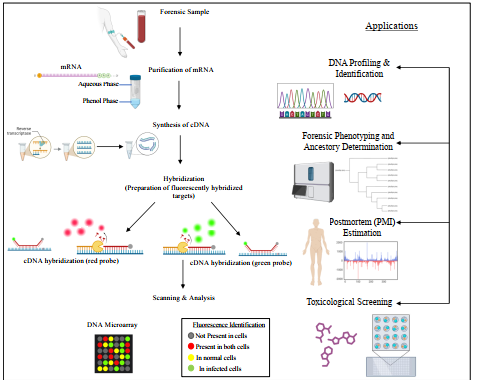
Background: In Forensic medicine, microarray technology has an immense impact in the areas of investigation, to conduct in-depth Single Nucleotide Polymorphism (SNP) analysis in forensic phenotyping. That allows for the probabilistic prediction of externally visible characteristics (EVCs), such eye and hair colour, and yields useful leads for identifying suspects. The use of microarray technology to estimate the Postmortem Interval (PMI), or time since death, is another area of active research. Moreover, by observing post-mortem, gene expression, microbial DNA, and identification through biological fluids like saliva, CSF, venous blood, menstrual blood, and semen, researchers hope to increase PMI accuracy. These developments and implications of microarrays in forensic science allows for more enhanced and informative genetic analyses, ultimately strengthening forensic investigations. Objective: This review aims to evaluate the current applications and future directions of microarray-based techniques in forensic medicine. Methods: A systematic search was conducted in PubMed, Scopus, Web of Science, Research Gate and Google Scholar for studies published between January 2000 to March 2025. Studies focusing on forensic applications of microarrays, including gene expression profiling, identification of body fluids, time of death estimation, and toxicological assessments were included. Results: Out of 789 initially identified articles, 34 studies met the inclusion criteria. Microarrays demonstrated significant utility in identifying specific gene expression patterns related to postmortem interval estimation, tissue-specific markers, and toxin exposure. However, variability in sample preservation, data interpretation, and lack of standardization limit its widespread forensic adoption. Conclusion: Microarray technology shows promising potential in forensic medicine. Integrating it with traditional methods and next-generation sequencing could enhance accuracy and reliability in forensic investigations.
References
- 1. Priya A, Rana AK, Kumar A, Bara N, Soren AN. Genetic incompatibility between father and child due to maternal uniparental isodisomy at locus D13S317 in a paternity testing: a case report. Journal of Forensic Legal & Investigative Science. 2023. doi: 10.24966/FLIS-733X/100074
- 2. Priya A, Bara N, Soren AN. The importance of Y-DNA profiling in detecting uniparental maternal heterodisomy at locus D8S1179 in case of paternity testing. Austin J Forensic Sci Criminol. 2024;10(2):1100.
- 3. Iwamoto K, Bundo M, Ueda J, Nakano Y, Ukai W, Hashimoto E. Detection of chromosomal structural alterations in single cells by SNP arrays: a systematic survey of amplification bias and optimized workflow. PLoS One. 2007;2(12):e1306. doi:10.1371/journal.pone.0001306.
- 4. Shrestha R, Kanchan T, Krishan K. Methods of estimation of time since death. In: StatPearls [Internet]. Treasure Island (FL): StatPearls Publishing; 2025 Jan-. [Updated 2023 May 30; cited 2025 Sep 18]. Available from: https://www.ncbi.nlm.nih.gov/books/NBK549867/.
- 5. Priya A, Kumar A, et al. Molecular approaches for forensic body fluid identification. In: Advanced forensic biotechnology. Vol 2. Akinik Publication; 2023. ISBN:978-93-5570-937-0. doi:10.22271/ed.book.2493.
- 6. Rocchi A, Chiti E, Maiese A, Turillazzi E, Spinetti I. MicroRNAs: an update of applications in forensic science. Diagnostics (Basel). 2020 Dec 26;11(1):32.
- 7. Kayser M, de Knijff P. Improving human forensics through advances in genetics, genomics and molecular biology. Nat Rev Genet. 2011 Mar;12(3):179-92.
- 8. Kayser M. Forensic DNA phenotyping: predicting human appearance from crime scene material for investigative purposes. Forensic Sci Int Genet. 2015 Sep;18:33-48.
- 9. Schneider PM, Prainsack B, Kayser M. The use of forensic DNA phenotyping in predicting appearance and biogeographic ancestry. Dtsch Arztebl Int. 2019 Dec 23;116(51-52):873-80.
- 10. Zubakov D, Kokshoorn M, Kloosterman A, Kayser M. New markers for old stains: stable mRNA markers for blood and saliva identification from up to 16-year-old stains. Int J Legal Med. 2009 Jan;123(1):71-4.
- 11. Juusola J, Ballantyne J. mRNA profiling for body fluid identification by multiplex quantitative RT-PCR. J Forensic Sci. 2007 Nov;52(6):1252-62.
- 12. Saeed AI, Sharov V, White J, Li J, Liang W, Bhagabati N, et al. TM4: a free, open-source system for microarray data management and analysis. Biotechniques. 2003 Feb;34(2):374-8.
- 13. Sears D, Hajdu SI. The cytologic diagnosis of malignant neoplasms in pleural and peritoneal effusions. Acta Cytol. 1987 Mar-Apr;31(2):85-97.
- 14. Vrana KE, Freeman WM, Aschner M. Use of microarray technologies in toxicology research. Neurotoxicology. 2003 Jun;24(3):321-32.
Data Sharing Statement
There are no additional data available.
Funding
This research received no funding.
Author Contributions
All authors contributed significantly to the work and approve its publication.
Ethics Declaration
This article does not involve any human or animal subjects, and therefore does not require ethics approval.
Acknowledgements
Information not provide.
Conflicts of Interest
The authors report no conflicts of interest in this work.
About this article

Cite this article
Kuril SR, Priya A. Implications of Microarray Technology in Forensic Medicine. Indian J Forensic Med Pathol. 2025;18(2):125-130.
Licence:
Attribution-Non-commercial 4.0 International (CC BY-NC 4.0)This license enables reusers to distribute, remix, adapt, and build upon the material in any medium or format for noncommercial purposes only, and only so long as attribution is given to the creator.
| Received | Accepted | Published |
|---|---|---|
| March 31, 2025 | June 03, 2025 | June 20, 2025 |
DOI: https://doi.org/10.21088/ijfmp.0974.3383.18225.6
Keywords
DNA MicroarraySingle Nucleotide Polymorphism (SNP)Postmortem Interval (PMI)Complimentary HybridizationToxicogenomicsRNA ProfilingSearch for Similar Articles
Similar Articles
- Diatom Analysis in Thermophilic water bodies: A Study on Hot Water Springs of Ma...
- Morphometric Study of Supra-meatal Triangle and Mastoid process in the Adult dry...
- Histopathological Spectrum of Autopsy Cases: A One Year Retrospective Observatio...
- Forensic Differentiation of Manner of Death in Railway Fatalities: A FourCase Se...
- Understanding assault Patterns: A Cross-sectional study of Cases at Chri, Kelamb...
Article Level Metrics
Last UpdatedSunday 18 October 2026, 10:56:19 (IST)
16257
Accesses
52
3205
00
Citations
NA
NA
NA
Download citation
Article Keywords
Keyword Highlighting
Highlight selected keywords in the article text.
Timeline
| Received | March 31, 2025 |
| Accepted | June 03, 2025 |
| Published | June 20, 2025 |
licence
Attribution-Non-commercial 4.0 International (CC BY-NC 4.0)
This license enables reusers to distribute, remix, adapt, and build upon the material in any medium or format for noncommercial purposes only, and only so long as attribution is given to the creator.