Full Text (PDF)
Indian Journal of Pathology: Research and Practice 14(2):p 61-67, may-august 2025. | DOI: https://doi.org/10.21088/ijprp.2278.148X.14225.2
Original Article
Histopathological Evaluation of Endometrial Samplings in Cases of Endometrial Hyperplasia
Neha B. Desai, Nanda J. Patil, Sujata Kanetkar, Nidhi Goswami
Author Information
Licence:
Attribution-Non-commercial 4.0 International (CC BY-NC 4.0)This license
enables reusers to distribute, remix, adapt, and build upon the material in any
medium or format for noncommercial purposes only, and only so long as
attribution is given to the creator.
Indian Journal of Pathology: Research and Practice 14(2):p 61-67, may-august 2025. | DOI: https://doi.org/10.21088/ijprp.2278.148X.14225.2
How Cite This Article:
Nanda J. Patil, Sujata Kanetkar, Neha B. Desai et. al, Histopathological Evaluation of Endometrial Samplings in Cases of Endometrial Hyperplasia. Ind Jr of Path: Res and Practice 2025; 14(2) 61-67.Timeline
Received : March 06, 2025
Accepted : April 05, 2025
Published : August 30, 2025
Abstract
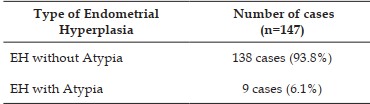
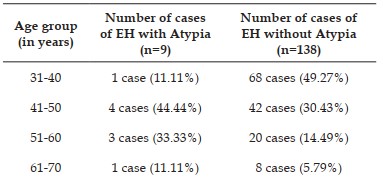
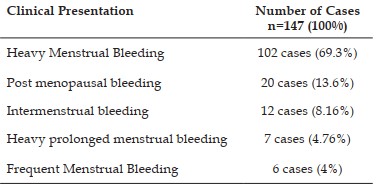
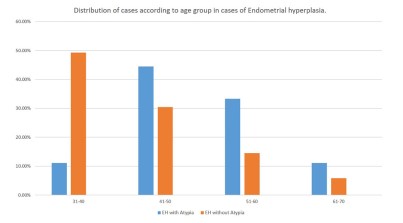
Introduction: Endometrial hyperplasia (EH) is a pathological condition characterized by the proliferation of endometrial glands, which can range from simple hyperplasia to complex atypical forms with a significant risk of progression to endometrial carcinoma. Histopathological evaluation of endometrial samplings plays a crucial role in the diagnosis, classification, and management of EH. Aim: This study aims to evaluate the histopathological spectrum of endometrial hyperplasia in endometrial samplings, assess the prevalence of various subtypes, and determine their association with clinical and demographic factors to aid in early diagnosis, risk assessment and appropriate management. Material & Methods: A cross sectional descriptive study was conducted on endometrial samples obtained from patient with suspected endometrial hyperplasia. The specimens received for histopathological evaluation at histopathology section in Tertiary care hospital from October 2020 to September 2022. Relevant clinical data, including age, symptoms, and associated risk factors, were analysed. Results: The study findings highlight the distribution of different EH subtypes, including EH with atypia and EH without atypia. Out of total 147 cases of EH; 9 cases (6.1%) were histopathologically classified as EH with atypia and 138 cases (93.8%) were EH without atypia. The commonest age group of EH with atypia was 41 to 50 years followed by 51 to 60 years and EH without atypia was 31 to 40 years. The most common clinical presentation was abnormal uterine bleeding. Conclusion: Histopathological evaluation remains the gold standard for diagnosing and classifying endometrial hyperplasia. Accurate assessment of endometrial samples aids in risk stratification and guides appropriate clinical management, thereby preventing the progression to endometrial carcinoma.
References
- 1. Contreras N.A., Sabadell J., Verdaguer P., Julià C., Fernández-Montolí M.E. FertilitySparing Approaches in Atypical Endometrial Hyperplasia and Endometrial Cancer Patient: Current Evidence and Future Directions. Int J Mol Sci. 2022; 23(5): 2531.
- 2. Nees L.K., Heublein S., Steinmacher S., JuhaszBöss I., Brucker S., Tempfer C.B., Wallwiener M. Endometrial hyperplasia as a risk factor of endometrial cancer. Arch Gynecol Obstet. 2022; 306(2): 407-421.
- 3. Sanderson P.A., Critchley H.O., Williams A.R., Arends M.J., Saunders P.T. New concepts for an old problem: the diagnosis of endometrial hyperplasia. Hum Reprod Update. 2017; 23(2): 232-254.
- 4. Dueholm M., Hjorth IMD, Dahl K., Pedersen L.K., Ørtoft G. Identification of endometrial cancers and atypical hyperplasia: Development and validation of a simplified system for ultrasound scoring of endometrial pattern. Maturitas. 2019; 123(1): 15-24.
- 5. Ryan NAJ, McMahon R., Tobi S., Snowsill T., Esquibel S., Wallace A.J., et al. The proportion of endometrial tumours associated with Lynch syndrome (PETALS): A prospective cross-sectional study. PLoS Med. 2020; 17(9): e1003263.
- 6. Bhatta S., Sinha A.K. Histopathological spectrum of endometrial biopsies in abnormal uterine bleeding. Int J Clin Diagn Pathol. 2021; 4(2): 63-67.
- 7. Batra N., Chaudhari S., Hatwal D. Histopathological variations in endometrial biopsies. Int J Med Sci Public Health. 2019; 5(1): 88-93.
- 8. Azatçam M., Güngördük K., Sancı M. Histopathological evaluation of endometrial sampling in different age groups - 1374 cases. J Med Sci. 2017; 32(1): 26-32.
- 9. Kurman R.J., Norris H.J. Evaluation of criteria for distinguishing atypical endometrial hyperplasia from well-differentiated carcinoma. Cancer. 1982 Jun; 49(12): 2547-59.
- 10. Vani B.S., Vani R. Histopathological evaluation of endometrial biopsies and curettings in abnormal uterine bleeding. J Pathol Med. 2020; 6(1):1-6.
- 11. J.E. Hunter, D.E. Tritz, M.G. Howell, P.D. DePriest, H.H. Gallion, S.J. Andrews, et al., The prognostic and therapeutic implications of cytologic atypiain patients with endometrial hyperplasia, Gynecol. Oncol. 55 (1994) 66–71.
Data Sharing Statement
There are no additional data available. All raw data and code are available upon request.
Funding
This research received no funding.
Author Contributions
All authors contributed significantly to the work and approve its publication.
Ethics Declaration
This article does not involve any human or animal subjects, and therefore does not require ethics approval.
Acknowledgements
We would like to express our gratitude to the patients, their families, and all those who have contributed to this study.
Conflicts of Interest
No conflicts of interest in this work.
About this article

Cite this article
Nanda J. Patil, Sujata Kanetkar, Neha B. Desai et. al, Histopathological Evaluation of Endometrial Samplings in Cases of Endometrial Hyperplasia. Ind Jr of Path: Res and Practice 2025; 14(2) 61-67.
Licence:
Attribution-Non-commercial 4.0 International (CC BY-NC 4.0)This license
enables reusers to distribute, remix, adapt, and build upon the material in any
medium or format for noncommercial purposes only, and only so long as
attribution is given to the creator.
| Received | Accepted | Published |
|---|---|---|
| March 06, 2025 | April 05, 2025 | August 30, 2025 |
DOI: https://doi.org/10.21088/ijprp.2278.148X.14225.2
Keywords
Endometrial hyperplasiaEndometrial samplingEndometrial biopsyRisk assessmentSearch for Similar Articles
Similar Articles
- Clinico-Pathological and Immunohistochemical Study of Primary CNS Tumors in a Te...
- The Role of SGLT2 Inhibitors in Cardiovascular Protection Beyond Diabetes: A Co...
- Epidermal Inclusion Cyst Presenting as 4th Ventricle Space Occupying Lesion: A R...
- Silent Retroperitoneal Seminoma Arising from an Occult Undescended Testis: Diagn...
- Scapular Metastasis of Oral Squamous Cell Carcinoma: A Case Report of an Unusual...
Article Level Metrics
Last UpdatedSaturday 17 October 2026, 10:28:57 (IST)
4177
Accesses
16
671
00
Citations
NA
NA
NA
Download citation
Article Keywords
Keyword Highlighting
Highlight selected keywords in the article text.
Timeline
| Received | March 06, 2025 |
| Accepted | April 05, 2025 |
| Published | August 30, 2025 |
licence
Attribution-Non-commercial 4.0 International (CC BY-NC 4.0)
This license
enables reusers to distribute, remix, adapt, and build upon the material in any
medium or format for noncommercial purposes only, and only so long as
attribution is given to the creator.