Full Text (PDF)
Indian Journal of Pathology: Research and Practice 14(3):p 107-114, Sep-Dec 2025. | DOI: https://doi.org/10.21088/ijprp.2278.148X.14325.2
Review Article
Revolutionizing Apheresis: The Transformative Impact of Artificial Intelligence on Precision, Safety, and Clinical Outcomes
Ajit Pal Singh, Rahul Saxena, Suyash Saxena
Author Information
Licence:
Attribution-Non-commercial 4.0 International (CC BY-NC 4.0)This license enables reusers to distribute, remix, adapt, and build upon the material in any medium or format for noncommercial purposes only, and only so long as attribution is given to the creator.
Indian Journal of Pathology: Research and Practice 14(3):p 107-114, Sep-Dec 2025. | DOI: https://doi.org/10.21088/ijprp.2278.148X.14325.2
How Cite This Article:
Ajit Pal Singh, Rahul Saxena, Suyash Saxena. Revolutionizing Apheresis: The Transformative Impact of Artificial Intelligence on Precision, Safety, and Clinical Outcomes. Ind Jr of Path: Res and Practice 2025; 14(3) 107-114.Timeline
Received : August 12, 2025
Accepted : October 06, 2025
Published : December 25, 2025
Abstract
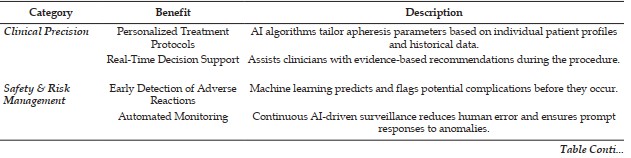
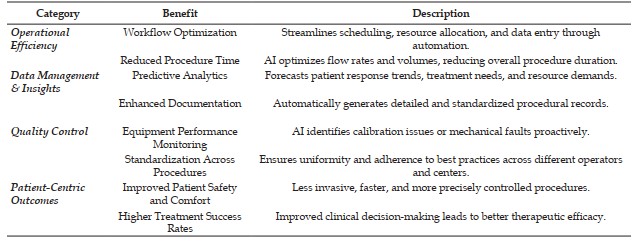
The emergence of AI in medical practice is revolutionizing clinical practices, specifically for the separation of blood components from apheresis. There is growing evidence that AI enhances the accuracy and effectiveness of apheresis through real-time data analytics, predictive modeling and advance decision support systems. Machine learning algorithms use patient-specific characteristics to improve working conditions, personalize treatment routines and predict potential side effects; since they provide the necessary preventative care. Artificial intelligence helps to improve medical service by automatically monitoring and documenting data, which can help relieve the mental burden of clinicians and administrative pressure. Enhanced pattern recognition and anomaly detection helps with quality control and early detection of equipment failures or biological irregularities. In therapeutic apheresis, AI modalities augment evidence-based medicine by combining clinical datasets, laboratory results, procedural measures, and patient outcomes. This combination raises evidence-based recommendations to help guide treatment decisions and improve patient outcomes. Despite these accomplishments, many challenges persist such as data privacy concerns, interfacing with legacy systems, and the need for tight regulatory oversight. However, gradual convergence of AI and apheresis has significant potential to improve patient care, organization productivity, and therapeutics effectiveness. Expected developments will further extend AI’s role in diagnostics, prediction, and apheresis process automation and remote monitoring. In this talk we emphasize the potential of AI for advancing safety, personalization, and efficiency in state-ofthe-art apheresis.
References
- 1. Singh, A. P., Saxena, R., Saxena, S., & Maurya, N. K. (2024). Artificial intelligence revolution in healthcare: Transforming diagnosis, treatment, and patient care. Asian Journal of Advances in Research, 7(1), 241-263.
- 2. Muthu Kumaran, E., Velmurugan, K., Venkumar, P., Amutha Guka, D., & Divya, V. (2022, February). Artificial intelligenceenabled IoT-based smart blood banking system. In Proceedings of 2nd International Conference on Artificial Intelligence: Advances and Applications: ICAIAA 2021 (pp. 119-130). Singapore: Springer Nature Singapore.
- 3. Altayar, M. A., Alqaraleh, M., Alzboon, M. S., & Almagharbeh, W. T. (2025). Revolutionizing Blood Banks: AI-Driven Fingerprint-Blood Group Correlation for Enhanced Safety. arXiv preprint arXiv:2506.01069.
- 4. Huatuco, C. C., Zhang, C., Patel, J., Moniruzzaman, M., & Sultana, A. (2024, July). Cloud-Enabled Blood Bank Management for an Efficient Healthcare System. In 2024 IEEE/ACIS 27th International Conference on Software Engineering, Artificial Intelligence, Networking and Parallel/Distributed Computing (SNPD) (pp. 257-262). IEEE. Ajit Pal Singh, Rahul Saxena Suyash Saxena. Revolutionizing Apheresis: The Transformative Impact of Artificial Intelligence on Precision, Safety, and Clinical Outcomes
- 5. Singh, A. P., Saxena, R., & Saxena, S. (2025). Revolutionizing Blood Bank Management: Leveraging Machine Learning for Inventory Optimization and Shortage Prediction. April. Asian Journal of Current Research, 10(2), 61-84.
- 6. Markavathi, J. N. P., Pandiarajan, R., Gurumoorthy, S., Madhankumar, M., Sharmi, V., & Priyadharshika, J. (2025, April). Blood Bank Management System: Enhancing Security and Transparency in Blood Donation. In 2024 International Conference on IT Innovation and Knowledge Discovery (ITIKD) (pp. 1-6). IEEE.
- 7. Sharma, C., Shah, V., Singh, V., Tank, K., Gupta, S., & Hakim, A. (2024, August). BloodBond: Optimising Blood Bank System through a Comprehensive Smart Management System. In 2024 8th International Conference on Computing, Communication, Control and Automation (ICCUBEA) (pp. 1-6). IEEE.
- 8. Singh, A. P., Pandey, R., Saxena, R., & Saxena, S. (2025). Leveraging Artificial Intelligence for Enhanced Platelet Management in Dengue Fever. Asian Journal of Current Research, 10(3), 93-107.
- 9. Obeagu, E. I., & Alsadi, R. A. (2025). Blood Banking Systems in Africa: Challenges, Innovations, and Recommendations for Strengthening Blood Banking Systems in Africa–A Narrative Review. Universal Journal of Pharmaceutical Research.
- 10. Azman, N., Subramaniam, S. K., & Esro, M. (2023). Investigation and development of a data acquisition system for blood Bank. International Journal of Artificial Intelligence, 10(1), 21-38.
- 11. Zulkifli, N. S. I., & Hamid, R. S. (2023). Blood bank management system.
- 12. Govender, P., & Ezugwu, A. E. (2022). Boosting symbiotic organism search algorithm with ecosystem service for dynamic blood allocation in blood banking system. Journal of Experimental & Theoretical Artificial Intelligence, 34(2), 261-293.
- 13. Gahane, S., Kombe, S., Bhoyar, G., Anawade, P., & Sharma, D. (2024, August). Enhancing Healthcare Ecosystem: Cloud-Based Blood Bank System for Efficient Communication and Collaboration Between Blood Banks and Donors. In International Conference on ICT for Sustainable Development (pp. 135-144). Singapore: Springer Nature Singapore.
- 14. Devi, R. A., Rajanarayanan, S., Sekaran, S. C., Sivaraman, A., & Srinivasan, S. (2025, February). Optimizing Blood Bank Management with Cloud-Hosted Long Short-Term Memory Models for Inventory Forecasting and Utilization. In 2025 International Conference on Electronics and Renewable Systems (ICEARS) (pp. 1041-1046). IEEE.
- 15. Khan, S. A., Shams, S., Alam, P., Yakubu, H., & Warsi, A. H. (2025). IoT Based E-Blood Bank System for Real Time Hospital Monitoring and Inventory Management.
- 16. Arora, S., Batni, K., Dua, S., & Pokhrel, A. (2025). Role of instant messaging applications in Indian blood banking. Vox Sanguinis.
- 17. Ben Elmir, W., Hemmak, A., & Senouci, B. (2023). Smart Platform for Data Blood Bank Management: Forecasting Demand in Blood Supply Chain Using Machine Learning”, Information January 2023, 14 (1): 1-31.
- 18. Talukdar, B., & Bhattacharya, P. (2025). Novel aspects in blood transfusion–From donor to patient. Journal of Hematology and Allied Sciences, 5(1), 18-25.
- 19. Al-Riyami, A. Z., Gammon, R. R., Seheult, J., Arora, S., & Goel, R. (2025). Artificial intelligence and transfusion education, research and practice: The view from the ISBT Clinical Transfusion Working Party. Vox Sanguinis.
- 20. Muthu Kumaran, E., Velmurugan, K., Venkumar, P., Amutha Guka, D., & Divya, V. (2022, February). Artificial intelligenceenabled IoT-based smart blood banking system. In Proceedings of 2nd International Conference on Artificial Intelligence: Advances and Applications: ICAIAA 2021 (pp. 119-130). Singapore: Springer Nature Singapore.
Data Sharing Statement
There are no additional data available. All raw data and code are available upon request.
Funding
This research received no funding.
Author Contributions
All authors contributed significantly to the work and approve its publication.
Ethics Declaration
This article does not involve any human or animal subjects, and therefore does not require ethics approval.
Acknowledgements
We would like to express our gratitude to the patients, their families, and all those who have contributed to this study.
Conflicts of Interest
No conflicts of interest in this work.
About this article

Cite this article
Ajit Pal Singh, Rahul Saxena, Suyash Saxena. Revolutionizing Apheresis: The Transformative Impact of Artificial Intelligence on Precision, Safety, and Clinical Outcomes. Ind Jr of Path: Res and Practice 2025; 14(3) 107-114.
Licence:
Attribution-Non-commercial 4.0 International (CC BY-NC 4.0)This license enables reusers to distribute, remix, adapt, and build upon the material in any medium or format for noncommercial purposes only, and only so long as attribution is given to the creator.
| Received | Accepted | Published |
|---|---|---|
| August 12, 2025 | October 06, 2025 | December 25, 2025 |
DOI: https://doi.org/10.21088/ijprp.2278.148X.14325.2
Keywords
ApheresisArtificial IntelligenceTreatmentAccuracyDiagnosticsSearch for Similar Articles
Similar Articles
- Clinico-Pathological and Immunohistochemical Study of Primary CNS Tumors in a Te...
- The Role of SGLT2 Inhibitors in Cardiovascular Protection Beyond Diabetes: A Co...
- Epidermal Inclusion Cyst Presenting as 4th Ventricle Space Occupying Lesion: A R...
- Silent Retroperitoneal Seminoma Arising from an Occult Undescended Testis: Diagn...
- Scapular Metastasis of Oral Squamous Cell Carcinoma: A Case Report of an Unusual...
Article Level Metrics
Last UpdatedTuesday 22 September 2026, 04:25:51 (IST)
3671
Accesses
17
541
00
Citations
NA
NA
NA
Download citation
Article Keywords
Keyword Highlighting
Highlight selected keywords in the article text.
Timeline
| Received | August 12, 2025 |
| Accepted | October 06, 2025 |
| Published | December 25, 2025 |
licence
Attribution-Non-commercial 4.0 International (CC BY-NC 4.0)
This license enables reusers to distribute, remix, adapt, and build upon the material in any medium or format for noncommercial purposes only, and only so long as attribution is given to the creator.