Full Text (PDF)
Indian Journal of Forensic Medicine and Pathology 19(3):p 346-351, July -Sept. 2026. | DOI: https://doi.org/10.21088/ijfmp.0974.3383.19326.9
Original Article
Forensic Evaluation of Sharp Weapons Fatalities: An Autopsy Based Study
Mrityunjay Singh, Jeet Karan Patidar, Lalchand Verma, Deepak Sharma, Vinod Kumar Garg
Author Information
Licence:
Attribution-Non-commercial 4.0 International (CC BY-NC 4.0)This license enables reusers to distribute, remix, adapt, and build upon the material in any medium or format for noncommercial purposes only, and only so long as attribution is given to the creator.
Indian Journal of Forensic Medicine and Pathology 19(3):p 346-351, July -Sept. 2026. | DOI: https://doi.org/10.21088/ijfmp.0974.3383.19326.9
How Cite This Article:
Jeet Karan Patidar, Lalchand Verma, Mrityunjay Singh, et al. Forensic Evaluation of Sharp Weapons Fatalities: An Autopsy Based Study. Indian J Forensic Med Pathol. 2026; 19(3): 346-351.Timeline
Received : May 18, 2026
Accepted : July 20, 2026
Published : September 30, 2026
Abstract
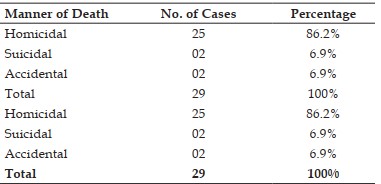
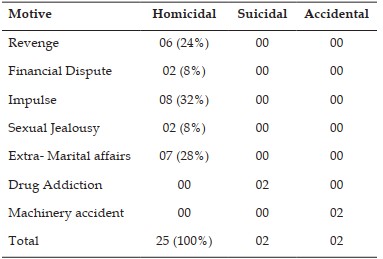
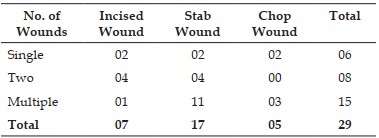
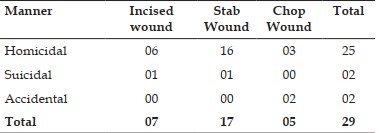
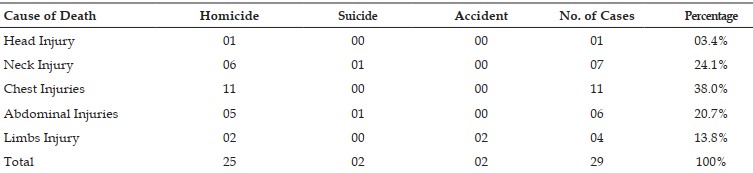
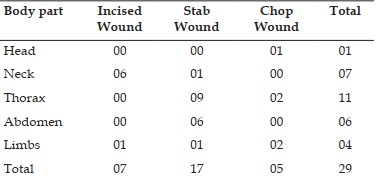
Sharp weapon is defined as any instrument designed or adapted for use to cause injury through a cutting edge. Fatalities due sharp weapons injuries are mostly seen in homicides followed by suicides and rarely in accidents. The injuries by sharp weapon suggest a high degree of intention and overkill, which is often associated with strong emotional triggers such as anger, jealousy, or revenge. In India where sharp instruments are commonly used in daily life, their involvement in violent crime warrants focused research attention. The study was conducted with the basic aim to analyze the deaths due to injuries by sharp weapons. Deaths involving sharp weapon injuries, the vast majority were as homicidal, accounting for 86.2% deaths. More than one-quarter of homicides were attributed to injuries sustained from sharp-edge weapons. Impulse or Momentary rage was the commonest motive behind homicide, suicides were linked to drug addiction and accidental deaths were attributed to machinery accidents. Multiple stab wounds were the most frequent wounds, and chest injuries constituted the most common cause of death. Prevention of fatalities from sharp weapons injuries requires a multidimensional strategy, integrating the rigorous enforcement of sale and possession regulation and implementing youth-focused counseling programs.
References
- 1. Jat VK, Punia RK. Socio-demographic Profile of Fatal and Non-Fatal Cases of Sharp Weapon trauma at S.M.S. Medical College & Hospital, Jaipur During the year 2015-16. Medico-Legal Update. January 2018; 18(1): 215-129.
- 2. New Criminal Major Acts- Bharatiya Nyaya Sahita, 2023. New Delhi: Sunil Law Agency; 2024.
- 3. Disania NL, Verma RK, Punia RK. Pattern and Profile of Injuries Sustained During Assault by Sharp Weapon: A Prospective Study During Year 2015-2016 at SMS Medical CollegeJaipur. Indian Journal of Forensic Medicine & Toxicology. July- September 2020; 14(3):83-87.
- 4. Yousfani GM, Memon MU. Spectrum of Unnatural Deaths in Hyderabad: An Autopsy Based Study. Journal of Dow University of Health Sciences, Karachi. 2010; 4(2): 54-57.
- 5. Handles P, Svecova T, Vrtkova A, Handlosova K, Dokoupil M, Klabal O, Timkovic J, Uvira M. Review of patters in homicides by sharp force: one institution’s experience. Forensic Science Medicine and Pathology. February 2023; 19(4): 525-533.
- 6. Kumari J. Profile of sharp weapon trauma cases in Jharkhand, India: An autopsy-based report. Journal of Family Medicine and Prime care. January 2023; 12(6): 1133-1136.
- 7. Jagannath SR, Naveen Kumar T, karibasavaiah A. Study of homicidal deaths in south Bangalore. Journal of South India Medico-legal Association. September 2011; 3(2): 53-55.
- 8. Mittal S, Garg S, Mittal MS, Chanana A, Rai H. Homicide by Sharp Weapons. Journal of Indian Academy of Forensic Medicine. April – June 2007; 29(2): 61-63.
- 9. Reddy KSN, Murty OP. The Essential of Forensic Medicine & Toxicology. 35th edition. New Delhi: Jaypee Brothers Medical publisher; 2022.
- 10. Prahlow JA, Ross KF, Lene WJ, Kirby DB. Accidental sharp force injury fatalities. The American Journal of Forensic Medicine and Pathology. December 2001; 22(4): 358-366.
- 11. Dudhe JY, Gedam MS, Mukherjee AA. A Two Year Sharp Force Fatalities Study at A Tertiary Care Centre of Central India. International Journal of Scientific Research. May 2023; 12(5): 1-3.
- 12. Shah JP, Vora DH, Mangal HM, Chauhan VN, Doshi SM, Chotaliya DB. Profile of Homicidal Deaths in and around Rajkot Region, Gujrat. Journal of Indian Academy of Forensic Medicine. January-March 2013; 35(1): 33-36.
- 13. Zanzrukiya K, Tailor C, Chandegara P, Govekar G, Patel U, Parkhe S. Profile of homicide death cases at government Medical College and New Civil Hospital, Surat. International Journal of Medical Sciences and Public Health. January 2014; 3(7): 885-888.
- 14. Rathod VV, Choudhary UK, Ghormade PS, Keoliya AN. Study of Socio-demographic profile of victims in cases of deaths due to homicide. Indian Journal of Forensic and Community Medicine. June 2020; 7(2): 66-71.
- 15. Ambade VN, Godbole HV. Comparison of wound patterns in homicide by sharp and blunt force. Forensic Science International. January 2006; 156(2): 166-170.
- 16. Basher MZ, Saeed A, Khan D, Aslam M, Iqbal J, Ahmad M. Pattern of homicidal deaths in Faisalabad. Journal of Ayub Medical College, Abbottabad. 2004; 9(1):57-59.
- 17. Qadir G, Aziz K. The study of homicidal deaths in Larkana. Pak Postgraduate Medical Journal. 2000; 11(2): 79-80.
- 18. Mirza FH, Hasan Q, Memon AA, Adil SER. An Audit of Sharp Weapon Deaths in Metropolis of Karachi – An Autopsy Based Study. Journal of Ayub Medical College Abbottabad. 2010; 22(4): 176-178.
- 19. Kaheri GQ, Hussain Z, Saeed A, Balouch ZA, Memon A, Khalil AR. Sharp Injury fatalities in pashawar. Medical Channel. 2003;9(4):41-44.
- 20. Sukhdev RB, Sonawane SS, Tyagi S. An Analysis of Trends of Homicidal Deaths in Western Mumbai Region. Medico-legal Update. July- September 2020; 20(3): 168-172.
- 21. Sumangala CN, Raksha L, Venkata RS. Pattern of homicidal autopsied at Victoria Hospital, Bangalor-A one-year study. Journal of Indian Academy of Forensic Medicine. JulySeptember 2019; 41(3):163-166.
- 22. Mohanty S, Mohanty SK, Patnaik KK. Homicide in Southern India-A five year retrospective study. Journal of Forensic Medicine and anatomy Research. April 2013; 1(2):18-24.
- 23. Kemal CJ, Patterson T, Molina DK. Death due to Sharp Force Injuries in Bexar Country, Texas, with Respect to Manner of Death. American Journal of Forensic Medicine and Pathology. April 2013; 34(3):
- 24. Vij A, Menon A Menezes RG, kanchan T, Rastogi P. A retrospective review of homicide in Mangalore, South India. Journal of forensic and legal Medicine. August 2010; 17(6):312- 315.
- 25. Manso NL, Ribeiro IP. Sharp force fatalities: Differentiating homicide from suicide through a retrospective review (2012-2019) of autopsy findings in Lisbon. Forensic Science International. October 2021; 327.
Data Sharing Statement
There are no additional data available. All raw data and code are available upon request.
Funding
This research received no funding.
Author Contributions
All authors contributed significantly to the work and approve its publication.
Ethics Declaration
This article does not involve any human or animal subjects, and therefore does not require ethics approval.
Acknowledgements
We would like to express our gratitude to the patients, their families, and all those who have contributed to this study.
Conflicts of Interest
No conflicts of interest in this work.
About this article

Cite this article
Jeet Karan Patidar, Lalchand Verma, Mrityunjay Singh, et al. Forensic Evaluation of Sharp Weapons Fatalities: An Autopsy Based Study. Indian J Forensic Med Pathol. 2026; 19(3): 346-351.
Licence:
Attribution-Non-commercial 4.0 International (CC BY-NC 4.0)This license enables reusers to distribute, remix, adapt, and build upon the material in any medium or format for noncommercial purposes only, and only so long as attribution is given to the creator.
| Received | Accepted | Published |
|---|---|---|
| May 18, 2026 | July 20, 2026 | September 30, 2026 |
DOI: https://doi.org/10.21088/ijfmp.0974.3383.19326.9
Keywords
Sharp Weapon InjuriesHomicidal DeathsImpulsive ActSearch for Similar Articles
Similar Articles
- Diatom Analysis in Thermophilic water bodies: A Study on Hot Water Springs of Ma...
- Morphometric Study of Supra-meatal Triangle and Mastoid process in the Adult dry...
- Histopathological Spectrum of Autopsy Cases: A One Year Retrospective Observatio...
- Forensic Differentiation of Manner of Death in Railway Fatalities: A FourCase Se...
- Understanding assault Patterns: A Cross-sectional study of Cases at Chri, Kelamb...
Article Level Metrics
Last UpdatedSaturday 17 October 2026, 04:14:21 (IST)
16160
Accesses
33
3204
00
Citations
NA
NA
NA
Download citation
Article Keywords
Keyword Highlighting
Highlight selected keywords in the article text.
Timeline
| Received | May 18, 2026 |
| Accepted | July 20, 2026 |
| Published | September 30, 2026 |
licence
Attribution-Non-commercial 4.0 International (CC BY-NC 4.0)
This license enables reusers to distribute, remix, adapt, and build upon the material in any medium or format for noncommercial purposes only, and only so long as attribution is given to the creator.