Full Text (PDF)
Indian Journal of Forensic Medicine and Pathology 19(3):p 352-360, July -Sept. 2026. | DOI: https://doi.org/10.21088/ijfmp.0974.3383.19326.10
Original Article
Utility of the IAC Yokohama System for Reporting Breast Fine Needle Aspiration Cytology: A Cytohistological Correlation Study
Asha Mahadevappa, Kushala Puttapaga, Archana M
Author Information
Licence:
Attribution-Non-commercial 4.0 International (CC BY-NC 4.0)This license enables reusers to distribute, remix, adapt, and build upon the material in any medium or format for noncommercial purposes only, and only so long as attribution is given to the creator.
Indian Journal of Forensic Medicine and Pathology 19(3):p 352-360, July -Sept. 2026. | DOI: https://doi.org/10.21088/ijfmp.0974.3383.19326.10
How Cite This Article:
Kushala Puttapaga, Asha Mahadevappa, Archana M. Utility of the IAC Yokohama System for Reporting Breast Fine Needle Aspiration Cytology: A Cytohistological Correlation Study. Indian J Forensic Med Pathol. 2026; 19(3): 352-360.Timeline
Received : March 18, 2026
Accepted : June 27, 2026
Published : September 30, 2026
Abstract
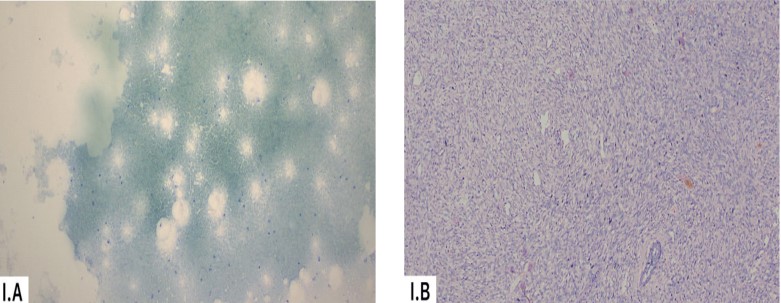
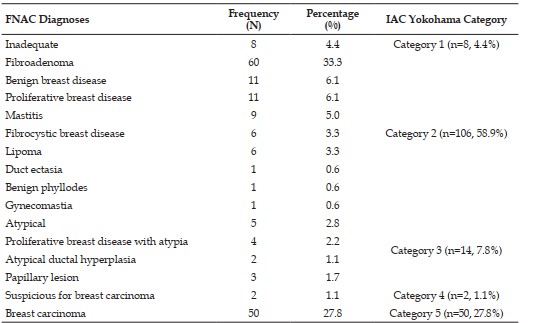
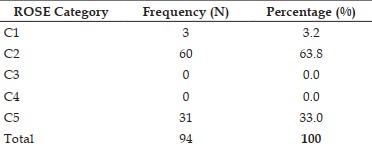
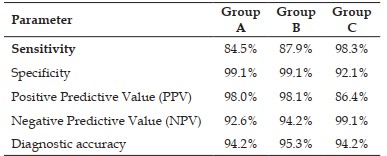
Background: Breast lumps require prompt and reliable assessment because malignant lesions may be clinically indistinguishable from benign conditions at presentation. Fine-needle aspiration cytology (FNAC) remains a practical first-line investigation in many hospitals because it is quick, inexpensive and minimally invasive. The International Academy of Cytology (IAC) Yokohama reporting system groups breast FNAC findings into five diagnostic categories linked to an estimated risk of malignancy (ROM). Rapid on-site evaluation (ROSE) can additionally confirm whether aspirated material is adequate before the patient leaves the procedure area. Objective: To determine the diagnostic performance of the IAC Yokohama system for breast FNAC at three cytological positivity thresholds. Additional objectives were to describe the distribution of cases within the five Yokohama categories, estimate the ROM for each category and examine the usefulness of ROSE in prospective samples. Methods: This cross-sectional analytical study was undertaken in the Department of Pathology, JSS Medical College, Mysore, over 42 months. A total of 180 patients with palpable breast lumps and available cytological and histopathological diagnoses were studied. The dataset included 86 retrospective cases and 94 prospective cases. In the prospective arm, FNAC was performed using aseptic precautions and smear adequacy was checked on site with toluidine blue staining. Each cytology specimen was assigned to category C1, C2, C3, C4 or C5 according to the IAC Yokohama system. Histopathology was treated as the reference standard. Diagnostic indices were calculated for three positive-test definitions: C5 alone; C4 plus C5; and C3 plus C4 plus C5. Results: Of the 180 aspirates, 8 (4.4%) were categorized as C1, 106 (58.9%) as C2, 14 (7.8%) as C3, 2 (1.1%) as C4 and 50 (27.8%) as C5. The category-wise ROM was 25% for C1, 0.94% for C2, 35.7% for C3, 100% for C4 and 98% for C5. The most inclusive threshold (C3-C5 positive) yielded the greatest sensitivity (98.3%), whereas the C5- only and C4-C5 thresholds both showed a specificity of 99.1%. The best overall diagnostic accuracy was obtained when C4 and C5 were regarded as positive (95.3%). Among cases assessed with ROSE, inadequate smears accounted for 3.2%. Conclusion: Classification of breast FNAC using the IAC Yokohama system produced clinically meaningful ROM estimates and showed strong agreement with histopathology, especially for benign and malignant categories. A positivity threshold that included suspicious and malignant aspirates provided the most balanced diagnostic performance. ROSE was associated with a low proportion of inadequate samples in the prospective component and may improve the efficiency of FNAC-based evaluation.
References
- 1. Mehrotra R, Yadav K. Breast cancer in India: present scenario and the challenges ahead. World J Clin Oncol. 2022;13(3):209-218.
- 2. Agrawal N, Kothari K, Tummidi S, Sood P, Agnihotri M, Shah V. Fine-needle aspiration biopsy cytopathology of breast lesions using the International Academy of Cytology Yokohama System and rapid on-site evaluation: a singleinstitute experience. Acta Cytol. 2021;65(6): 463-477.
- 3. Swain M, Nedunuri S. Utility of Yokohama system for classification of breast FNA. Indian J Pathol Oncol. 2024;11(1):20-26.
- 4. Kamatar PV, Athanikar VS, Dinesh US. Breast fine needle aspiration biopsy cytology reporting using International Academy of Cytology Yokohama System: two-year retrospective study in a tertiary care centre in Southern India. Natl J Lab Med. 2019;8(3):1-3.
- 5. Field AS, Schmitt F, Vielh P. IAC standardized reporting of breast fine-needle aspiration biopsy cytology. Acta Cytol. 2017;61(1):3-6.
- 6. Mathur P, Sathishkumar K, Chaturvedi M, Das P, Sudarshan KL, Santhappan S, et al. Cancer statistics, 2020: report from National Cancer Registry Programme, India. JCO Glob Oncol. 2020;6:1063-1075.
- 7. Wong S, Rickard M, Earls P, Arnold L, Bako B, Field AS, et al. The International Academy of Cytology Yokohama System for reporting breast fine needle aspiration biopsy cytopathology: a single institutional retrospective study of the application of the system categories and the impact of rapid onsite evaluation. Acta Cytol. 2019;63(4): 280-291.
- 8. Joshi C, Varma R, Pande ST. A comparative study of breast lesions using the IAC Yokohama System for reporting breast cytopathology against histopathological biopsy. MGM J Med Sci. 2024;11:186-194.
- 9. Field AS, Raymond WA, Rickard M, Schmitt F. Breast fine needle aspiration biopsy cytology: the potential impact of the International Academy of Cytology Yokohama System for Reporting Breast Fine Needle Aspiration Biopsy Cytopathology and the use of rapid on-site evaluation. J Am Soc Cytopathol. 2020;9(2):103-111.
- 10. Yadav R, Singh N, Bakna M, Srivastava A, Agarwal N, Srivastava R, et al. Cytomorphological spectrum of breast fine needle aspiration cytology using the International Academy of Cytology Yokohama System and evaluation of associated risk of malignancy: a retrospective study in a tertiary care center. Surg Exp Pathol. 2024;7(1):6.
- 11. Munjal P, Singh M, Bhatt VR, Gautam R, Ankita, Singh G, et al. The impact of International Academy of Cytology Yokohama System in breast fine-needle aspiration biopsy cytology and its correlation with BI-RADS: a six-year single-institutional experience. J Cytol. 2025;42:88-94.
- 12. Agarwal A, Singh D, Mehan A, Paul P, Puri N, Gupta P, et al. Accuracy of the International Academy of Cytology Yokohama System of breast cytology reporting for fine needle aspiration biopsy of the breast in a dedicated breast care setting. Diagn Cytopathol. 2021;49(2):195-202.
- 13. Ahuja S, Malviya A. Categorization of breast fine needle aspirates using the International Academy of Cytology Yokohama System along with assessment of risk of malignancy and diagnostic accuracy in a tertiary care centre. J Cytol. 2021;38:158-163.
- 14. Rohilla V, Kundu P, Gathwal M, Malik P, Gathwal C, Hooda S. Categorization of breast fine needle aspirates using Yokohama classification and its correlation with histopathological findings. Eur J Breast Health. 2025;21(3):237-245.
- 15. Montezuma D, Malheiros D, Schmitt FC. Breast fine needle aspiration biopsy cytology using the newly proposed IAC Yokohama System for Reporting Breast Cytopathology: the experience of a single institution. Acta Cytol. 2019;63:274-279.
Data Sharing Statement
There are no additional data available. All raw data and code are available upon request.
Funding
This research received no funding.
Author Contributions
All authors contributed significantly to the work and approve its publication.
Ethics Declaration
This article does not involve any human or animal subjects, and therefore does not require ethics approval.
Acknowledgements
We would like to express our gratitude to the patients, their families, and all those who have contributed to this study.
Conflicts of Interest
No conflicts of interest in this work.
About this article

Cite this article
Kushala Puttapaga, Asha Mahadevappa, Archana M. Utility of the IAC Yokohama System for Reporting Breast Fine Needle Aspiration Cytology: A Cytohistological Correlation Study. Indian J Forensic Med Pathol. 2026; 19(3): 352-360.
Licence:
Attribution-Non-commercial 4.0 International (CC BY-NC 4.0)This license enables reusers to distribute, remix, adapt, and build upon the material in any medium or format for noncommercial purposes only, and only so long as attribution is given to the creator.
| Received | Accepted | Published |
|---|---|---|
| March 18, 2026 | June 27, 2026 | September 30, 2026 |
DOI: https://doi.org/10.21088/ijfmp.0974.3383.19326.10
Keywords
Breast lumpFine-needle aspiration cytologyIAC Yokohama systemRisk of malignancyRapid on-site evaluationHistopathologySearch for Similar Articles
Similar Articles
- Diatom Analysis in Thermophilic water bodies: A Study on Hot Water Springs of Ma...
- Morphometric Study of Supra-meatal Triangle and Mastoid process in the Adult dry...
- Histopathological Spectrum of Autopsy Cases: A One Year Retrospective Observatio...
- Forensic Differentiation of Manner of Death in Railway Fatalities: A FourCase Se...
- Understanding assault Patterns: A Cross-sectional study of Cases at Chri, Kelamb...
Article Level Metrics
Last UpdatedSaturday 17 October 2026, 03:30:10 (IST)
16159
Accesses
30
3204
00
Citations
NA
NA
NA
Download citation
Article Keywords
Keyword Highlighting
Highlight selected keywords in the article text.
Timeline
| Received | March 18, 2026 |
| Accepted | June 27, 2026 |
| Published | September 30, 2026 |
licence
Attribution-Non-commercial 4.0 International (CC BY-NC 4.0)
This license enables reusers to distribute, remix, adapt, and build upon the material in any medium or format for noncommercial purposes only, and only so long as attribution is given to the creator.