Full Text (PDF)
Indian Journal of Forensic Medicine and Pathology 19(3):p 328-334, July -Sept. 2026. | DOI: https://doi.org/10.21088/ijfmp.0974.3383.19326.7
Original Article
Age-Related Histopathological Changes in the Prostate: An Autopsy Study
Author Information
Licence:
Attribution-Non-commercial 4.0 International (CC BY-NC 4.0)This license enables reusers to distribute, remix, adapt, and build upon the material in any medium or format for noncommercial purposes only, and only so long as attribution is given to the creator.
Indian Journal of Forensic Medicine and Pathology 19(3):p 328-334, July -Sept. 2026. | DOI: https://doi.org/10.21088/ijfmp.0974.3383.19326.7
How Cite This Article:
Amit Singla, Ravdeep Singh. Age-Related Histopathological Changes in the Prostate: An Autopsy Study. Indian J Forensic Med Pathol. 2026; 19(3): 328-334.Timeline
Received : April 03, 2026
Accepted : June 08, 2026
Published : September 30, 2026
Abstract
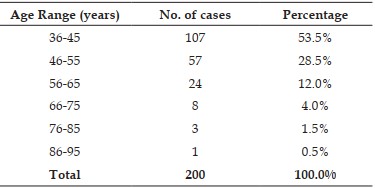
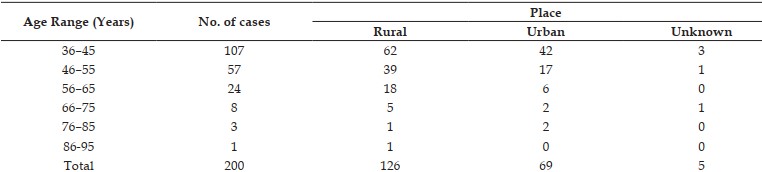
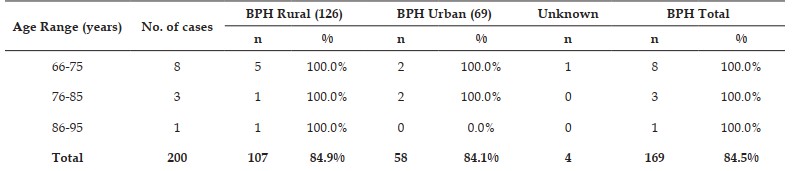
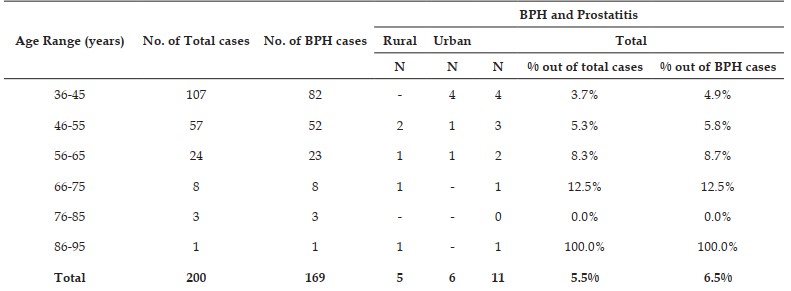
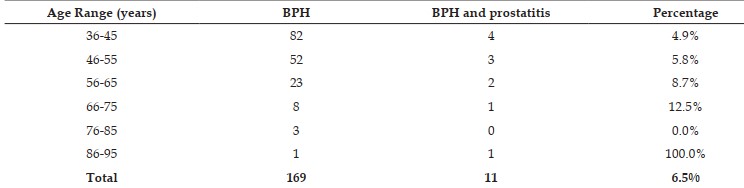
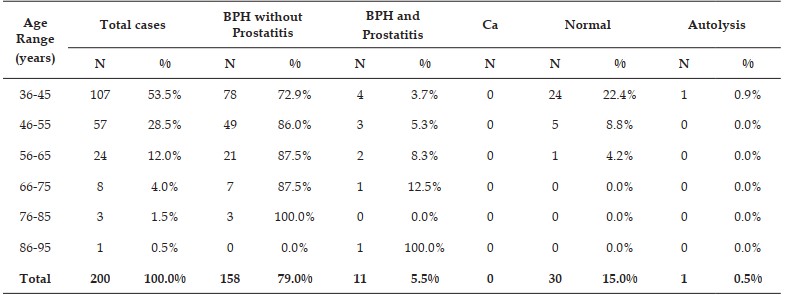
Background: The prostate gland is a vital male reproductive organ, and its diseases, particularly benign prostatic hyperplasia (BPH), prostatitis, and carcinoma, are common with advancing age. Autopsy-based studies provide valuable insights into latent and subclinical prostatic pathology. Aim: To evaluate histopathological changes in the prostate with respect to age and to determine the prevalence of BPH, prostatitis, and carcinoma in autopsy cases. Materials and Methods: This prospective study was conducted on 200 male autopsy cases above 35 years of age at Government Medical College & Rajindra Hospital, Patiala. Prostate specimens were retrieved, examined grossly, and subjected to histopathological analysis. Data were analyzed with respect to age, residence, and associated lesions. Results: The majority of cases were in the 36–45 years age group (53.5%). BPH was the most common lesion, observed in 84.5% of cases, with increasing prevalence with age. BPH with prostatitis was found in 5.5% of cases. No cases of carcinoma were detected. No significant rural–urban difference was observed. Conclusion: BPH is highly prevalent in males above 35 years and increases with age. Prostatitis is less common and often associated with BPH. Autopsy studies are valuable in detecting subclinical prostatic changes.
References
- 1. Billis A. Prostatic atrophy: An autopsy study of a histologic mimic of adenocarcinoma. Mod Pathol. 1998; 11(1): 47–54.
- 2. Anunobi C.C., Akinde O.R., Elesha S.O., Daramola A.O., Tijani K.H., Ojewola R.W. Prostate diseases in Lagos, Nigeria: A histologic study with tPSA correlation. Niger Postgrad Med J. 2011; 18(2): 98–104.
- 3. Billis A. Latent carcinoma and atypical lesions of prostate: An autopsy study. Urology. 1986; 28(4): 324–329. DOI: 10.1016/0090- 4295(86)90319-0.
- 4. National Cancer Registry Programme. Consolidated report of population-based cancer registries 2001–2004. Bangalore: ICMR; 2006.
- 5. Hameed S., Malik A., Bilal S., Dogar S., Aslam S. Pattern of prostatic disease: A histopathological survey. Prof Med J. 2010; 17(4): 573–577.
- 6. Andriole G. Benign Prostatic Hyperplasia (BPH). Merck Manual Professional Edition.
- 7. Verhamme K.M.C., Dieleman J.P., Bleumink G.S., et al. Incidence and prevalence of LUTS suggestive of BPH in primary care. Eur Urol. 2002; 42(4): 323–328. DOI: 10.1016/S0302- 2838(02)00354-8.
- 8. Zlotta A.R., Egawa S., Pushkar D., et al. Prevalence of inflammation and BPH on autopsy. Eur Urol. 2014; 66(4): 619–622. DOI: 10.1016/j.eururo.2013.12.026
- 9. De Nunzio C., Kramer G., Marberger M., et al. Relationship between BPH and prostate cancer. Eur Urol. 2011; 60(1): 106–117. DOI: 10.1016/j.eururo.2011.03.055.
- 10. Soler R., Andersson K.E., Chancellor M.B., et al. Pharmacotherapy for LUTS. Eur Urol. 2013; 64(4): 610–621. DOI: 10.1016/j. eururo.2013.05.029.
- 11. Nickel J.C., Roehrborn C.G., O’Leary M.P., et al. Prostate inflammation and LUTS. Eur Urol. 2008; 54(6): 1379–1384. DOI: 10.1016/j. eururo.2008.08.011.
- 12. Wang W., Guo Y., Zhang D., et al. Prevalence of BPH in mainland China. Sci Rep. 2015; 5: 13546. DOI: 10.1038/srep13546.
- 13. Goh H.J., Kim S.A., Nam J.W., et al. B.P.H. prevalence in Korean rural area. Korean J Urol. 2015; 56(1): 68–75. DOI: 10.4111/ kju.2015.56.1.68.
- 14. Shan G., Deng F., Wang X., Gu F. Urban–rural difference in prostate volume growth. Chin J Urol. 1997; 18: 134–136.
- 15. Wang J. Epidemiological study in urban and rural elderly. Chin J Prev Control. 1999; 7: 267–269.
- 16. Gu F. Changes in BPH prevalence in China. Chin Med J. 1997; 110(3): 163–166. DOI: Not available.
- 17. Parsons J.K. Lifestyle factors and BPH. Curr Opin Urol. 2011; 21(1): 1–4. DOI: 10.1097/ MOU.0b013e32834100c9
- 18. Raheem O.A., Parsons J.K. Obesity, activity, diet and BPH. Curr Opin Urol. 2014; 24(1): 10– 14. DOI: 10.1097/MOU.0000000000000016
- 19. Wang Z., Wu Y., Zhao L., et al. Hypertension trends in China. Hypertens Res. 2004; 27(10): 703–709. DOI: 10.1291/hypres.27.703
- 20. George E., Thomas S. Histopathologic survey of prostate disease in Oman. Internet J Pathol. 2004; 3(2): 1–4.
- 21. Bal M., Goyal A., Singla N. Prostatic lesions in biopsy. JK Pract. 2011; 16(1–2): 33–34.
- 22. Mansoor I. Pattern of prostatic diseases in Saudi Arabia. Int J Pathol. 2003; 2: 2.
- 23. Anjorin A., Adeniji K., Ogunsulire I. Histopathological study in Nigeria. Cent Afr J Med. 1998; 44(3): 72–75.
- 24. Ukoli F., Egbagbe E., Zhao B., et al. PSA predictors in Nigerians. West Afr J Med. 2007; 26(1): 7–13.
- 25. Huh J., Kim Y., Kim S. BPH prevalence in Korea. World J Mens Health. 2012; 30(2): 131– 137. DOI: 10.5534/wjmh.2012.30.2.131
- 26. Kumar V., Abbas A.K., Aster J.C. Robbins & Cotran Pathologic Basis of Disease. 9th ed. Saunders; 2014.
- 27. Steers W.D., Zorn B. Benign prostatic hyperplasia. Dis Mon. 1995; 41(7): 437–497. DOI: 10.1016/S0011-5029(05)80009-0.
- 28. Simpson R.J. Benign prostatic hyperplasia. Br J Gen Pract. 1997; 47(417): 235–240.
- 29. Anim J.T., Ebrahim B.H., Sathar S.A. Benign disorders of prostate. Ann Saudi Med. 1998; 18(1): 22–27.
- 30. Burdak P., Joshi N., Nag B., et al. Prostate biopsies study. Int J Sci Res. 2015; 4(6): 420–423.
- 31. Nickel J. JALYN for Benign Prostatic Hyperplasia (BPH) and Chronic Prostatitis/ Chronic Pelvic Pain Syndrome (CP/CPPS) [Internet]. Los Angeles: The Cleveland Clinic, University of California; 2014 Oct. Report No.: NCT01830829. Available from: https:// clinicaltrials.gov/ct2/show/NCT01830829.
- 32. Nickel J.C., Elhilali M., Vallancien G. BPH and prostatitis symptoms. BJU Int. 2005; 95(4): 571– 574. DOI: 10.1111/j.1464-410X.2005.05376.x.
- 33. Edlin R.S., Heyns C.F., Van Vuuren S.P.J., et al. Histological prostatitis prevalence. S Afr J Surg . 2012; 50(4). DOI: 10.7196/SAJS.1448.
- 34. Delongchamps N.B., de la Roza G., Chandan V., et al. Prostatitis in autopsied prostates. J Urol. 2008; 179(5): 1736–1740. DOI: 10.1016/j. juro.2008.01.014.
Data Sharing Statement
There are no additional data available. All raw data and code are available upon request.
Funding
This research received no funding.
Author Contributions
All authors contributed significantly to the work and approve its publication.
Ethics Declaration
This article does not involve any human or animal subjects, and therefore does not require ethics approval.
Acknowledgements
We would like to express our gratitude to the patients, their families, and all those who have contributed to this study.
Conflicts of Interest
No conflicts of interest in this work.
About this article

Cite this article
Amit Singla, Ravdeep Singh. Age-Related Histopathological Changes in the Prostate: An Autopsy Study. Indian J Forensic Med Pathol. 2026; 19(3): 328-334.
Licence:
Attribution-Non-commercial 4.0 International (CC BY-NC 4.0)This license enables reusers to distribute, remix, adapt, and build upon the material in any medium or format for noncommercial purposes only, and only so long as attribution is given to the creator.
| Received | Accepted | Published |
|---|---|---|
| April 03, 2026 | June 08, 2026 | September 30, 2026 |
DOI: https://doi.org/10.21088/ijfmp.0974.3383.19326.7
Keywords
Benign prostatic hyperplasiaProstatitisAutopsy studyHistopathologyAge-related changesProstate glandSearch for Similar Articles
Similar Articles
- Diatom Analysis in Thermophilic water bodies: A Study on Hot Water Springs of Ma...
- Morphometric Study of Supra-meatal Triangle and Mastoid process in the Adult dry...
- Histopathological Spectrum of Autopsy Cases: A One Year Retrospective Observatio...
- Forensic Differentiation of Manner of Death in Railway Fatalities: A FourCase Se...
- Understanding assault Patterns: A Cross-sectional study of Cases at Chri, Kelamb...
Article Level Metrics
Last UpdatedSaturday 17 October 2026, 05:02:49 (IST)
16162
Accesses
27
3204
00
Citations
NA
NA
NA
Download citation
Article Keywords
Keyword Highlighting
Highlight selected keywords in the article text.
Timeline
| Received | April 03, 2026 |
| Accepted | June 08, 2026 |
| Published | September 30, 2026 |
licence
Attribution-Non-commercial 4.0 International (CC BY-NC 4.0)
This license enables reusers to distribute, remix, adapt, and build upon the material in any medium or format for noncommercial purposes only, and only so long as attribution is given to the creator.