Full Text (PDF)
Indian Journal of Forensic Medicine and Pathology 19(3):p 322-327, July -Sept. 2026. | DOI: https://doi.org/10.21088/ijfmp.0974.3383.19326.6
Original Article
Assessment of Knowledge and Attitude about POCSO Act among Medical Practitioners and Medical Interns: A Questionnaire-Based Study
Dipayan Deb Barman, Karthikeyan K.
Author Information
Licence:
Attribution-Non-commercial 4.0 International (CC BY-NC 4.0)This license enables reusers to distribute, remix, adapt, and build upon the material in any medium or format for noncommercial purposes only, and only so long as attribution is given to the creator.
Indian Journal of Forensic Medicine and Pathology 19(3):p 322-327, July -Sept. 2026. | DOI: https://doi.org/10.21088/ijfmp.0974.3383.19326.6
How Cite This Article:
Karthikeyan K., Dipayan Deb Barman. Assessment of Knowledge and Attitude about POCSO Act among Medical Practitioners and Medical Interns: A Questionnaire-Based Study. Indian J Forensic Med Pathol. 2026; 19(3): 322-327.Timeline
Received : April 01, 2026
Accepted : June 07, 2026
Published : September 30, 2026
Abstract
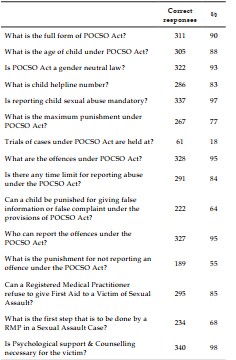
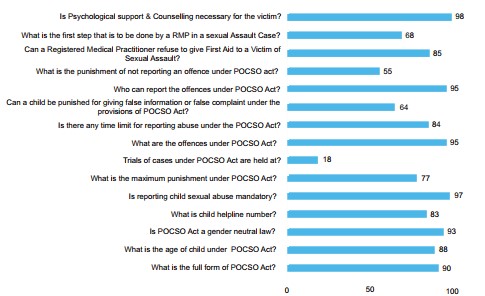
Introduction: A global social concern that is both common and pervasive is child sexual crimes. India has a problem with underreporting child sexual abuse. Over 3 million kids experience maltreatment every year. The POCSO Act 2012 (Recent amendments 2019) addresses all types of child sexual abuse and the fundamentals of treating the child in an organised manner. The knowledge of medical practitioners has been found to be inadequate in several instances when handling such sensitive cases. Aim: To analyse the knowledge gap among medical practitioners about the POCSO Act. Methodology: A 15-question questionnaire-based study was conducted. 346 doctors and interns took part in the research. The questionnaire was focused on their knowledge, comprehension, attitudes, and practices regarding child abuse and the POCSO Act of 2012. Results: Most respondents correctly answered basic questions about the POCSO Act: 90% knew its full form, 93% knew it is gender-neutral, and 97% knew reporting abuse is mandatory. However, knowledge of procedural aspects was limited— only 18% knew where trials are held, and 55% knew the punishment for failing to report. Conclusion: While awareness of general provisions was high, gaps were evident in legal responsibilities and in adherence to protocol among medical professionals. Although the foundational awareness of the POCSO Act among medical interns and practitioners was satisfactory, notable deficiencies in procedural knowledge were observed. This includes poor understanding of trial venues, punishment for non-reporting, and the first steps in handling abuse cases. These gaps highlight the urgent need for curriculum enhancements, targeted training programs, and institutional protocols to better equip healthcare providers.
References
- 1. Singh M.M., Parsekar S.S., Nair S.N. An Epidemiological Overview of Child Sexual Abuse. J Family Med Prim Care. 2014; 3(4): 430- 435. doi:10.4103/2249-4863.148139
- 2. Mathews B., Finkelhor D., Pacella R., et al. Child sexual abuse by different classes and types of perpetrator: Prevalence and trends from an Australian national survey. Child Abuse Negl. 2024; 147: 106562. doi:10.1016/j. chiabu.2023.106562
- 3. Chacko A.Z., Paul J.S.G., Vishwanath R., et al. A study on child sexual abuse reported by urban indian college students. J Family Med Prim Care. 2022; 11(9): 5072-5076. doi:10.4103/ jfmpc.jfmpc_1081_21
- 4. Tyagi S, Karande S. Child sexual abuse in India: A wake-up call. J Postgrad Med. 2021; 67(3): 125- 129. doi:10.4103/jpgm.JPGM_264_21
- 5. Anchan V, Janardhana N, Kommu JVS. POCSO Act, 2012: Consensual Sex as a Matter of Tug of War Between Developmental Need and Legal Obligation for the Adolescents in India. Indian J Psychol Med. 2021;43(2):158- 162. doi:10.1177/0253717620957507
- 6. Seth R., Srivastava R.N.. Child Sexual Abuse: Management and Prevention, and Protection of Children from Sexual Offences (POCSO) Act. Indian Pediatr. 2017; 54(11): 949-953. doi:10.1007/s13312-017-1189-9
- 7. Duron J.F. Legal decision-making in child sexual abuse investigations: A mixed-methods study of factors that influence prosecution. Child Abuse Negl. 2018; 79: 302-314. doi:10.1016/j.chiabu.2018.02.022
- 8. Palusci V.J., Cox E.O., Cyrus T.A., Heartwell S.W., Vandervort F.E., Pott E.S. Medical assessment and legal outcome in child sexual abuse. Arch Pediatr Adolesc Med. 1999; 153(4): 388-392. doi:10.1001/archpedi.153.4.388
- 9. Moirangthem S., Kumar N.C., Math S.B.. Child sexual abuse: Issues & concerns. Indian J Med Res. 2015; 142(1): 1-3. doi:10.4103/0971- 5916.162084
- 10. Juyal D., Kumar M., Kumar A., Dhawan N., Dhawan B. Addressing sexual offences against children under the POCSO Act, 2012: What a Medical practitioner should know. J Family Med Prim Care. 2025; 14(7): 3079-3081. doi:10.4103/jfmpc.jfmpc_2067_24
- 11. Nath A., Ropmay A.D., Slong D., Patowary A.J., Rao A.J. A cross-sectional study on knowledge of registered medical practitioners, regarding management of medico-legal cases in Meghalaya. J Family Med Prim Care. 2022; 11(3): 904-907. doi:10.4103/jfmpc.jfmpc_49_21
- 12. Singh R., Koushal V., Bharti B. A descriptive study on child sexual abuse act in India. J Family Med Prim Care. 2022; 11(6): 2923-2932. doi:10.4103/jfmpc.jfmpc_1071_21
- 13. Goni N., Goyal M.K., Shikarwar C., Jangir C. A questionnaire-based Study of Knowledge and Attitude in Healthcare Professionals about Child Sexual Abuse related to POCSO (Protection of Children from Sexual Offences) Act: A Cross-sectional Study. Indian Journal of Forensic Medicine & Toxicology. 2021; 15(1): 1398-1405. doi:10.37506/ijfmt.v15i1.13609
- 14. Tyagi U., Chougule V.T., Devanna R., et al. Knowledge and awareness of child sexual abuse related to POCSO (Protection of Children from Sexual Offences) Act among medical and dental professionals in India: A cross-sectional study. J Family Med Prim Care. 2024; 13(11): 4880-4884. doi:10.4103/jfmpc.jfmpc_430_24
- 15. Gupta M., Bhatnagar N., Bahugana P. Inequity in awareness and utilization of adolescent reproductive and sexual health services in union territory, Chandigarh, North India. Indian J Public Health. 2015; 59(1): 9-17. doi:10.4103/0019-557X.152846
- 16. Dsouza N., Dsouza S.A., Dsouza M.G., A.J., Dsouza J.G. Knowledge, Attitude, and Practice Related to Child Abuse Among Doctors in Mangalore, India: A Cross-Sectional Study. Cureus. 17(7): e88919. doi:10.7759/ cureus.88919
- 17. Aldardeir N., Abdullah Q.K., Jones L. Patient safety education in undergraduate medical education through a global lens: a scoping review. BMC Med Educ. 2025; 25: 544. doi:10.1186/s12909-025-07159-x
- 18. Buhumaid R., Otaki F., Czabanowska K., et al. Professionalism-training in undergraduate medical education in a multi-cultural, multiethnic setting in the Gulf Region: an exploration of reflective essays. BMC Med Educ. 2024; 24: 117. doi:10.1186/s12909-024-05103-z
- 19. Kaur R., Sharma R., Sharma D., et al. Awareness Regarding POCSO Act: A Cross-Sectional Study. Indian J Public Health. 2023; 67(4): 566- 567. doi:10.4103/ijph.ijph_1637_22
- 20. Plaiasu M.C., Alexandru D.O., Nanu C.A. Physicians’ legal knowledge of informed consent and confidentiality. A cross-sectional study. BMC Med Ethics. 2022; 23: 93. doi:10.1186/s12910-022-00835-3
- 21. Tegegne M.D., Melaku M.S., Shimie A.W., et al. Health professionals’ knowledge and attitude towards patient confidentiality and associated factors in a resource-limited setting: a crosssectional study. BMC Med Ethics. 2022; 23: 26. doi:10.1186/s12910-022-00765-0.
Data Sharing Statement
There are no additional data available. All raw data and code are available upon request.
Funding
This research received no funding.
Author Contributions
All authors contributed significantly to the work and approve its publication.
Ethics Declaration
This article does not involve any human or animal subjects, and therefore does not require ethics approval.
Acknowledgements
We would like to express our gratitude to the patients, their families, and all those who have contributed to this study.
Conflicts of Interest
No conflicts of interest in this work.
About this article

Cite this article
Karthikeyan K., Dipayan Deb Barman. Assessment of Knowledge and Attitude about POCSO Act among Medical Practitioners and Medical Interns: A Questionnaire-Based Study. Indian J Forensic Med Pathol. 2026; 19(3): 322-327.
Licence:
Attribution-Non-commercial 4.0 International (CC BY-NC 4.0)This license enables reusers to distribute, remix, adapt, and build upon the material in any medium or format for noncommercial purposes only, and only so long as attribution is given to the creator.
| Received | Accepted | Published |
|---|---|---|
| April 01, 2026 | June 07, 2026 | September 30, 2026 |
DOI: https://doi.org/10.21088/ijfmp.0974.3383.19326.6
Keywords
POCSO ActChild abuseMedical practitionersSexual offencePosttraumatic stress disorderSearch for Similar Articles
Similar Articles
- Diatom Analysis in Thermophilic water bodies: A Study on Hot Water Springs of Ma...
- Morphometric Study of Supra-meatal Triangle and Mastoid process in the Adult dry...
- Histopathological Spectrum of Autopsy Cases: A One Year Retrospective Observatio...
- Forensic Differentiation of Manner of Death in Railway Fatalities: A FourCase Se...
- Understanding assault Patterns: A Cross-sectional study of Cases at Chri, Kelamb...
Article Level Metrics
Last UpdatedSaturday 17 October 2026, 05:50:45 (IST)
16164
Accesses
32
3204
00
Citations
NA
NA
NA
Download citation
Article Keywords
Keyword Highlighting
Highlight selected keywords in the article text.
Timeline
| Received | April 01, 2026 |
| Accepted | June 07, 2026 |
| Published | September 30, 2026 |
licence
Attribution-Non-commercial 4.0 International (CC BY-NC 4.0)
This license enables reusers to distribute, remix, adapt, and build upon the material in any medium or format for noncommercial purposes only, and only so long as attribution is given to the creator.