Full Text (PDF)
Indian Journal of Forensic Medicine and Pathology 15(1):p 899-904, January-March 2022. | DOI: https://doi.org/10.21088/ifjmp.0974.3383.15122.17
Original Article
Fatality as a Result of Traditional Circumcision in Mthatha Region in South Africa (2004-2014)
Author Information
Licence:
Attribution-Non-commercial 4.0 International (CC BY-NC 4.0)This license enables reusers to distribute, remix, adapt, and build upon the material in any medium or format for noncommercial purposes only, and only so long as attribution is given to the creator
Indian Journal of Forensic Medicine and Pathology 15(1):p 899-904, January-March 2022. | DOI: https://doi.org/10.21088/ifjmp.0974.3383.15122.17
How Cite This Article:
Meel B. Fatality as a result of traditional circumcision in Mthatha region in South Africa (2004-2014). Indian J Forensic Med Pathol. 2022;15(1):43-8.Timeline
Received : January 13, 2022
Accepted : February 15, 2022
Published : March 30, 2022
Abstract
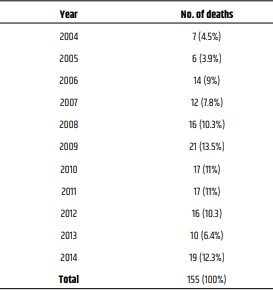
Context: The practice of culture is to protect people and preserve life. No culture allowed becoming a danger to human beings, sacrificing young lives year after year. The community keeps turning a blind eye to one death after the other because of tradition and culture. Objective: The main objective of the study was to describe the deaths that occurred between 2004 and 20014 due to traditional circumcisions. method: This is a record review descriptive study. The data were collected from the Forensic Pathology Laboratory of Hospital Complex from 2004 to 2014. results: A hundred and fifty-five cases of circumcision-related deaths were reported over a period of 11 years (2004-14) in the region of South Africa. The causes of death included septicaemia (66-42.6%), blunt trauma (6-3.9%), dehydration (4-2.6%), renal failure (3-1.9%), hypothermia (2-1.2%), and pulmonary thrombo-embolism (2-1.2%). conclusions: Death due to circumcision is unethical and unacceptable conduct due to unacceptable cultural practices. This practice must be banned. A strong political message needs to be sent to the community as well as to the practitioners of circumcision.
References
- 1. SAPA. Half a million successful traditional circumcisions in KZN. The Citizen. citizen. co.za/.../half-million-successful-traditionalcircumcisions-kzn (Accessed on 3.06.2021).
- 2. Wilcken A, Keil T, Dick B. Traditional male circumcision in eastern and southern Africa: A systematic review of prevalence and complications. Bull World Health Organ.2010; 88(12):907-14.
- 3. Mogotlane SM, Ntlangulela JT, Ogunbanjo BG. Mortality and morbidity among traditionally circumcised Xhosa boys in the Eastern Cape Province, South Africa. Curationis, 2004; 27(2):57-62.
- 4. Kepe T. ‘Secrets’ that kill: Crisis, custodianship and responsibility in ritual male circumcision in the Eastern Cape Province, South Africa. SocSci Med. 2010; 70(5):729-35.
- 5. Meissner O, Buso DL. Traditional male circumcision in the Eastern Cape - Scourge or blessing? S Afr Med J. 2007; 97(5):371-3.
- 6. Rijken D. South African traditional leaders attack graphic male circumcision website. Mail and Guardian, Wednesday 29 January 2014. Website: http://www.the guardian.com/world/2014/jan/29/Southafrica-doctor-website-botched (accessed 02.06.2021).
- 7. Peltzer K, Nqeketo A, Petros G, Kanta X. Traditional circumcision during manhood initiation rituals in the Eastern Cape, South Africa: A pre-post intervention evaluation. BMC Public Health.2008; 8:64.
- 8. Meel BL. Traditional male circumcision related fatalities in Mthatha area of South Africa. Med Sci Law. 2010; 50(4):189-91.
- 9. Vincent L. ‘Boys will be boys’: Traditional Xhosa male circumcision, HIV and sexual socialisation in contemporary South Africa. Cult Health Sex.2008; 10(5):431-46.
- 10. Banwari M. Dangerous to mix: Culture and politics in a traditional circumcision in South Africa. Afr Health Sci.2015; 15 (1):283- 7.
- 11. Meel B. Witchcraft in Transkei region of South Africa: Case report. African Health Sciences, 2009; 9(1):61-64.
- 12. Mayatula V, Mavundla TR. A review on male circumcision procedures among South African blacks. Curationis.1997; 20(3):16-20.
- 13. Mavundla TR, Netswera FG, Bottoman B, Toth F. Rationalization of indigenous male circumcision as a sacred religious custom: Health beliefs of Xhosa men in South Africa. J Transcult Nurs.2009; 20(4):395-404.
- 14. Shenfeld OZ, Ad-EI D. Penile reconstruction after complete glans amputation during ritual circumcision. Harefuah. 2000; 139(9):352-4.
- 15. Meel BL. Suicide among teenagers and young adults in the Transkei. Case reports. Anil Aggrawal’s Internet Journal of Forensic Medicine and Toxicology, 2004; 5(2):1-4. http://www.geradts.com/anil/ij/vol_005_ no_002/papers/paper003.html (accessed 29.06.2015).
- 16. SABC News. Traditional circumcision questioned in the Eastern Cape: Friday 10 July 2015. http://www.sabc.co.za/news/a/ b8864700490eb38fb2dfbb70b5a2a8d2/ circumcision-question (Accessed on 03.06.2021).
- 17. Meel BL. Community perception of traditional circumcision in a sub-region of the Transkei, Eastern Cape, South Africa. SA Fam Pract.2005; 47(6):58-59. 18. Occonor M. Circumcision in Western Cape is much safer. Die Burger. 1 September 2015.
- 19. Lim L. Painful Memories for China’s Foot binding Survivors. http://www. npr.org/templates/story/story. php?storyId=8966942 (accessed on 05.06.2021)
Data Sharing Statement
There are no additional data available. All raw data and code are available upon request.
Funding
This research received no funding.
Author Contributions
All authors contributed significantly to the work and approve its publication.
Ethics Declaration
This article does not involve any human or animal subjects, and therefore does not require ethics approval.
Acknowledgements
We would like to express our gratitude to the patients, their families, and all those who have contributed to this study.
Conflicts of Interest
No conflicts of interest in this work.
About this article

Cite this article
Meel B. Fatality as a result of traditional circumcision in Mthatha region in South Africa (2004-2014). Indian J Forensic Med Pathol. 2022;15(1):43-8.
Licence:
Attribution-Non-commercial 4.0 International (CC BY-NC 4.0)This license enables reusers to distribute, remix, adapt, and build upon the material in any medium or format for noncommercial purposes only, and only so long as attribution is given to the creator
| Received | Accepted | Published |
|---|---|---|
| January 13, 2022 | February 15, 2022 | March 30, 2022 |
DOI: https://doi.org/10.21088/ifjmp.0974.3383.15122.17
Keywords
circumcisionsepsisdeathukwalukaxhosa tribesSearch for Similar Articles
Similar Articles
- Diatom Analysis in Thermophilic water bodies: A Study on Hot Water Springs of Ma...
- Morphometric Study of Supra-meatal Triangle and Mastoid process in the Adult dry...
- Histopathological Spectrum of Autopsy Cases: A One Year Retrospective Observatio...
- Forensic Differentiation of Manner of Death in Railway Fatalities: A FourCase Se...
- Understanding assault Patterns: A Cross-sectional study of Cases at Chri, Kelamb...
Article Level Metrics
Last UpdatedSunday 18 October 2026, 11:00:45 (IST)
16257
Accesses
22
3205
00
Citations
NA
NA
NA
Download citation
Article Keywords
Keyword Highlighting
Highlight selected keywords in the article text.
Timeline
| Received | January 13, 2022 |
| Accepted | February 15, 2022 |
| Published | March 30, 2022 |
licence
Attribution-Non-commercial 4.0 International (CC BY-NC 4.0)
This license enables reusers to distribute, remix, adapt, and build upon the material in any medium or format for noncommercial purposes only, and only so long as attribution is given to the creator