Full Text (PDF)
Indian Journal of Forensic Medicine and Pathology 19(2):p 206-213, April - June 2026. | DOI: https://doi.org/10.21088/ijfmp.0974.3383.19226.13
Original Article
Assessment of Knowledge on Sexual Assault Forensic Examination among Nurses in India: A Cross-Sectional Study
Vinod C. Nayak, Renjulal Yesodharan, Tessy Treesa Jose
Author Information
Licence:
Attribution-Non-commercial 4.0 International (CC BY-NC 4.0)This license enables reusers to distribute, remix, adapt, and build upon the material in any medium or format for noncommercial purposes only, and only so long as attribution is given to the creator.
Indian Journal of Forensic Medicine and Pathology 19(2):p 206-213, April - June 2026. | DOI: https://doi.org/10.21088/ijfmp.0974.3383.19226.13
How Cite This Article:
Renjulal Yesodharan, Tessy Treesa Jose, Vinod C. Nayak. Assessment of Knowledge on Sexual Assault Forensic Examination among Nurses in India: A Cross-Sectional Study. Indian J Forensic Med Pathol. 2026; 19(2): 206-213Timeline
Received : March 17, 2026
Accepted : May 20, 2026
Published : June 30, 2026
Abstract
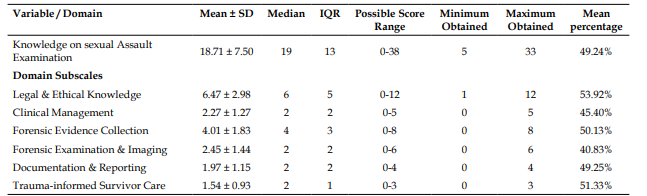
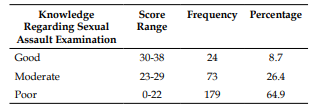
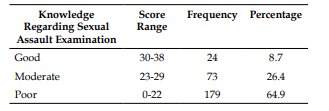
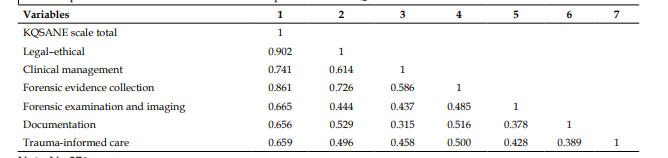
Background: Sexual violence is a major global public health and human rights issue that affects women and children in various societies. Survivors of sexual assault need immediate medical care and forensic examination, where healthcare professionals play a very crucial role. Nurses are the first point of contact in most of the health care settings to give immediate and prompt care. Nurses help to identify injuries, collect, preserve, and pack evidence, document findings and maintain chain of custody. However, limited training in forensic aspects may impact their ability to perform this task effectively. Objectives: This study aimed to evaluate the knowledge level regarding sexual assault examination among registered nurses and final-year nursing students Methods: A quantitative cross-sectional study was conducted with 276 participants from hospitals and nursing colleges in Dakshina Kannada and Udupi districts. Data were collected using socio-demographic proforma and a 38 item knowledge questionnaire on sexual assault nurse examination (KQSANE). Descriptive statistics summarize knowledge levels. Spearman’s correlation and generalized linear model regression were used to explore the relationships between knowledge domains and socio-demographic variables. Results: The findings indicate that overall knowledge about sexual assault examination was inadequate, with most participants demonstrating poor knowledge. Among the knowledge areas, the legal and ethical knowledge domain received the highest scores. The domain forensic examination and imaging received the lowest scores. Significant pos itive correlation was found between the overall knowledge scores and domains of knowledge. Conclusion: The study points out significant gaps in knowledge about forensic sexual assault examination among nurses and nursing students. Improving forensic nursing education through better curriculum integration and in-service education and training is important to prepare nurses for enhancing the survivorcentered care and ensuring proper evidence management
References
- 1. Abou Hashish, E.A. (2024). Knowledge and attitude of university nursing students towards forensic nursing and their influencing factors: a mixed-methods study. Egyptian Journal of Forensic Sciences, 14(1), 31. https:// doi.org/10.1186/s41935-024-00404-2
- 2. Bektaş, G., & Pakiş, I. (2021). Awareness of Forensic Cases Among Nurses: A Descriptive, Cross-Sectional Study. Journal of Forensic Nursing, 17(3), 182–187. https://doi. org/10.1097/JFN.0000000000000323
- 3. Campbell, R., Patterson, D., & Bybee, D. (2012). Prosecution of Adult Sexual Assault Cases: A Longitudinal Analysis of the Impact of a Sexual Assault Nurse Examiner Program. Violence Against Women, 18(2). https://doi. org/10.1177/1077801212440158
- 4. Dandona, R., Gupta, A., George, S., Kishan, S., & Kumar, G.A. (2022). Administrative data deficiencies plague understanding of the magnitude of rape-related crimes in Indian women and girls. BMC Public Health, 22(1), 788. https://doi.org/10.1186/s12889-022-13182-0
- 5. Dworkin, E.R., Krahé, B., & Zinzow, H. (2021). The Global Prevalence of Sexual Assault: A Systematic Review of International Research Since 2010. Psychology of Violence, 11(5), 497– 508. https://doi.org/10.1037/vio0000374
- 6. Emami, S.Z., Lynch, V.A., & Banazadeh, M. (2024). Forensic nursing in the emergency department: the distance between nurses’ performed role behaviors and their perception of behaviors’ importance. BMC Nursing, 23(1), 23. https://doi.org/10.1186/s12912-023-01682-2
- 7. Jayanti Humbe, Kajalkar, M., Jyoti Bhavthankar, Mandakini Mandale, Vaishali Nandkhedkar, & Savita Wagh. (2023). Knowledge, Attitude and Awareness of the Nurses towards Forensic Dentistry: A questionnaire-based survey. International Journal of Forensic Odontology, 8(1), 28–37. https://doi.org/10.56501/ intjforensicodontol.v8i1.793213 IJFMP/Volume 19 Number 2 April–June 2026 Renjulal Yesodharan, Tessy Treesa Jose, Vinod C. Nayak. Assessment of Knowledge on Sexual Assault Forensic Examination among Nurses in India: A Cross-Sectional Study.
- 8. Lechner, M., Britton-Susino, S., Daiber, D., Day, K., Faugno, D., Gill-Hopple, K., Maguire, K., Nash, K., Pierce-Weeks, J., & Rooney, E. (2018). Sexual assault nurse examiner (SANE) education guidelines. International Association of Forensic Nurses.
- 9. Machado, B.P., Batista de Araújo, I.M., & Figueiredo, M. do C.B. (2020). Forensic nursing practice - What do the students know anyway? Forensic Science International: Synergy, 2, 138–143. https://doi.org/10.1016/j.fsisyn.2020.04.003
- 10. National Crime Records Bureau (NCRB). (2013). Crime in India 2012. https://ncrb.gov.in
- 11. National Crime Records Bureau (NCRB). (2014). Crime in India 2013. https://ncrb.gov.in
- 12. National Crime Records Bureau (NCRB). (2015). Crime in India 2014. https://ncrb.gov.in
- 13. National Crime Records Bureau (NCRB). (2016a). Crime in India 2015. http://ncrb.nic. in/StatPublications/CII/CII2015/FILES/ Statistics-2015_rev1_1.pdf
- 14. National Crime Records Bureau (NCRB). (2016b). Crime in India 2015. https://ncrb.gov.in
- 15. National Crime Records Bureau (NCRB). (2017a). Crime in India 2016.
- 16. National Crime Records Bureau (NCRB). (2017b). Crime in India 2016. https://ncrb.gov.in
- 17. National Crime Records Bureau (NCRB). (2019a). Crime in India - 2017. http://ncrb.gov. in/StatPublications/CII/CII2017/cii2017.html
- 18. National Crime Records Bureau (NCRB). (2019b). Crime in India 2017. https://ncrb.gov.in
- 19. National Crime Records Bureau (NCRB). (2019c). Crime in India 2019 Volume 1. https:// ncrb.gov.in/sites/default/files/CII 2019 Volume 1.pdf
- 20. National Crime Records Bureau (NCRB). (2020a). Crime in India 2018. https://ncrb.gov.in
- 21. National Crime Records Bureau (NCRB). (2020b). Crime in India 2019. https://ncrb.gov.in
- 22. National Crime Records Bureau (NCRB). (2021). Crime in India 2020. https://ncrb.gov.in
- 23. National Crime Records Bureau (NCRB). (2022). Crime in India 2021. https://ncrb.gov.in
- 24. National Crime Records Bureau (NCRB). (2023). Crime in India 2022. https://ncrb.gov.in
- 25. National Crime Records Bureau (NCRB). (2024). Crime in India 2023. https://ncrb.gov.in
- 26. National Crimes Record Bureau (NCRB). (2023). Crime in India 2022 Statistics Volume I.
- 27. Patterson, D., & Resko, S. (2020). Factors Associated With Knowledge Retention 3 Months After a Sexual Assault Forensic Examiner Blended Learning Course. Journal of Forensic Nursing, 16(3), 138–145. https://doi. org/10.1097/JFN.0000000000000293
- 28. Piolanti, A., Schmid, I.E., Fiderer, F.J., Ward, C.L., Stöckl, H., & Foran, H.M. (2025). Global Prevalence of Sexual Violence Against Children. JAMA Pediatrics, 179(3), 264. https:// doi.org/10.1001/jamapediatrics.2024.5326
- 29. Ribeiro, G.P. de O., & Dixe, M. dos A.C. R. (2020). Knowledge of Forensic Nursing Practices: Efficacy of an Intervention for Nursing Students. Journal of Forensic Nursing, 16(3), 154–160. https://doi.org/10.1097/ JFN.0000000000000289
- 30. Sakallı, D., & Aslan, M. (2020). Levels of Knowledge of Emergency Nurses Regarding Forensic Cases and Approaches to Evidence. Signa Vitae, 16(1), 65. https://doi. org/10.22514/sv.2020.16.0009
- 31. Sardinha, L., Maheu-Giroux, M., Stöckl, H., Meyer, S.R., & García-Moreno, C. (2022). Global, regional, and national prevalence estimates of physical or sexual, or both, intimate partner violence against women in 2018. The Lancet, 399(10327), 803–813. https:// doi.org/10.1016/S0140-6736(21)02664-7
- 32. Vos, T., Lim, S. S., Abbafati, C., Abbas, K. M., Abbasi, M., Abbasifard, M., Abbasi-Kangevari, M., Abbastabar, H., Abd-Allah, F., Abdelalim, A., Abdollahi, M., Abdollahpour, I., Abolhassani, H., Aboyans, V., Abrams, E. M., Abreu, L. G., Abrigo, M. R. M., Abu-Raddad, L. J., Abushouk, A. I., … Murray, C. J. L. (2020). Global burden of 369 diseases and injuries in 204 countries and territories, 1990–2019: a systematic analysis for the Global Burden of Disease Study 2019. The Lancet, 396(10258), 1204–1222. https://doi.org/10.1016/S0140- 6736(20)30925-9.
Data Sharing Statement
There are no additional data available. All raw data and code are available upon request.
Funding
This research received no funding.
Author Contributions
Whether all authors contributed significantly to the work and approve its publication.
Ethics Declaration
This article does not involve any human or animal subjects, and therefore does not require ethics approval.
Acknowledgements
We would like to express our gratitude to the patients, their families, and all those who have contributed to this study.
Conflicts of Interest
No conflicts of interest in this work.
About this article

Cite this article
Renjulal Yesodharan, Tessy Treesa Jose, Vinod C. Nayak. Assessment of Knowledge on Sexual Assault Forensic Examination among Nurses in India: A Cross-Sectional Study. Indian J Forensic Med Pathol. 2026; 19(2): 206-213
Licence:
Attribution-Non-commercial 4.0 International (CC BY-NC 4.0)This license enables reusers to distribute, remix, adapt, and build upon the material in any medium or format for noncommercial purposes only, and only so long as attribution is given to the creator.
| Received | Accepted | Published |
|---|---|---|
| March 17, 2026 | May 20, 2026 | June 30, 2026 |
DOI: https://doi.org/10.21088/ijfmp.0974.3383.19226.13
Keywords
Sex OffensesForensic NursingSexual Assault ExaminationEvidenceBased PracticeKnowledgeProfessional CompetenceSDG 3Good Health and Well-BeingSDG 16 – PeaceJustice and Strong InstitutionsSearch for Similar Articles
Similar Articles
- Diatom Analysis in Thermophilic water bodies: A Study on Hot Water Springs of Ma...
- Morphometric Study of Supra-meatal Triangle and Mastoid process in the Adult dry...
- Histopathological Spectrum of Autopsy Cases: A One Year Retrospective Observatio...
- Forensic Differentiation of Manner of Death in Railway Fatalities: A FourCase Se...
- Understanding assault Patterns: A Cross-sectional study of Cases at Chri, Kelamb...
Article Level Metrics
Last UpdatedWednesday 21 October 2026, 11:05:14 (IST)
16502
Accesses
60
3225
00
Citations
NA
NA
NA
Download citation
Article Keywords
Keyword Highlighting
Highlight selected keywords in the article text.
Timeline
| Received | March 17, 2026 |
| Accepted | May 20, 2026 |
| Published | June 30, 2026 |
licence
Attribution-Non-commercial 4.0 International (CC BY-NC 4.0)
This license enables reusers to distribute, remix, adapt, and build upon the material in any medium or format for noncommercial purposes only, and only so long as attribution is given to the creator.