Full Text (PDF)
Indian Journal of Forensic Medicine and Pathology 17(1):p 51-55, January-March 2024. | DOI: https://doi.org/10.21088/ijfmp.0974.3383.17124.8
Original Article
Epidemiologocial Profile of Medico-Legal Cases at Tertiary Care Centre in Eastern India
Sarala M., Ishita Manral, Tippesh Kumar, Dipankar Ojha, Gautam R. Dhokia, Anandhakrishnan T.
Author Information
Licence:
Attribution-Non-commercial 4.0 International (CC BY-NC 4.0)This license enables reusers to distribute, remix, adapt, and build upon the material in any medium or format for noncommercial purposes only, and only so long as attribution is given to the creator.
Indian Journal of Forensic Medicine and Pathology 17(1):p 51-55, January-March 2024. | DOI: https://doi.org/10.21088/ijfmp.0974.3383.17124.8
How Cite This Article:
Sarala M, Manral I, Kumar T, et al. Epidemiologocial Profile of Medico-Legal Cases at Tertiary Care Centre in Eastern India. Indian J Forensic Med Pathol. 2024;17(1):51-55.Timeline
Received : November 27, 2023
Accepted : February 29, 2024
Published : March 29, 2024
Abstract
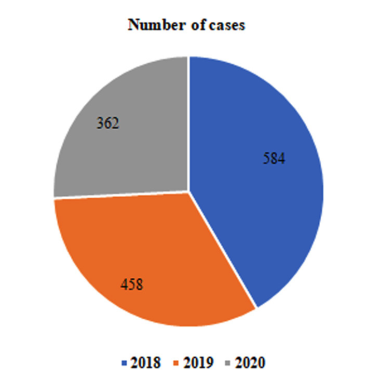
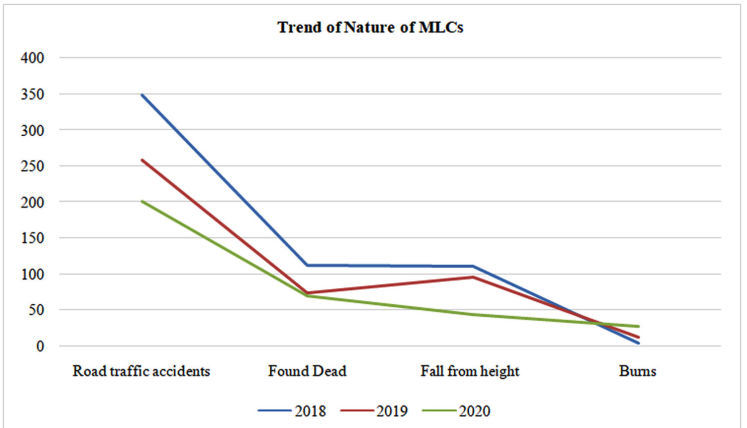
Introduction: There is an increasing rate of mortality and morbidity amongst the medicolegal cases in India. Knowledge of these cases is necessary to initiate a medico-legal case, treat such cases and further disposal in hospital. It is also needed to implement changes in the law and safety at work, home and roads. The saim of the study was to determine the epidemiological profile of medico-legal cases reported to Tertiary Centre in West Bengal during the study period and to study the epidemiological profile of different medico-legal cases in the hospital. Methodology: This study is a retrospective hospital based observational study which was conducted in the casualty of tertiary hospital in Eastern India from November 2018 to January 2021. It is a tertiary care centres with referrals from in and around the state. Results: In our study we saw a decreasing trend of Medico-legal cases as the years passed by. A male preponderance of the cases (60%) compared to females. The ratio of males: Female was 1.5:1. 57% of our Medico-legal cases were road traffic accident and 18% were fall from height and found dead cases respectively. 36% (505) cases were in the 31- 40 years age group followed closely by the 41-50 years age group 30% (421). This was followed by 51-60 years (11%) and 21-30 years and 61-70 years (10% each). Conclusion: The aim of raising a Medico-legal case is to inform the police and application of medical knowledge in practice. The attending doctor needs to tackle the case with medical bent of mind and describe the alleged circumstances in simple language and describe relevant findings.
References
- 1. Modi RB. A textbook of medical jurisprudence and toxicology. Elsevier; 2013 Oct 22.
- 2. Reddy DK. The essentials of forensic medicine and toxicology. 2019 Jul 25.
- 3. Lyon IB Dogra TD Rudra A. Lyon's Medical Jurisprudence & Toxicology: The First Indian Book of Forensic Medicine & Toxicology Completely Revised Updated & Enlarged with Latest Case Laws. 11th ed. Delhi: Delhi Law House; 2005.
- 4. Garg V, Verma SK. Profile of Medico-legal Cases at Adesh Institute of Medical Sciences and Research, Bathinda, Punjab. Journal of Indian academy of forensic medicine. 2010;32(2):150-2.
- 5. Kumar D, Siddaramanna TC, Parate SV, Hemanthraj MN. Retrospective Study of Profile of medicolegal cases in Tumkur region, Karnataka. International Journal of Biomedical and Advance Research. 2015 Apr 30;6(4):339- 40.
- 6. Siddappa SC, Datta A. A study pattern of medico-legal cases treated at a tertiary care hospital in central Karnataka. Indian J Forensic Comm Med. 2015;2(4):193-7.
- 7. Haridas SV, Pawale DA. A retrospective study of pattern of clinical Medico-legal cases registered at tertiary health care centre in Kolhapur district. J Forensic Med Sci Law. 2014 Jul;23(2):1-5.
- 8. Hussaini SN, Kulkarni CS, Batra AK. Profile of medico-legal cases coming to casualty of government medical college, Akola. J Forensic Med Sci Law. 2013 Jul;22(2):1-5.
- 9. Mir MS, Jan FA, Yatoo GH, Khalil I, Ganai S, Irshad H. Profile and Pattern of Medico-Legal Cases in a Tertiary Care Hospital of North India. J Med SciClin Res. 2016;4(9):2628-34.
- 10. Sharma BR, Harish D, Sharma V, Vij K. Road Traffic Accidents – a Demographic and Topographic analysis. Med Sci Law 2001; 41:266-74.
- 11. Harish KN, Srinivasa RP. Analysis of Medico-Legal Cases at Harsha Hospital Nelamangala, Bangalore Rural. Indian Journal of Forensic Medicine & Toxicology 2013; 7(1):254-87.
- 12. Sahdev P, Lacqua MJ, Singh B, Dogra TD. Road Traffic Fatalities in Delhi: Causes, Injury Patternand Incidence of Preventable Deaths. Accid Ann Prev1994; 26:377-84.
- 13. Malik Yogendra, Rahul Chawla, Gaurav Sharma, Pushpendra Malik, Rajendra Singh, Achal Tripathi. Profile of medico legal cases in causality of a rural medical college of Hariyana. Journal of Indian Academy of Forensic Medicine 2013; 35(4):367-8.
Data Sharing Statement
There are no additional data available.
Funding
This research received no funding.
Author Contributions
All authors contributed significantly to the work and approve its publication.
Ethics Declaration
Taken from the Institute CH/Kol/2021/Aug.
Acknowledgements
Information not provide.
Conflicts of Interest
No conflicts of interest in this work.
About this article

Cite this article
Sarala M, Manral I, Kumar T, et al. Epidemiologocial Profile of Medico-Legal Cases at Tertiary Care Centre in Eastern India. Indian J Forensic Med Pathol. 2024;17(1):51-55.
Licence:
Attribution-Non-commercial 4.0 International (CC BY-NC 4.0)This license enables reusers to distribute, remix, adapt, and build upon the material in any medium or format for noncommercial purposes only, and only so long as attribution is given to the creator.
| Received | Accepted | Published |
|---|---|---|
| November 27, 2023 | February 29, 2024 | March 29, 2024 |
DOI: https://doi.org/10.21088/ijfmp.0974.3383.17124.8
Keywords
Medico-legal casesRoad traffic accidentsFall from heightTertiary care setupsSearch for Similar Articles
Similar Articles
- Diatom Analysis in Thermophilic water bodies: A Study on Hot Water Springs of Ma...
- Morphometric Study of Supra-meatal Triangle and Mastoid process in the Adult dry...
- Histopathological Spectrum of Autopsy Cases: A One Year Retrospective Observatio...
- Forensic Differentiation of Manner of Death in Railway Fatalities: A FourCase Se...
- Understanding assault Patterns: A Cross-sectional study of Cases at Chri, Kelamb...
Article Level Metrics
Last UpdatedSunday 18 October 2026, 14:52:32 (IST)
16276
Accesses
23
3209
00
Citations
NA
NA
NA
Download citation
Article Keywords
Keyword Highlighting
Highlight selected keywords in the article text.
Timeline
| Received | November 27, 2023 |
| Accepted | February 29, 2024 |
| Published | March 29, 2024 |
licence
Attribution-Non-commercial 4.0 International (CC BY-NC 4.0)
This license enables reusers to distribute, remix, adapt, and build upon the material in any medium or format for noncommercial purposes only, and only so long as attribution is given to the creator.