Full Text (PDF)
Indian Journal of Surgical Nursing 15(1):p 25-30, Jan-April 2026. | DOI: https://doi.org/10.21088/ijsn.2277.467X.15126.5
Review Article
Deep Vein Thrombosis: A Comprehensive Review
Anjum Abbasi, Vineet Rebeiro, Adil Hussain, Vinod Bhatt
Author Information
Licence:
Attribution-Non-commercial 4.0 International (CC BY-NC 4.0)This license enables reusers to distribute, remix, adapt, and build upon the material in any medium or format for noncommercial purposes only, and only so long as attribution is given to the creator.
Indian Journal of Surgical Nursing 15(1):p 25-30, Jan-April 2026. | DOI: https://doi.org/10.21088/ijsn.2277.467X.15126.5
How Cite This Article:
Vineet Rebeiro, Adil Hussain, Anjum Abbasi, et al. Deep Vein Thrombosis: A Comprehensive Review. J Surg. Nurs. 2026; 15(1): 25-30.Timeline
Received : October 06, 2025
Accepted : November 12, 2025
Published : April 30, 2026
Abstract
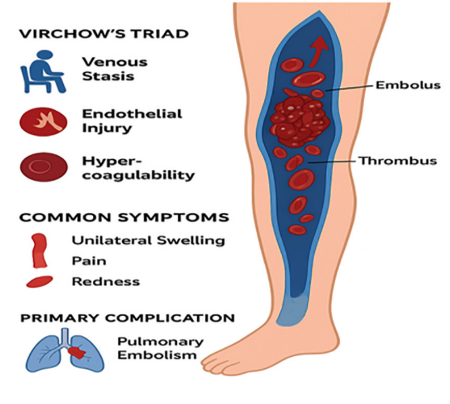
Deep vein thrombosis (DVT) is a significant vascular condition characterized by the formation of blood clots within the deep venous system, most commonly affecting the lower extremities. It represents a major public health concern due to its association with morbidity, mortality, and long-term complications such as pulmonary embolism and post-thrombotic syndrome. Nursing professionals play a pivotal role in prevention, early recognition, patient education, and management of DVT. This review provides an in-depth exploration of epidemiology, risk factors, pathophysiology, clinical manifestations, diagnostic approaches, and management strategies, with a particular focus on the implications for nursing education and practice. By synthesizing current evidence and highlighting emerging trends, this article aims to strengthen nursing faculty’s knowledge base, support clinical decision-making, and enhances teaching effectiveness in preparing future nurses to manage patients at risk for or affected by DVT.
References
- 1. Ageno, W., Becattini, C., Brighton, T., Selby, R., & Kamphuisen, P.W. (2012). Epidemiology and risk factors of venous thromboembolism. Seminars in Thrombosis and Hemostasis, 38(6), 614– 622. https://doi.org/10.1055/s-0032-1322663
- 2. Anderson, F.A., & Spencer, F.A. (2003). Risk factors for venous thromboembolism. Circulation, 107(23 Suppl 1), I9–I16. https:// doi.org/10.1161/01.CIR.0000078469.07362.E6
- 3. Becattini, C., Agnelli, G., & Schenone, A. (2012). Aspirin for preventing the recurrence of venous thromboembolism. The New England Journal of Medicine, 366(21), 1959–1967. https:// doi.org/10.1056/NEJMoa1114238
- 4. Cushman, M. (2007). Epidemiology and risk factors for venous thrombosis. Seminars in Hematology, 44(2), 62–69. https://doi. org/10.1053/j.seminhematol.2007.02.004
- 5. Di Nisio, M., van Es, N., & Büller, H.R. (2016). Deep vein thrombosis and pulmonary embolism. The Lancet, 388(10063), 3060–3073. https://doi. org/10.1016/S0140-6736(16)30514-1
- 6. Farge, D., et al. (2019). International clinical practice guidelines for the treatment and prophylaxis of venous thromboembolism in patients with cancer. The Lancet Oncology, 20(10), e566–e581. https://doi.org/10.1016/ S1470-2045(19)30336-5
- 7. Galanaud, J. P., et al. (2018). Predictive factors for recurrent venous thromboembolism. Thrombosis Research, 163, 6–11. https://doi. org/10.1016/j.thromres.2017.12.006
- 8. Geerts WH, Bergqvist D, Pineo GF, Heit JA, Samama CM, Lassen MR, et al. Prevention of venous thromboembolism: American College of Chest Physicians Evidence-Based Clinical Practice Guidelines (8th Edition). Chest. 2008;133(6 Suppl):381S-453S. https://doi.org/10.1378/ chest.08-0656
- 9. Heit, J.A. (2015). Epidemiology of venous thromboembolism. Nature Reviews Cardiology, 12(8), 464–474. https://doi.org/10.1038/ nrcardio.2015.83
- 10. Kahn, S.R., & Lim, W. (2021). Prevention of VTE in nonsurgical patients. Chest, 160(6), 2129–2140. https://doi.org/10.1016/j. chest.2021.07.056
- 11. Kakkos, S.K., et al. (2021). European Society for Vascular Surgery (ESVS) 2021 Clinical Practice Guidelines on the management of venous thrombosis. European Journal of Vascular and Endovascular Surgery, 61(1), 9–82. https://doi. org/10.1016/j.ejvs.2020.09.023
- 12. Kesieme, E., Kesieme, C., Jebbin, N., Irekpita, E., & Dongo, A. (2011). Deep vein thrombosis: A clinical review. Journal of Blood Medicine, 2, 59–69. https://doi.org/10.2147/JBM.S19009
- 13. Konstantinides, S.V., et al. (2020). 2019 ESC Guidelines for the diagnosis and management of acute pulmonary embolism. European Heart Journal, 41(4), 543–603. https://doi. org/10.1093/eurheartj/ehz405
- 14. Lyman, G. H., et al. (2021). Venous thromboembolism prophylaxis and treatment in patients with cancer: ASCO guideline update. Journal of Clinical Oncology, 39(12), 1326–1349. https://doi.org/10.1200/JCO.20.01461
- 15. Prandoni, P., & Villalta, S. (2011). Venous thromboembolism and the post-thrombotic syndrome: Prevention and treatment. Vascular Health and Risk Management, 7, 557–564. https://doi.org/10.2147/VHRM.S10326
- 16. Raskob, G.E., et al. (2018). Thrombosis: A major contributor to global disease burden. Arteriosclerosis, Thrombosis, and Vascular Biology, 38(12), 3023–3026. https://doi.org/10.1161/ ATVBAHA.118.311704
- 17. Schünemann, H.J., et al. (2018). American Society of Hematology 2018 guidelines for management of venous thromboembolism: Prophylaxis for hospitalized and nonhospitalized medical patients. Blood Advances, 2(22), 3198–3225. https://doi. org/10.1182/bloodadvances.2018022954
- 18. Thaler, J., & Ay, C. (2020). Venous thromboembolism: Epidemiology, risk factors, and genetics. Hamostaseologie, 40(6), 366–374. https://doi.org/10.1055/a-1268-9728
- 19. Wells, P.S., et al. (2014). Evaluation of D-dimer in the diagnosis of suspected deepvein thrombosis. The New England Journal of Medicine, 349(13), 1227–1235. https://doi. org/10.1056/NEJMoa023153
- 20. Wendelboe, A. M., & Raskob, G. E. (2016). Global burden of thrombosis: Epidemiologic aspects. Circulation Research, 118(9), 1340–1347. https:// doi.org/10.1161/CIRCRESAHA.115.306841
Data Sharing Statement
There are no additional data available. All raw data and code are available upon request.
Funding
This research received no funding.
Author Contributions
All authors contributed significantly to the work and approve its publication.
Ethics Declaration
This article does not involve any human or animal subjects, and therefore does not require ethics approval.
Acknowledgements
We would like to express our gratitude to the patients, their families, and all those who have contributed to this study.
Conflicts of Interest
No conflicts of interest in this work.
About this article

Cite this article
Vineet Rebeiro, Adil Hussain, Anjum Abbasi, et al. Deep Vein Thrombosis: A Comprehensive Review. J Surg. Nurs. 2026; 15(1): 25-30.
Licence:
Attribution-Non-commercial 4.0 International (CC BY-NC 4.0)This license enables reusers to distribute, remix, adapt, and build upon the material in any medium or format for noncommercial purposes only, and only so long as attribution is given to the creator.
| Received | Accepted | Published |
|---|---|---|
| October 06, 2025 | November 12, 2025 | April 30, 2026 |
DOI: https://doi.org/10.21088/ijsn.2277.467X.15126.5
Keywords
Nursing ProfessionalDeep Vein ThrombosisBlood ClotPulmonary embolismPost-thrombotic syndromeSearch for Similar Articles
Similar Articles
- Total Anomalous Pulmonary Venous Connection (TAPVC) Presenting with Respiratory...
- Dandy–Walker Syndrome (DWS): Clinical Features, Diagnosis, and Nursing Managemen...
- Benign Prostatic Hyperplasia: A Comprehensive Evidence-Based Review of Etiopatho...
- Challenges Faced During Data Collection on Substance abuse Prevention among Coll...
- Effectiveness of structured Teaching Programme on Knowledge Regarding Health Haz...
Article Level Metrics
Last UpdatedMonday 19 October 2026, 07:24:11 (IST)
2170
Accesses
35
313
00
Citations
NA
NA
NA
Download citation
Article Keywords
Keyword Highlighting
Highlight selected keywords in the article text.
Timeline
| Received | October 06, 2025 |
| Accepted | November 12, 2025 |
| Published | April 30, 2026 |
licence
Attribution-Non-commercial 4.0 International (CC BY-NC 4.0)
This license enables reusers to distribute, remix, adapt, and build upon the material in any medium or format for noncommercial purposes only, and only so long as attribution is given to the creator.