Full Text (PDF)
Indian Journal of Surgical Nursing 15(2):p 53-57, May - August 2026. | DOI: https://doi.org/10.21088/ijsn.2277.467X.15226.1
Original Article
Effectiveness of structured Teaching Programme on Knowledge Regarding Health Hazards of Junk Food and Its Prevention among Adolescents
Deepa S.P., Priya. C, Gowri. R, Ciby Jose, Abirami P
Author Information
Licence:
Attribution-Non-commercial 4.0 International (CC BY-NC 4.0)This license enables reusers to distribute, remix, adapt, and build upon the material in any medium or format for noncommercial purposes only, and only so long as attribution is given to the creator.
Indian Journal of Surgical Nursing 15(2):p 53-57, May - August 2026. | DOI: https://doi.org/10.21088/ijsn.2277.467X.15226.1
How Cite This Article:
Deepa S.P., Priya. C, Gowri. R, et. al, Effectiveness of structured Teaching Programme on Knowledge Regarding Health Hazards of Junk Food and Its Prevention among Adolescents. J Surg. Nurs. 2026; 15(2): 53-57.Timeline
Received : February 27, 2026
Accepted : March 30, 2026
Published : August 30, 2026
Abstract
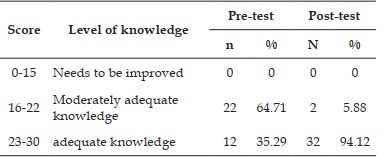
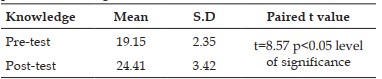
Background: Junk food consumption and its consequences has become a major public health concern globally because of its deteriorating health consequences and surging prevalence. Though its adverse health consequences are widely prevalent in all age groups, children and adolescents are more at risk. It may lead to obesity and act as a risk factor for different non-communicable diseases. Aims and Objectives: To evaluate the effectiveness of a structured teaching program on knowledge regarding health hazards of junk food and its prevention among adolescents. Methodology: Quantitative research approach, pre-experimental one group pre-test and post-test research design was used. Thirty-four adolescents were selected using convenient sampling technique. The study was conducted at Vels Vidyashram, Thalambur, Chennai. Structured knowledge questionnaire was used to assess the knowledge about health hazards of junk food and its prevention. On the first day, demographic details were obtained through a structured profile. Followed by pre-test assessment of the level of knowledge among adolescents about health hazards and preventive measures of junk food, a structured teaching programme was given to the students. Post-test assessment of the level of knowledge among adolescents about health hazards and prevention of junk foods was done on the 7th day. Results: The pre-test mean score of knowledge about health hazards of junk food and its prevention was 19.15, the post-test mean score was 24.41, and the mean difference score was 5.26. The calculated paired ‘t’ test value (t = 8.57) was found to be statistically significant at p < 0.05 level. This study findings infer that the structured teaching program on health hazards of junk food and its prevention was found to be effective in improving knowledge among adolescents.
References
- 1. Basavanthappa, B. T. (2008). Textbook of child health nursing (5th ed.). Ahuja Publications.
- 2. Polit, D. F., & Hungler, B. P. (1999). Nursing research: Principles and methods (6th ed.). Lippincott.
- 3. Lasky, M. J. (2005). The complete junk food book (1st ed.). Kindle Publishers.
- 4. Bowden, M. (1998). Children and their families (1st ed.). W. B. Saunders.
- 5. Potter, P. A., & Perry, A. G. (1999). Basic nursing: Theory and practice (3rd ed.). Mosby.
- 6. Kearney, J. (2010). Food consumption trends and adolescents (1st ed.). Philos Trans Publishers.
- 7. Neumark-Sztainer D, Story M, Perry C, Casey MA(1999). Factors influencing food choices of adolescents: findings from focus-group discussions with adolescents. J Am Diet Assoc. ;99:929–37.
- 8. Pourabdolahi P, Rozati M, Razaviye S, Dastgiri S, GhaemMaghami SJ, Fathi Azar E. (2005) Effect of nutrition education on knowledge and performance of primary school children on junk food consumption. J Zanjan Univ Med Sci. ;13:13–20.
- 9. Ramchandra Ujwala More, Salunkh. H Avinash.(2015) A study to assess the existing knowledge of adolescents regarding the health hazards of junk food in a selected college. International Journal of Science and Research.;4(4):43-46.
- 10. S.Shalin, Professor. Dhai Panna (2020). Effectiveness of Structured Teaching Programme on Knowledge regarding Hazards of Junk Food among Adolescents. Asian J. Nursing Education and Research.;10(2): 207-209
Data Sharing Statement
There are no additional data available. All raw data and code are available upon request.
Funding
This research received no funding.
Author Contributions
All authors contributed significantly to the work and approve its publication.
Ethics Declaration
This article does not involve any human or animal subjects, and therefore does not require ethics approval.
Acknowledgements
The author acknowledges Dr Ciby Jose Principal for constant guidance, We would like to thank study participants for their constant support.
Conflicts of Interest
No conflicts of interest in this work.
About this article

Cite this article
Deepa S.P., Priya. C, Gowri. R, et. al, Effectiveness of structured Teaching Programme on Knowledge Regarding Health Hazards of Junk Food and Its Prevention among Adolescents. J Surg. Nurs. 2026; 15(2): 53-57.
Licence:
Attribution-Non-commercial 4.0 International (CC BY-NC 4.0)This license enables reusers to distribute, remix, adapt, and build upon the material in any medium or format for noncommercial purposes only, and only so long as attribution is given to the creator.
| Received | Accepted | Published |
|---|---|---|
| February 27, 2026 | March 30, 2026 | August 30, 2026 |
DOI: https://doi.org/10.21088/ijsn.2277.467X.15226.1
Keywords
Structured teaching programLevel of knowledgeHealth hazards of junk food and its preventionAdolescentsSearch for Similar Articles
Similar Articles
- Total Anomalous Pulmonary Venous Connection (TAPVC) Presenting with Respiratory...
- Dandy–Walker Syndrome (DWS): Clinical Features, Diagnosis, and Nursing Managemen...
- Benign Prostatic Hyperplasia: A Comprehensive Evidence-Based Review of Etiopatho...
- Challenges Faced During Data Collection on Substance abuse Prevention among Coll...
- A Study to Evaluate the Degree of Knowledge and Practical Understanding of Lazar...
Article Level Metrics
Last UpdatedMonday 19 October 2026, 21:09:11 (IST)
2174
Accesses
60
313
00
Citations
NA
NA
NA
Download citation
Article Keywords
Keyword Highlighting
Highlight selected keywords in the article text.
Timeline
| Received | February 27, 2026 |
| Accepted | March 30, 2026 |
| Published | August 30, 2026 |
licence
Attribution-Non-commercial 4.0 International (CC BY-NC 4.0)
This license enables reusers to distribute, remix, adapt, and build upon the material in any medium or format for noncommercial purposes only, and only so long as attribution is given to the creator.