Full Text (PDF)
Indian Journal of Surgical Nursing 15(2):p 77-82, May - August 2026. | DOI: https://doi.org/10.21088/ijsn.2277.467X.15226.5
Case Report
Total Anomalous Pulmonary Venous Connection (TAPVC) Presenting with Respiratory Distress and Cyanosis in an Infant: A Case Report with Nursing Management
Jayavel M, Radika null, Solomon James, Joyce Joseph, Raghu VA
Author Information
Licence:
Attribution-Non-commercial 4.0 International (CC BY-NC 4.0)This license enables reusers to distribute, remix, adapt, and build upon the material in any medium or format for noncommercial purposes only, and only so long as attribution is given to the creator.
Indian Journal of Surgical Nursing 15(2):p 77-82, May - August 2026. | DOI: https://doi.org/10.21088/ijsn.2277.467X.15226.5
How Cite This Article:
Jayavel M, Radika, Solomon James, et. al, Total Anomalous Pulmonary Venous Connection (TAPVC) Presenting with Respiratory Distress and Cyanosis in an Infant: A Case Report with Nursing Management. J Surg. Nurs. 2026; 15(2): 77-82.Timeline
Received : May 19, 2026
Accepted : June 24, 2026
Published : August 30, 2026
Abstract
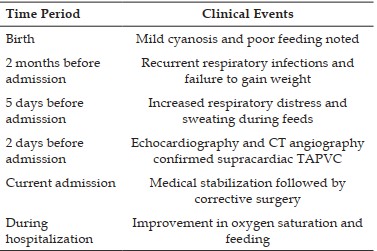
Introduction: Total anomalous pulmonary venous connection (TAPVC) is a rare congenital cyanotic heart disease in which all pulmonary veins drain into the systemic venous circulation instead of the left atrium. Survival depends on the presence of an interatrial communication, such as an atrial septal defect (ASD), which permits mixing of oxygenated and deoxygenated blood. Abnormal venous drainage may also cause mechanical obstruction to blood flow, leading to severe respiratory distress and heart failure. Early diagnosis and surgical correction are essential to improve survival and prevent complications. Case Presentation: A 3-month-old male infant presented with respiratory distress, poor feeding, cyanosis, and failure to gain weight since birth. Clinical examination revealed tachypnea, central cyanosis, and hypoxia. Echocardiography and computed tomography angiography confirmed supracardiac TAPVC with dilated right-sided cardiac chambers and pulmonary hypertension. Management and Outcome: The infant was managed with oxygen therapy, diuretics, inotropic support, and nutritional supplementation before undergoing corrective cardiac surgery. Comprehensive nursing management included monitoring oxygen saturation, maintaining airway patency, supporting feeding, preventing infection, and educating caregivers. Following treatment and surgery, the infant showed improvement in oxygen saturation, feeding tolerance, and respiratory status. Conclusion: This case highlights the importance of early recognition and multidisciplinary management of TAPVC in infants. Prompt diagnosis, timely surgical intervention, and effective nursing care are crucial for improving clinical outcomes and survival.
References
- 1. Kliegman RM, St Geme JW, Blum NJ, Shah SS, Tasker RC, Wilson KM. Nelson Textbook of Pediatrics. 21st ed. Philadelphia: Elsevier; 2020.
- 2. Hoffman JIE, Kaplan S. The incidence of congenital heart disease. J Am Coll Cardiol. 2002;39(12):1890–900.
- 3. Anderson RH, Baker EJ, Penny DJ, Redington AN, Rigby ML, Wernovsky G. Paediatric Cardiology. 3rd ed. Philadelphia: Churchill Livingstone; 2010.
- 4. Kirklin JW, Barratt-Boyes BG. Cardiac Surgery. 4th ed. Philadelphia: Elsevier; 2013.
- 5. Allen HD, Driscoll DJ, Shaddy RE, Feltes TF. Moss and Adams’ Heart Disease in Infants, Children, and Adolescents. 9th ed. Philadelphia: Wolters Kluwer; 2016.
- 6. Park MK. Park’s Pediatric Cardiology for Practitioners. 7th ed. Philadelphia: Elsevier; 2021.
- 7. Freedom RM, Yoo SJ, Mikailian H, Williams WG. The Natural and Modified History of Congenital Heart Disease. Oxford: Blackwell Publishing; 2004.
- 8. Behrman RE, Kliegman RM, Jenson HB. Nelson Essentials of Pediatrics. 8th ed. Philadelphia: Elsevier; 2019.
- 9. Hockenberry MJ, Wilson D. Wong’s Nursing Care of Infants and Children. 11th ed. St. Louis: Mosby Elsevier; 2019.
Data Sharing Statement
There are no additional data available. All raw data and code are available upon request.
Funding
This research received no funding.
Author Contributions
All authors contributed significantly to the work and approve its publication.
Ethics Declaration
This article does not involve any human or animal subjects, and therefore does not require ethics approval.
Acknowledgements
We would like to express our gratitude to the patients, their families, and all those who have contributed to this study.
Conflicts of Interest
No conflicts of interest in this work.
About this article

Cite this article
Jayavel M, Radika, Solomon James, et. al, Total Anomalous Pulmonary Venous Connection (TAPVC) Presenting with Respiratory Distress and Cyanosis in an Infant: A Case Report with Nursing Management. J Surg. Nurs. 2026; 15(2): 77-82.
Licence:
Attribution-Non-commercial 4.0 International (CC BY-NC 4.0)This license enables reusers to distribute, remix, adapt, and build upon the material in any medium or format for noncommercial purposes only, and only so long as attribution is given to the creator.
| Received | Accepted | Published |
|---|---|---|
| May 19, 2026 | June 24, 2026 | August 30, 2026 |
DOI: https://doi.org/10.21088/ijsn.2277.467X.15226.5
Keywords
Total Anomalous Pulmonary Venous ConnectionTapvcCongenital Heart DiseaseCyanosisPediatric Cardiac NursingSearch for Similar Articles
Similar Articles
- Dandy–Walker Syndrome (DWS): Clinical Features, Diagnosis, and Nursing Managemen...
- Benign Prostatic Hyperplasia: A Comprehensive Evidence-Based Review of Etiopatho...
- Challenges Faced During Data Collection on Substance abuse Prevention among Coll...
- Effectiveness of structured Teaching Programme on Knowledge Regarding Health Haz...
- A Study to Evaluate the Degree of Knowledge and Practical Understanding of Lazar...
Article Level Metrics
Last UpdatedSaturday 17 October 2026, 13:02:29 (IST)
2160
Accesses
56
313
00
Citations
NA
NA
NA
Download citation
Article Keywords
Keyword Highlighting
Highlight selected keywords in the article text.
Timeline
| Received | May 19, 2026 |
| Accepted | June 24, 2026 |
| Published | August 30, 2026 |
licence
Attribution-Non-commercial 4.0 International (CC BY-NC 4.0)
This license enables reusers to distribute, remix, adapt, and build upon the material in any medium or format for noncommercial purposes only, and only so long as attribution is given to the creator.