Full Text (PDF)
Indian Journal of Forensic Medicine and Pathology 11(2):p 124-128, April-June 2018. | DOI: 10.21088/ijfmp.0974.3383.11218.15
Original Article
Comparative Analysis of Clinical and Laboratory Parameters in Viper Bite Cases from Northern Kerala
Umasankar P. , Aravindan K.P. , Udhayabhaskaran V.
Author Information
Licence:
Attribution-Non-commercial 4.0 International (CC BY-NC 4.0)This license enables reusers to distribute, remix, adapt, and build upon the material in any medium or format for noncommercial purposes only, and only so long as attribution is given to the creator.
Indian Journal of Forensic Medicine and Pathology 11(2):p 124-128, April-June 2018. | DOI: 10.21088/ijfmp.0974.3383.11218.15
How Cite This Article:
Timeline
Received : April 11, 2018
Accepted : May 05, 2018
Published : May 30, 2018
Abstract
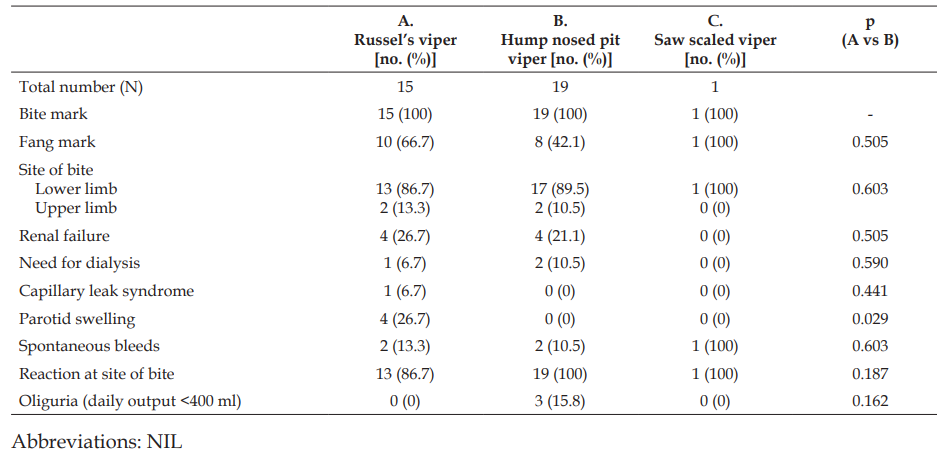
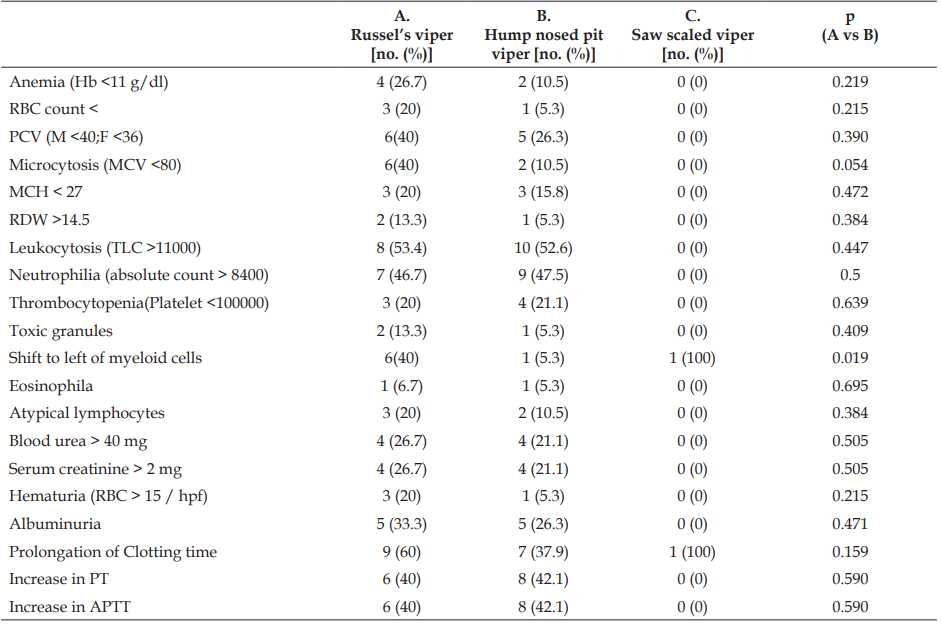
Context: India is a country with highest rates of mortalities and morbidities resulting from snake bite. There is a concept that four snake species namely Naja naja, Bungarus caeruleus, Daboia russelii, Echis carinatus, together called the ‘The Big 4 snakes of medical importance’ are solely responsible for morbidities and mortalities. Indian antivenom is effective against aforementioned species only. Aims: Aim of the study was to compare the clinical and laboratory variables in patients bitten by hump-nosed pit viper (Hypnale hypnale) and other vipers. Settings and Design: Study was conducted in Kozhikode Government Medical College, located in Northern Kerala. It was a descriptive study on various clinical and laboratory parameters. Methods and Material: Study was conducted comparing various clinical and laboratory parameters in among patients bitten by Daboia russelii and Hypnale Hypnale. Statistical analysis used: Analysis was done using EPIINFO and SPSS software. Comparisons between viper bites were done by the chisquare test. Results: Analysis proved that except for parotid swelling, which was seen only among Daboia russelii bitten patients, there were no statistically significant difference among the various parameters studied, including mortality rate. Conclusions: Our study emphasizes the urgent need for anti snake venom effective in Hypnale Hypnale envenomations.
References
- 1. Mohapatra B, Warrell DA, Suraweera W, Bhatia P, Dhingra N, Jotkar RM, et al. Snakebite mortality in India: a nationally representative mortality survey. PLoS Negl Trop Dis. 2011;5(4):e1018.
- 2. Umasankar P, Aravindan KP, Udhayabhaskaran V. Comparative analysis of clinical and laboratory parameters in viper bite cases from Northern Kerala. Indian J Forensic Med Pathol. 2018;11(2):128-34.
- 3. World Health Organization. WHO guidelines for the production, control and regulation of snake antivenom immunoglobulins. Geneva: World Health Organization; 2010.
- 4. Swaroop S, Grab B. Snakebite mortality in the world. Bull World Health Organ. 1954;10(1):35-76.
- 5. Sharma N, Chauhan S, Faruqi S, Bhat P, Varma S. Snake envenomation in a north Indian hospital. Emerg Med J. 2005;22(2):118-20.
- 6. Joseph J, Simpson I, Menon N, Jose M, Kulkarni K, Raghavendra G, et al. First authenticated cases of life-threatening envenoming by the hump-nosed pit viper in India. Trans R Soc Trop Med Hyg. 2007;101(1):85-90.
- 7. Ariaratnam CA, Thuraisingam V, Kularatne SA, Sheriff MH, Theakston RD, de Silva A, et al. Frequent and potentially fatal envenoming by hump-nosed pit vipers (Hypnale hypnale and H. nepa) in Sri Lanka: lack of effective antivenom. Trans R Soc Trop Med Hyg. 2008;102(11):1120-6.
- 8. Sharma CLR, Lal V, Simpson ID. Snakes of medical significance in India: the first reported case of envenoming by the Levantine viper (Macrovipera lebetina). Wilderness Environ Med. 2008;19(3):195-8.
- 9. Warrell DA, World Health Organization Regional Office for South-East Asia. Guidelines for the management of snake-bites. New Delhi: WHO Regional Office for South-East Asia; 2010.
- 10. Bawaskar HS, Bawaskar PH, Punde DP, Inamdar MK, Dongare RB, Bhoite RR. Profile of snakebite envenoming in rural Maharashtra, India. J Assoc Physicians India. 2008;56:88-95.
- 11. Suchithra N, Pappachan J, Sujathan P. Snakebite envenoming in Kerala, South India: clinical profile and factors involved in adverse outcomes. Emerg Med J. 2008;25(4):200-4.
- 12. Premawardena A, Seneviratne S, Gunatilake S, de Silva H. Excessive fibrinolysis: the coagulopathy following Merrem’s hump-nosed viper (Hypnale hypnale) bites. Am J Trop Med Hyg. 1998;58(6):821-3.
- 13. Chakraborty PP, Bhattacharjee R. Bilateral parotid swelling: an unusual complication of viper bite. J Assoc Physicians India. 2015;63(4):86-7.
Data Sharing Statement
There are no additional data available. All raw data and code are available upon request.
Funding
This research received no funding.
Author Contributions
Whether all authors contributed significantly to the work and approve its publication.
Ethics Declaration
This article does not involve any human or animal subjects, and therefore does not require ethics approval.
Acknowledgements
We would like to express our gratitude to the patients, their families, and all those who have contributed to this study.
Conflicts of Interest
The authors report no conflicts of interest in this work.
About this article

Cite this article
Licence:
Attribution-Non-commercial 4.0 International (CC BY-NC 4.0)This license enables reusers to distribute, remix, adapt, and build upon the material in any medium or format for noncommercial purposes only, and only so long as attribution is given to the creator.
| Received | Accepted | Published |
|---|---|---|
| April 11, 2018 | May 05, 2018 | May 30, 2018 |
DOI: 10.21088/ijfmp.0974.3383.11218.15
Keywords
Hump Nosed Pit ViperIndian Anti Snake VenomRussell’s ViperSearch for Similar Articles
Similar Articles
- Diatom Analysis in Thermophilic water bodies: A Study on Hot Water Springs of Ma...
- Morphometric Study of Supra-meatal Triangle and Mastoid process in the Adult dry...
- Histopathological Spectrum of Autopsy Cases: A One Year Retrospective Observatio...
- Forensic Differentiation of Manner of Death in Railway Fatalities: A FourCase Se...
- Understanding assault Patterns: A Cross-sectional study of Cases at Chri, Kelamb...
Article Level Metrics
Last UpdatedSunday 18 October 2026, 14:42:54 (IST)
16274
Accesses
6
3209
00
Citations
NA
NA
NA
Download citation
Article Keywords
Keyword Highlighting
Highlight selected keywords in the article text.
Timeline
| Received | April 11, 2018 |
| Accepted | May 05, 2018 |
| Published | May 30, 2018 |
licence
Attribution-Non-commercial 4.0 International (CC BY-NC 4.0)
This license enables reusers to distribute, remix, adapt, and build upon the material in any medium or format for noncommercial purposes only, and only so long as attribution is given to the creator.