Full Text (PDF)
Indian Journal of Forensic Medicine and Pathology 19(3):p 309-316, July -Sept. 2026. | DOI: https://doi.org/10.21088/ijfmp.0974.3383.19326.4
Original Article
When DNA Lies: A Forensic Dilemma Caused by Twin Absorption and Chimerism
Author Information
Licence:
Attribution-Non-commercial 4.0 International (CC BY-NC 4.0)This license enables reusers to distribute, remix, adapt, and build upon the material in any medium or format for noncommercial purposes only, and only so long as attribution is given to the creator.
Indian Journal of Forensic Medicine and Pathology 19(3):p 309-316, July -Sept. 2026. | DOI: https://doi.org/10.21088/ijfmp.0974.3383.19326.4
How Cite This Article:
Bhawna Poonia, Sangita Gupta. When DNA Lies: A Forensic Dilemma Caused by Twin Absorption and Chimerism. Indian J Forensic Med Pathol. 2026; 19(3): 309-316Timeline
Received : April 11, 2026
Accepted : June 14, 2026
Published : September 30, 2026
Abstract
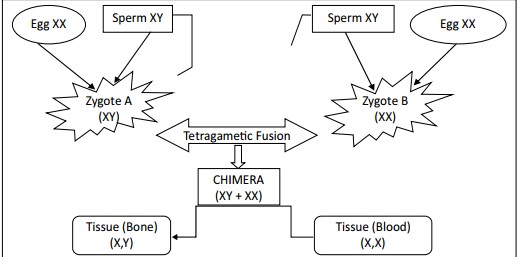
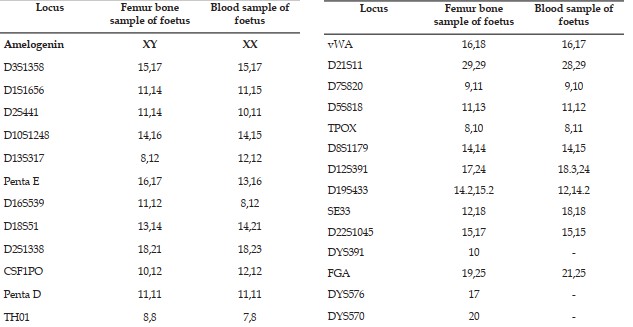
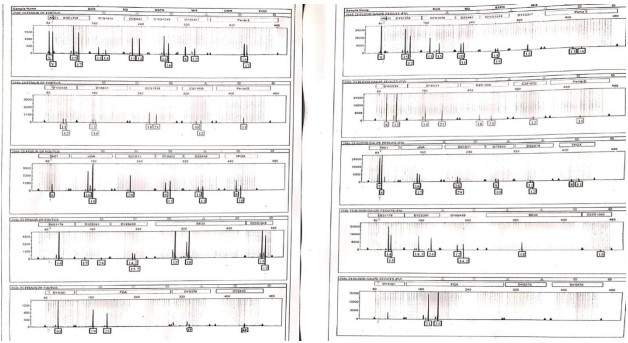
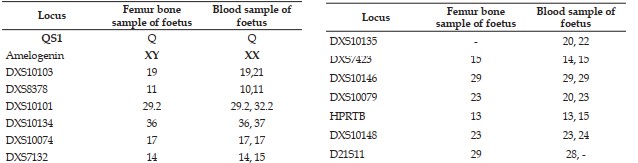
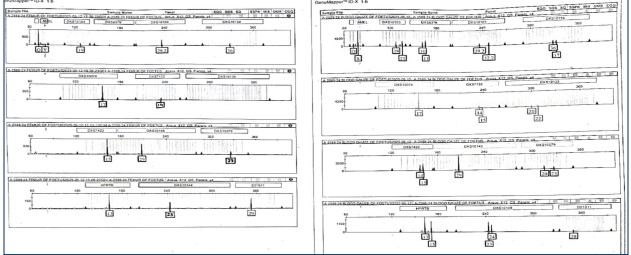
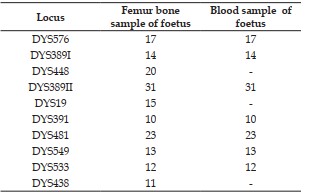
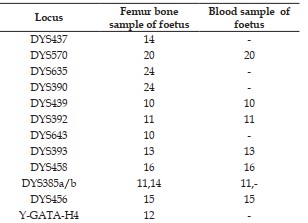
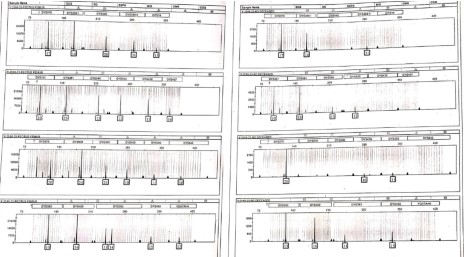
Background: Nuclear genomic markers, like short tandem repeats (STR), are frequently employed for paternity verification and investigating crimes. As per Mendel’s law of inheritance, every living cell of an individual are expected to inherit identical DNA profile. However, extremely rare conditions such as chimerism or genetic mosaicism, arising from the fusion of two fraternal embryos in early development (Tetra gametic origin), make possible the shared existence of two genetically distinct cell populations within a single individual. Method: This paper explores a case study in which a foetus displayed both male and female genetic markers—one from the femur and another from blood— regardless of the same origin. Blood and femur bone exhibited chimerism at all twenty three informative autosomal loci tested, provided in Powerplex®-Fusion 6C PCR amplification kit (Promega). The existence of genetically male cell population in the chimeric foetus was confirmed by typing a Y-chromosome haplotype. Result: It would have been reasonable to assume that these samples came from two distinct individuals. However, after putting together data from different genetic researches and contextual information, the most plausible explanation suggested that the foetus was a chimera or a genetic mosaic due to the shared existence of two genetically distinct cell populations. Conclusion: This case underscores that chimerism may pose challenges for forensic analyses, as it can result in false paternity exclusions or render it futile to correlate the offender to a stain detected at a crime scene. Cautious data interpretation, an amended sampling plan, as well as efficient recognition of mosaics or chimeras, should enable avoiding such errors.
References
- 1. James H.M. Overview of deoxyribonucleic acid (DNA). INOSR Scientific Research. 2016; 2: 1-6.
- 2. Arslan Z. Chimerism: Its impact on forensic science and biological identification. Int J Forensic Sci. 2020; 5(2): 50–56. doi:10.xxxx/ ijfs.2020.0050
- 3. Butler J.M. Forensic DNA typing: Biology, technology, and genetics of STR markers. Elsevier; 2005 Feb 8.
- 4. Homer. The Iliad. Murray A.T.s, translator. Cambridge (MA): Harvard University Press; 1924. Book 6, lines 179–182.
- 5. Brooker C. Churchill Livingstone Medical Dictionary E-Book: Churchill Livingstone Medical Dictionary E-Book. Elsevier Health Sciences; 2008 Jun 4.
- 6. MacCord K., Maienschein J. Chimeras and hybrids [Internet]. The Embryo Project Encyclopedia. Arizona State University; 2014 Jun 9 [cited 2026 Apr 27]. Available from: https://embryo.asu.edu/pages/chimerasand-hybrids
- 7. Sheets K.M., Baird M.L., Heinig J., Davis D., Sabatini M., Starr D.B. A case of chimerisminduced paternity confusion: what ART practitioners can do to prevent future calamity for families. Journal of Assisted Reproduction and Genetics. 2018 Feb; 35(2): 345-52.
- 8. Wenk R.E. A review of the biology and classification of human chimeras. Transfusion. 2018 Aug; 58(8): 2054-67.
- 9. Vymetalova Y., Bohuslavova R., Hubacek J.A., Dufkova B., Kocik M., Malek I., Kautzner J. High prevalence of microchimerism in female patients. InTransplantation proceedings 2008 Dec 1 (Vol. 40, No. 10, pp. 3685-3687). Elsevier.
- 10. Gammill H.S., Nelson J.L. Naturally acquired microchimerism. The International journal of developmental biology. 2010; 54(2-3): 531.
- 11. Yunis E.J., Zuniga J., Romero V., Yunis E.J. Chimerism and tetragametic chimerism in humans: implications in autoimmunity, allorecognition and tolerance. Immunologic research. 2007 Jul; 38(1): 213-36.
- 12. Madan K. Natural human chimeras: A review. European journal of medical genetics. 2020 Sep 1; 63(9): 103971.
- 13. Boklage C.E. Embryogenesis of chimeras, twins and anterior midline asymmetries. Human reproduction. 2006 Mar 1; 21(3): 579-91.
- 14. Magharehabed M., Almadani N., Askari M., Naji M., Akbari A., Gourabi H., Sedighi Gilani M.A., Reyhani Sabet F., Masoudi N.S., Totonchi M. Rare case of an oligospermic male with 46, XX/46, XY tetragametic chimerism. Andrologia. 2019 Aug; 51(7): e13290.
- 15. Sheets K., Wenk R. Relationship testing and forensics. InChimerism: A Clinical Guide 2018 Jun 22 (pp. 51-63). Cham: Springer International Publishing.
- 16. Novotný J., Lotz P., Müller S., Steinlein O. Identification of tetragametic human chimerism by routine DNA profiling. International Journal of Legal Medicine. 2019 Jul 1; 133(4): 989-92.
- 17. Batsry L., Yinon Y. The vanishing twin: diagnosis and implications. Best Practice & Research Clinical Obstetrics & Gynaecology. 2022 Nov 1; 84: 66-75.
- 18. George R., Donald P.M., Nagraj S.K., Idiculla J.J., Ismail R.H. The impact of chimerism in DNA-based forensic sex determination analysis. The Malaysian journal of medical sciences: MJMS. 2013 Jan; 20(1): 76.
- 19. Yu N., Kruskall M.S., Yunis J.J., Knoll J.H., Uhl L., Alosco S., Ohashi M., Clavijo O., Husain Z., Yunis E.J., Yunis J.J. Disputed maternity leading to identification of tetragametic chimerism. New England Journal of Medicine. 2002 May 16; 346(20): 1545-52.
- 20. Yu Q., Li Q., Gao S., Su Y., Deng Z. Congenital tetragametic blood chimerism explains a case of questionable paternity. Journal of Forensic Sciences. 2011 Sep; 56(5): 1346-8.
- 21. Szibor R. X-chromosomal markers: past, present and future. Forensic Science International: Genetics. 2007 Jun 1; 1(2): 93-9.
- 22. Arcabascio C. Chimeras: double the DNAdouble the fun for crime scene investigators, prosecutors, and defense attorneys. Akron L. Rev. 2007; 40: 435.
- 23. Darby A. The case of Lydia Fairchild and her chimerism (2002). Arizona State University. School of Life Sciences. Center for Biology and Society. Embryo Project Encyclopedia.| Arizona Board of Regents; 2021 Jun 1.
- 24. van Dijk E. Tetragametic chimerism in forensic DNA casework. Int J Legal Med. 2016; 130(2): 383–90.
- 25. Yu J., et al. Detection of chimerism in forensic samples: Challenges and case studies. Forensic Sci Int Genet. 2022; 60: 102717.
- 26. Alghafri R., Al Saeedi R., Al Lawati Z., Al Balushi F. Multi-locus approach for accurate sex determination in chimeric individuals. Forensic Res Criminol Int J. 2023; 11(1): 45–52.
- 27. Sato T. Genetic profiling strategies for identifying chimerism in forensic casework. Leg Med. 2022; 58: 102099.
Data Sharing Statement
There are no additional data available. All raw data and code are available upon request.
Funding
This research received no funding.
Author Contributions
All authors contributed significantly to the work and approve its publication.
Ethics Declaration
This article does not involve any human or animal subjects, and therefore does not require ethics approval.
Acknowledgements
We would like to express our gratitude to the patients, their families, and all those who have contributed to this study.
Conflicts of Interest
No conflicts of interest in this work.
About this article

Cite this article
Bhawna Poonia, Sangita Gupta. When DNA Lies: A Forensic Dilemma Caused by Twin Absorption and Chimerism. Indian J Forensic Med Pathol. 2026; 19(3): 309-316
Licence:
Attribution-Non-commercial 4.0 International (CC BY-NC 4.0)This license enables reusers to distribute, remix, adapt, and build upon the material in any medium or format for noncommercial purposes only, and only so long as attribution is given to the creator.
| Received | Accepted | Published |
|---|---|---|
| April 11, 2026 | June 14, 2026 | September 30, 2026 |
DOI: https://doi.org/10.21088/ijfmp.0974.3383.19326.4
Keywords
DNA evidenceTetra-gametic chimerismShort Tandem Repeat (STR) analysisForensic investigationSearch for Similar Articles
Similar Articles
- Diatom Analysis in Thermophilic water bodies: A Study on Hot Water Springs of Ma...
- Morphometric Study of Supra-meatal Triangle and Mastoid process in the Adult dry...
- Histopathological Spectrum of Autopsy Cases: A One Year Retrospective Observatio...
- Forensic Differentiation of Manner of Death in Railway Fatalities: A FourCase Se...
- Understanding assault Patterns: A Cross-sectional study of Cases at Chri, Kelamb...
Article Level Metrics
Last UpdatedSaturday 17 October 2026, 09:05:01 (IST)
16171
Accesses
32
3204
00
Citations
NA
NA
NA
Download citation
Article Keywords
Keyword Highlighting
Highlight selected keywords in the article text.
Timeline
| Received | April 11, 2026 |
| Accepted | June 14, 2026 |
| Published | September 30, 2026 |
licence
Attribution-Non-commercial 4.0 International (CC BY-NC 4.0)
This license enables reusers to distribute, remix, adapt, and build upon the material in any medium or format for noncommercial purposes only, and only so long as attribution is given to the creator.