Full Text (PDF)
Indian Journal of Forensic Medicine and Pathology 17(4):p 293-296, OCT. DEC. 2024. | DOI: https://doi.org/10.21088/ijfmp.0974.3383.17424.11
Case Report
Use of Hospital-Based Blood Gas Analyzer for Diagnosis of Carbon Monoxide Poisoning in Medicolegal Autopsy Cases: An Experience from Series of Cases
Jagruti J. Nikam, H.S. Tatiya, H.V. Vaidya, V.T. Jadhao
Author Information
Licence:
Attribution-Non-commercial 4.0 International (CC BY-NC 4.0)This license enables reusers to distribute, remix, adapt, and build upon the material in any medium or format for noncommercial purposes only, and only so long as attribution is given to the creator.
Indian Journal of Forensic Medicine and Pathology 17(4):p 293-296, OCT. DEC. 2024. | DOI: https://doi.org/10.21088/ijfmp.0974.3383.17424.11
How Cite This Article:
Nikam JJ, Tatiya HS, Vaidya HV, et al. Use of Hospital-Based Blood Gas Analyzer for Diagnosis of Carbon Monoxide Poisoning in Medicolegal Autopsy Cases: An Experience from Series of Cases. Indian J Forensic Med Pathol. 2024;17(4):293-296.Timeline
Received : September 20, 2024
Accepted : December 11, 2024
Published : December 15, 2024
Abstract
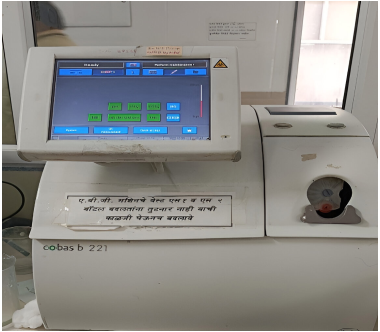
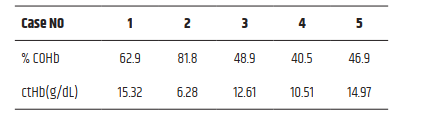
Cases of carbon monoxide (CO) poisoning are challenging for toxicology laboratories, on the other hand immediate confirmation of CO poisoning is sometimes very essential for investigating agencies. Though autopsy findings are self-sufficient for this confirmation, a laboratory validation adds more weightage. Currently, in many of our Regional Forensic Science Laboratories (RFSL), spectrophotometric analysis is used for the detection of Carboxy-haemoglobin (COHb). However, samples being susceptibile to alterations of optical state and degradation during sampling, transport and storage pose difficulties in analysis. Secondly reports from RFSL are received after much longer durations. However, hospitalbased blood gas analyzers with CO-oximetry, provide automated spectrophotometric measurement of concentration of total haemoglobin (ctHb) in blood along with that of other four haemoglobin derivatives and COHb levels, that too immediately and at a low cost. Over the background of delayed reporting from RFSL, we hereby discuss five cases of CO poisoning, confirmed with the help of hospital-based blood gas analyser.
References
- 1. Jaffe FA. Pathogenicity of Carbon Monoxide. American J Forensic Med Pathol 1997; 18:406-410.
- 2. V V Pillay. Comprehensive Medical Toxciology. 3rd edition. Hyderabad: Paras Medical Publisher; 2018.
- 3. Biswas Gautam. Review of Forensic Medicine and Toxicology. 5th edition. New Delhi: Jaypee Brothers Medical Publishers (P) Ltd; 2021.
- 4. Siek T, Rieders F. Determination of Carboxyhemoglobin in the Presence of Other Blood Hemoglobin Pigments by Visible Spectrophotometry. J. Forensic Sci 1984; 29(1): 39–54.
- 5. Lewis R, Jhonson R, Canfield D. An accurate method of determination of Carbon monoxide in postmortem blood using GC-TCD. J Ana Toxicol 2004; 28:59-62.
- 6. Bounba V, Vougiouklakis T. Evaluation of methods used for carboxyhemoglobin analysis in postmortem blood. Int J Toxicol 2005; 24:275-81.
- 7. Coburn R, Williams W, Forster RE. Effect of erythrocyte destruction on carbon monoxide production in man. J clin invest 1964; 43:1098-1103.
- 8. Lippi G, Rastelli G, Meschi T, Borghi L, Cervellin G. Pathophysiology clinics, diagnosis and treatment of heart involvement in carbon monoxide poisoning. Clin Biochem 2012; 45:1278- 85.
- 9. Levine B, D’Nicoula J, Kunsman G, Smith M, Stahl C. Meethodologic Considerations in interpretation of postmortem carboxyhemoglobin concentrations. Toxicology 1996; 115:129-34.
- 10. Lee CW, Tam J, Kung LK. Validity of CO-oximetric determination of Carboxyhemoglobin in putrefying blood and body cavity fluid. Forensic Sci Int 2003; 132:153-56.
Data Sharing Statement
There are no additional data available.
Funding
This research received no funding.
Author Contributions
All authors contributed significantly to the work and approve its publication.
Ethics Declaration
This article does not involve any human or animal subjects, and therefore does not require ethics approval.
Acknowledgements
We would like to thank, Dr. Abhay Jagtap, Associate Professor, Department of Biochemistry, BJGMC, Pune, for his valuable help in making us understand the functionality of hospital-based ABG Machine. We would also like to extend our thanks to Dr. Deepak Joshi, Dy Director, RFSL, Pune for his prompt response to queries regarding the methodology used forthe determination of COHb at RFSL, Pune.
Conflicts of Interest
The authors report no conflicts of interest in this work.
About this article

Cite this article
Nikam JJ, Tatiya HS, Vaidya HV, et al. Use of Hospital-Based Blood Gas Analyzer for Diagnosis of Carbon Monoxide Poisoning in Medicolegal Autopsy Cases: An Experience from Series of Cases. Indian J Forensic Med Pathol. 2024;17(4):293-296.
Licence:
Attribution-Non-commercial 4.0 International (CC BY-NC 4.0)This license enables reusers to distribute, remix, adapt, and build upon the material in any medium or format for noncommercial purposes only, and only so long as attribution is given to the creator.
| Received | Accepted | Published |
|---|---|---|
| September 20, 2024 | December 11, 2024 | December 15, 2024 |
DOI: https://doi.org/10.21088/ijfmp.0974.3383.17424.11
Keywords
Postmortem blood sampleHospital-based ABG machineCOHbCO-oximetrySpectrophotometrySearch for Similar Articles
Similar Articles
- Diatom Analysis in Thermophilic water bodies: A Study on Hot Water Springs of Ma...
- Morphometric Study of Supra-meatal Triangle and Mastoid process in the Adult dry...
- Histopathological Spectrum of Autopsy Cases: A One Year Retrospective Observatio...
- Forensic Differentiation of Manner of Death in Railway Fatalities: A FourCase Se...
- Understanding assault Patterns: A Cross-sectional study of Cases at Chri, Kelamb...
Article Level Metrics
Last UpdatedMonday 19 October 2026, 10:58:39 (IST)
16327
Accesses
24
3215
00
Citations
NA
NA
NA
Download citation
Article Keywords
Keyword Highlighting
Highlight selected keywords in the article text.
Timeline
| Received | September 20, 2024 |
| Accepted | December 11, 2024 |
| Published | December 15, 2024 |
licence
Attribution-Non-commercial 4.0 International (CC BY-NC 4.0)
This license enables reusers to distribute, remix, adapt, and build upon the material in any medium or format for noncommercial purposes only, and only so long as attribution is given to the creator.