Full Text (PDF)
Indian Journal of Forensic Medicine and Pathology 17(4):p 288-292, OCT. DEC. 2024. | DOI: https://doi.org/10.21088/ijfmp.0974.3383.17424.10
Original Article
EA Profile of Medicolegal Autopsy Cases at the Mortuary of A Tertiary Care Hospital in Ambala, Haryana
Vikram Jeet Singh, Kanika Kohli, K.K. Aggarwal, Arpan Kumar Pan, Abhishek Anand
Author Information
Licence:
Attribution-Non-commercial 4.0 International (CC BY-NC 4.0)This license enables reusers to distribute, remix, adapt, and build upon the material in any medium or format for noncommercial purposes only, and only so long as attribution is given to the creator.
Indian Journal of Forensic Medicine and Pathology 17(4):p 288-292, OCT. DEC. 2024. | DOI: https://doi.org/10.21088/ijfmp.0974.3383.17424.10
How Cite This Article:
Singh VJ, Kohli K, Aggarwal KK, et al. EA Profile of Medicolegal Autopsy Cases at the Mortuary of A Tertiary Care Hospital in Ambala, Haryana. Indian J Forensic Med Pathol. 2024;17(4):288-292.Timeline
Received : July 19, 2024
Accepted : December 13, 2024
Published : December 15, 2024
Abstract
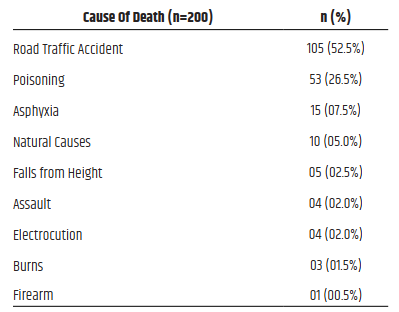
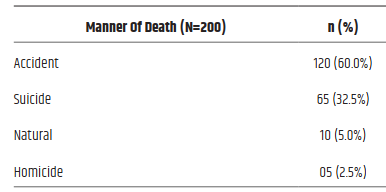
Background: Autopsies are critical in determining the cause and manner of death, providing valuable insights into mortality patterns, and forming public health strategies. Aims & Objectives: This study aims to determine the socio-demographic profile of the autopsy cases and compare the different autopsy cases conducted in a tertiary care hospital in rural Haryana to identify prevalent causes of death and highlight areas for public health intervention. Methodology: This is a prospective observational study include 200 autopsy cases conducted in the mortuary at a tertiary care hospital in Ambala, Haryana from March 1, 2023, to April 30, 2024. Data were collected from the postmortem examination findings and police inquests, and descriptive statistics were analyzed. Results: Of the 200 autopsy cases, majority, 170 (85%) were males. Most of the autopsies, 103 (51.5%) cases, were in the 21-40 years age group, followed by 54 (27%) cases in 41-60 years. Urban domicile constituted 125 (62.5%) of cases, indicating a higher prevalence of mortality events among individuals residing in urban areas. The majority 163 (81.5%) cases, were individuals of the Hindu faith. The most common cause of death was due to RTAs (105 cases, 52.5%), which resulted in head injuries, multiple mechanical injuries, hemorrhagic shock, etc., followed by poisoning, which constituted 53 (26.5%) of cases. Most of the autopsy cases were of accidental deaths, 120 (60.0%), followed by suicide, 65 (32.5%). Conclusion: The study highlights the urgent need for targeted public health interventions to address the high incidence of RTAs and poisoning in Haryana.
References
- 1. Perper JA. Time of death and changes after death: Part 1: anatomical considerations. In: Spitz WU (ed) Spitz and Fisher’s Medicolegal investigation of death, 3rd edn. Charlas Thomas Publisher, USA. 1993.p.14-50.
- 2. Kannan K, Mathiharan K. Ed. In: Modi-A textbook of Medical Jurisprudence and Toxicology. 24th Ed. LexisNexis Butterworth’s. Nagpur: 2012.p. 293, 295,297, 360.
- 3. Subrahmanyam BV. Parikh’s Textbook of Medical Jurisprudence, Forensic Medicine and Toxicology for Classrooms and Courtrooms. 6th ed. New Delhi: CBS Publishers and Distributors; 2011.p. 2.39,2.40.
- 4. Kotabagi R, Charati S, Jayachandar D. Clinical Autopsy vs Medicolegal Autopsy. Med J Armed Forces India. 2005;61(3):258-63.
- 5. Road accidents in India 2022 [Internet]. morth.nic.in. Ministry Of Road Transport And Highways (Transport Research Wing); 2023 [cited 2024 May 31]. Available from: https://morth.nic. in/sites/default/files/RA_2022_30_Oct. pdf.
- 6. Singh SP, Aggarwal AD, Oberoi SS, Aggarwal KK, Thind AS, Bhullar DS, Walia DS, Chahal PS. Study of poisoning trends in north India–a perspective in relation to world statistics. Forensic Leg Med. 2013 Jan 1;20(1):14-8.
- 7. Garg V, Verma SK. Trends of poisoning in rural area of South-West, Punjab. Journal of Indian Academy of Forensic Medicine. 2010;32(3):189-93.
- 8. Patel JB, Chandegara PV, Patel UP, Parkhe SN, Govekar G. Profile of autopsy cases at New Civil Hospital, Surat: a retrospective study. Int J Med Sci Public Health. 2016 Jan 1;5(1):10-3.
- 9. Sarala M, Manral I, Kumar T, et al. Epidemiologocial Profile of MedicoLegal Cases at Tertiary Care Centre in Eastern India. Indian J Forensic Med Pathol.2024;17(1):51-55.
- 10. Subedi N, Yadav BN, Jha S, Shah D, Shrestha U, Sharma A, Rai MK. The spectrum of autopsy in a tertiary referral center in Eastern Nepal. Res Rep Forensic Med Sci. 2013;3:7-12.
- 11. Crimmins EM, Shim H, Zhang YS, Kim JK. Differences between men and women in mortality and the health dimensions of the morbidity process. Clin Chem. 2019;65(1):135-45.
- 12. Wang H, Abajobir AA, Abate KH, et al. Global, regional, and national under-5 mortality, adult mortality, age-specific mortality, and life expectancy, 1970– 2016: a systematic analysis for the Global Burden of Disease Study 2016. Lancet. 2017;390(10100):1084-150.
- 13. Jaglan S, Aggarwal P, Singhal D, Dass S. Vulnerable road user accidents analysis on various roads of Haryana. In: AIP Conference Proceedings. AIP Publishing.2023 Sep 22; Vol. 2856, No. 1. https://doi.org/10.1063/5.0165909.
- 14. Molina-Guzmán LP, Ríos-Osorio LA. Occupational health and safety in agriculture: A systematic review. Rev Fac Med. 2020;68(4):625-38.
- 15. Singh K, Junnarkar MO, Singh D, Suchday S, Mitra S, Dayal P. Associations between religious/ spiritual practices and well-being in Indian elderly rural women. J Relig Health. 2020;59:2753-74.
- 16. Mohan VR, Muliyil J. Mortality patterns and the effect of socioeconomic factors on mortality in rural Tamil Nadu, south India: A community-based cohort study. Trans R Soc Trop Med Hyg. 2009;103(8):801-6.
- 17. Roth GA, Johnson C, Abajobir A, et al. Global, regional, and national burden of cardiovascular diseases for 10 causes, 1990 to 2015. J Am Coll Cardiol. 2017;70(1):1-25.
- 18. Kumar P, Singh R, Buri S, Pal C, Saini O, Kumar S. Profile of medicolegal autopsy cases conducted at tertiary care centre in Bikaner, Rajasthan: A one year retrospective study. Int J Med Biomed Stud. 2020;4(8).
- 19. Junaidi KA, Pujar S, Honnungar RS, Jirli PS, Koulapur V, Ali K, et al. Profile of medicolegal autopsy cases at tertiary care centre in Belagavi, Karnataka. A one year retrospective study. Medicolegal Update. 2020;20:170-4.
Data Sharing Statement
There are no additional data available.
Funding
This research received no specific grant from funding agencies in the public, commercial, or not for-profit sectors.
Author Contributions
All authors have contributed equally to the study and approved the final draft of the manuscript.
Ethics Declaration
The ethical approval for the study was obtained from the Institutional Ethics Committee, Maharishi Markandeshwar Institute of Medical Sciences and Research (MMIMSR), Mullana, Ambala, Haryana (IEC-2596/MMIMSR).
Acknowledgements
Information not provide.
Conflicts of Interest
The authors report no conflicts of interest in this work.
About this article

Cite this article
Singh VJ, Kohli K, Aggarwal KK, et al. EA Profile of Medicolegal Autopsy Cases at the Mortuary of A Tertiary Care Hospital in Ambala, Haryana. Indian J Forensic Med Pathol. 2024;17(4):288-292.
Licence:
Attribution-Non-commercial 4.0 International (CC BY-NC 4.0)This license enables reusers to distribute, remix, adapt, and build upon the material in any medium or format for noncommercial purposes only, and only so long as attribution is given to the creator.
| Received | Accepted | Published |
|---|---|---|
| July 19, 2024 | December 13, 2024 | December 15, 2024 |
DOI: https://doi.org/10.21088/ijfmp.0974.3383.17424.10
Keywords
Medicolegal AutopsyRoad traffic accidentsPoisoningManner of deathAccidental deathsSearch for Similar Articles
Similar Articles
- Diatom Analysis in Thermophilic water bodies: A Study on Hot Water Springs of Ma...
- Morphometric Study of Supra-meatal Triangle and Mastoid process in the Adult dry...
- Histopathological Spectrum of Autopsy Cases: A One Year Retrospective Observatio...
- Forensic Differentiation of Manner of Death in Railway Fatalities: A FourCase Se...
- Understanding assault Patterns: A Cross-sectional study of Cases at Chri, Kelamb...
Article Level Metrics
Last UpdatedMonday 19 October 2026, 10:58:39 (IST)
16327
Accesses
15
3215
00
Citations
NA
NA
NA
Download citation
Article Keywords
Keyword Highlighting
Highlight selected keywords in the article text.
Timeline
| Received | July 19, 2024 |
| Accepted | December 13, 2024 |
| Published | December 15, 2024 |
licence
Attribution-Non-commercial 4.0 International (CC BY-NC 4.0)
This license enables reusers to distribute, remix, adapt, and build upon the material in any medium or format for noncommercial purposes only, and only so long as attribution is given to the creator.