Full Text (PDF)
Indian Journal of Forensic Medicine and Pathology 18((2 Suppl)):p 233-242, April-June 2025. | DOI: https://doi.org/10.21088/ijfmp.0974.3383.18225.24
Review Article
Role of Titanium Dioxide Nanoparticles in Forensic Science
Kajol Bhati, Parthasarathy K.P, Arkapravo Dey, Rajeev Kumar
Author Information
Licence:
Attribution-Non-commercial 4.0 International (CC BY-NC 4.0)This license enables reusers to distribute, remix, adapt, and build upon the material in any medium or format for noncommercial purposes only, and only so long as attribution is given to the creator.
Indian Journal of Forensic Medicine and Pathology 18((2 Suppl)):p 233-242, April-June 2025. | DOI: https://doi.org/10.21088/ijfmp.0974.3383.18225.24
How Cite This Article:
Parthasarathy KP, Dey A, Bhati K, et al. Role of Titanium Dioxide Nanoparticles in Forensic Science. Indian J Forensic Med Pathol. 2025;18(2 Suppl):233-242.Timeline
Received : April 02, 2024
Accepted : June 13, 2025
Published : June 30, 2025
Abstract
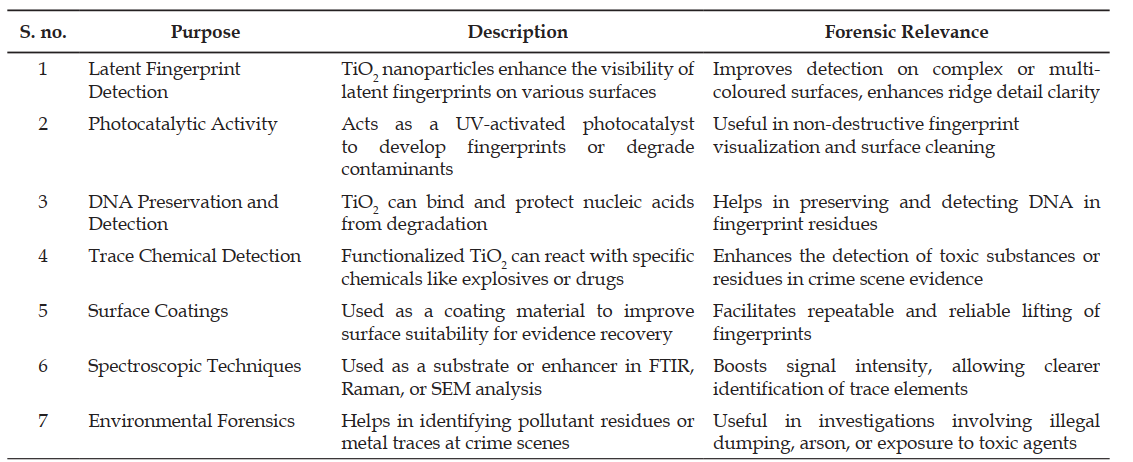
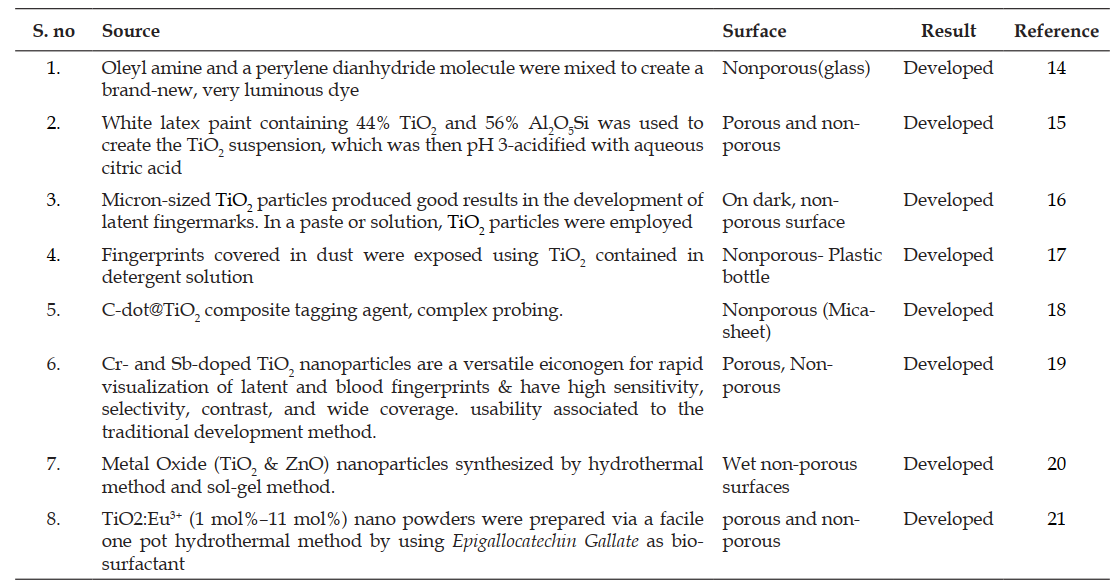
The use of science in the criminal justice system is known as forensic science. Justice is upheld through a proper analysis and assessment of the evidence. Due to factors like fire, explosion, environmental changes, water, dirt, and many others, crime scenes are usually damaged. The most reliable method of identifying a person is by their fingerprints, which is also one of the evidence types that are most frequently found at crime scenes. The perpetrator frequently makes a concerted effort to destroy a fingerprint that contains crucial evidence. Due to their extreme sensitivity, nanoparticles are used to improve latent fingerprints on porous, semiporous, and nonporous surfaces. The problem with the traditional fingerprint development technique is that it is not that durable for a longer period of time. The particle size of the black powder and the other nano traditional powders are much more as compared to the size of the particles. In addition to adhesives, titanium dioxide (TiO2), a common paint pigment, can be suspended in a surfactant and utilized as a powder suspension to remove latent impressions from a variety of surfaces. It is a tiny, non-flammable, non-toxic powder that is white in color and smaller than one micron in diameter. Aflatoxin genes can be identified using forensic genetics by adding silver and titanium dioxide nanoparticles to real-time PCR. It can also be used to detect explosives. Similarly, there are other applications as well. Therefore, this review paper will discuss the use of titanium dioxide nanoparticles in forensic research.
References
- 1. Jickells S., Wolstenholme R., Forbes S. Introduction to Forensic Science. Anal Tech Forensic Sci 2021: 1–33.
- 2. Morgan R.M. Conceptualising forensic science and forensic reconstruction. Part I: a conceptual model. Sci & Justice 2017; 57: 455–9.
- 3. Bhati K. Role of Nanoparticles in Latent Fingerprinting: An Update. Lett Appl NanoBioScience 2020; 9: 1427–43. https://doi. org/10.33263/lianbs93.14271443.
- 4. Bhati K., Tripathy D., Chhabra P. Role of Fluorescent Substances in Development of Latent Fingerprints: A Review. Indian J Forensic Med Pathol 2021; 14: 351–8. https:// doi.org/10.21088/ijfmp.0974.3383.14221.49.
- 5. Wang M., Ju J., Zhu Z., Shen D., Li M., Yuan C, et al. Recent progress in nanomaterial-based fluorescent development of latent fingerprints. Sci Sin Chim 2019; 49: 1425–41.
- 6. Bhati K., Bajpai Tripathy D., Kumaravel V., Sudhani H.P.K., Ali S., Choudhary R., et al. Sensitive Fingerprint Detection Using Biocompatible Mesoporous Silica Nanoparticle Coating on Non-Porous Surfaces. Coatings 2023; 13. https://doi.org/10.3390/ coatings13020268.
- 7. Chen Y.F. Forensic applications of nanotechnology. J Chinese Chem Soc 2011; 58: 828–35. https://doi.org/10.1002/ jccs.201190129.
- 8. Rawtani D., Hussain C.M. Technology in Forensic Science: Sampling, Analysis, Data and Regulations. John Wiley & Sons; 2020.
- 9. Pandya A., Shukla R.K. New perspective of nanotechnology: role in preventive forensic. Egypt J Forensic Sci 2018; 8: 1–11.
- 10. Otieno-Alego V. Some forensic applications of a combined micro-Raman and scanning electron microscopy system. J Raman Spectrosc An Int J Orig Work All Asp Raman Spectrosc Incl High Order Process Also Brillouin Rayleigh Scatt 2009; 40: 948–53.
- 11. Sharma V., Choudhary S., Mankotia P., Kumari A, Sharma K., Sehgal R., et al. Nanoparticles as fingermark sensors. TrAC Trends Anal Chem 2021; 143: 116378.
- 12. Yadav H.J.A., Eraiah B., Basavaraj RB, Nagabhushana H., Darshan G.P., Sharma S.C., et al. Rapid synthesis of C-dot@ TiO2 core-shell composite labeling agent: Probing of complex fingerprints recovery in fresh water. J Alloys Compd 2018; 742: 1006–18.
- 13. Sharma J., Dave P.Y. One step chemical synthesis of carbon dot based smart fluorescent security ink. Synthesis (Stuttg) 2020; 5. 14. Gares K.L., Hufziger K.T., Bykov S.V., Asher S.A. Review of explosive detection methodologies and the emergence of standoff deep UV resonance Raman. J Raman Spectrosc 2016; 47: 124–41.
- 15. Mahmoud M.A., Afifi M.I., Al-Othman M.R., Abd El-Aziz ARM. Addition of silver and titanium dioxide nanoparticles to realtime PCR for the detection Aspergillus Spp. and aflatoxin genes. Dig J Nanoparticles Biostructures 2017; 12: 1041–8.
- 16. Shukla R.K. Nanotechnology: An Applied and Robust Approach for Forensic Investigation. Foresic Res Criminol Int J 2016; 2:35–7. 17. Prasad V., Lukose S., Agarwal P., Prasad L. Role of Nanomaterials for Forensic Investigation and Latent Fingerprinting—A Review. J Forensic Sci 2020; 65: 26–36. https:// doi.org/10.1111/1556-4029.14172.
- 18. Aggarwal P., Chitkara M. Detection of Metabolites in Latent Fingerprints Through Green Nanoparticles for Both Forensic Investigations and Medical Purposes. ECS Trans 2022; 107: 10593.
- 19. Choi M.J., Smoother T., Martin A.A., McDonagh A.M., Maynard P.J., Lennard C, et al. Fluorescent TiO 2 powders prepared using a new perylene diimide dye: Applications in latent fingermark detection. Forensic Sci Int 2007; 173: 154–60.
- 20. Schiemer C., Lennard C., Maynard P., Roux C. Evaluation of techniques for the detection and enhancement of latent fingermarks on black electrical tape. J Forensic Identif 2005; 55: 214.
- 21. Polimeni G., Foti B.F., Saravo L., De Fulvio G. A novel approach to identify the presence of fingerprints on wet surfaces. Forensic Sci Int 2004; 146: S45-S46.
- 22. Kumar P., Singh S., Gupta B.K. Future prospects of luminescent nanomaterial based security inks: from synthesis to anti-counterfeiting applications. Nanoscale 2016; 8: 14297–340.
- 23. Cheng K., Qi R., Lan S., Wang H., Zheng X., Liu C., et al. Tunable excitation-dependentfluorescence of carbon dots: Fingerprint curves for super anti-counterfeiting. Dye Pigment 2020; 174: 108106.
- 24. Liu Y., Ai K., Lu L. Designing lanthanidedoped nanocrystals with both up-and down-conversion luminescence for anticounterfeiting. Nanoscale 2011; 3: 4804–10.
- 25. Singh V.K., Chitumalla R.K., Ravi S.K., Zhang Y., Xi Y., Sanjairaj V., et al. Inkjetprintable hydrochromic paper for encrypting information and anticounterfeiting. ACS Appl Mater & Interfaces 2017; 9: 33071–9.
- 26. Kumar P., Dwivedi J., Gupta B.K. Highly luminescent dual mode rare-earth nanorod assisted multi-stage excitable security ink for anti-counterfeiting applications. J Mater Chem C 2014; 2: 10468–75.
- 27. Cheng H., Lu Y., Zhu D., Rosa L., Han F., Ma M., et al. Plasmonic nanopapers: flexible, stable and sensitive multiplex PUF tags for unclonable anti-counterfeiting applications. Nanoscale 2020; 12: 9471–80.
- 28. Singh A., Arya S., Khanuja M., Hafiz A.K., Datt R., Gupta V., et al. Eu doped NaYF 4@ Er: TiO 2 nanoparticles for tunable ultraviolet light based anti-counterfeiting applications. Microsyst Technol 2020: 1–10.
- 29. Filanovsky B., Markovsky B., Bourenko T., Perkas N., Persky R., Gedanken A., et al. Carbon electrodes modified with TiO2/metal nanoparticles and their application for the detection of trinitrotoluene. Adv Funct Mater 2007; 17: 1487–92.
- 30. Matyas R., Pachman J. Primary explosives. Springer; 2013.
- 31. Kishi T., Nakamura J., Komo-oka Y., Fukuda H. A scheme for the analysis of explosives and explosive residues in Japan. Adv. Anal. Detect. Explos. Proc. 4th Int. Symp. Anal. Detect. Explos. Sept. 7-10, 1992, Jerusalem, Isr., 1993, p. 11–7.
- 32. Beer S., Müller G., Wöllenstein J. 6.4. 2 A Particle Sampler for Trace Detection of Explosives. Tagungsband 2012: 553–4.
- 33. Wang D.L., Chen A.T., Zhang Q.F., Cao G.Z. Room-Temperature Chemiresistive Effect of $$\{$$\backslash$rm TiO$\}$ \_ $\{$2$\}$$\backslash$!-$\backslash$!$\ {$$\backslash$rm B$\}$ $ Nanowires to Nitroaromatic and Nitroamine Explosives. IEEE Sens J 2010; 11: 1352–8.
- 34. Banerjee S., Mohapatra S.K., Misra M., Mishra I.B. The detection of improvised nonmilitary peroxide based explosives using a titania nanotube array sensor. Nanotechnology 2009; 20: 75502.
- 35. Ben-Jaber S., Peveler W.J., Quesada-Cabrera R., Cortés E., Sotelo-Vazquez C., Abdul-Karim N., et al. Photo-induced enhanced Raman spectroscopy for universal ultra-trace detection of explosives, pollutants and biomolecules. Nat Commun 2016; 7: 12189.
- 36. Son J.H., Hong S., Haack A.J., Gustafson L., Song M., Hoxha O., et al. Rapid optical cavity PCR. Adv Healthc Mater 2016; 5: 167–74.
- 37. Amadeh A., Ghazimirsaeed E., Shamloo A., Dizani M. Improving the performance of a photonic PCR system using TiO2 nanoparticles. J Ind Eng Chem 2021; 94: 195–204.
- 38. Amin M.O., Al-Hetlani E. Development of efficient SALDI substrate based on Au-TiO 2 nanohybrids for environmental and forensic detection of dyes and NSAIDs. Talanta 2021; 233: 122530.
Data Sharing Statement
There are no additional data available. All raw data and code are available upon request.
Funding
This research received no funding.
Author Contributions
All authors contributed significantly to the work and approve its publication.
Ethics Declaration
This article does not involve any human or animal subjects, and therefore does not require ethics approval.
Acknowledgements
We would like to express our gratitude to the patients, their families, and all those who have contributed to this study.
Conflicts of Interest
No conflicts of interest.
About this article

Cite this article
Parthasarathy KP, Dey A, Bhati K, et al. Role of Titanium Dioxide Nanoparticles in Forensic Science. Indian J Forensic Med Pathol. 2025;18(2 Suppl):233-242.
Licence:
Attribution-Non-commercial 4.0 International (CC BY-NC 4.0)This license enables reusers to distribute, remix, adapt, and build upon the material in any medium or format for noncommercial purposes only, and only so long as attribution is given to the creator.
| Received | Accepted | Published |
|---|---|---|
| April 02, 2024 | June 13, 2025 | June 30, 2025 |
DOI: https://doi.org/10.21088/ijfmp.0974.3383.18225.24
Keywords
Titanium dioxideForensic scienceFingerprintsExplosivesDNAGeneticsSearch for Similar Articles
Similar Articles
- Diatom Analysis in Thermophilic water bodies: A Study on Hot Water Springs of Ma...
- Morphometric Study of Supra-meatal Triangle and Mastoid process in the Adult dry...
- Histopathological Spectrum of Autopsy Cases: A One Year Retrospective Observatio...
- Forensic Differentiation of Manner of Death in Railway Fatalities: A FourCase Se...
- Understanding assault Patterns: A Cross-sectional study of Cases at Chri, Kelamb...
Article Level Metrics
Last UpdatedSunday 18 October 2026, 15:53:20 (IST)
16279
Accesses
72
3209
00
Citations
NA
NA
NA
Download citation
Article Keywords
Keyword Highlighting
Highlight selected keywords in the article text.
Timeline
| Received | April 02, 2024 |
| Accepted | June 13, 2025 |
| Published | June 30, 2025 |
licence
Attribution-Non-commercial 4.0 International (CC BY-NC 4.0)
This license enables reusers to distribute, remix, adapt, and build upon the material in any medium or format for noncommercial purposes only, and only so long as attribution is given to the creator.