Full Text (PDF)
New Indian Journal of Surgery 17(2):p 65-70, April-June 2026. | DOI: https://doi.org/10.21088/nijs.0976.4747.17226.4
Original Article
Robotic Inguinal Hernia Repair: A Review of Meta-Analyses Comparing Operative Outcomes and Safety
Author Information
Licence:
Attribution-Non-commercial 4.0 International (CC BY-NC 4.0)This license
enables reusers to distribute, remix, adapt, and build upon the material in any
medium or format for noncommercial purposes only, and only so long as
attribution is given to the creator.
New Indian Journal of Surgery 17(2):p 65-70, April-June 2026. | DOI: https://doi.org/10.21088/nijs.0976.4747.17226.4
How Cite This Article:
Arjun C., Abhijith M.H. Robotic Inguinal Hernia Repair: A Review of Meta-Analyses Comparing Operative Outcomes and Safety. New Indian J Surg. 2025; 17(2): 65-70.Timeline
Received : February 21, 2026
Accepted : March 23, 2026
Published : June 30, 2026
Abstract
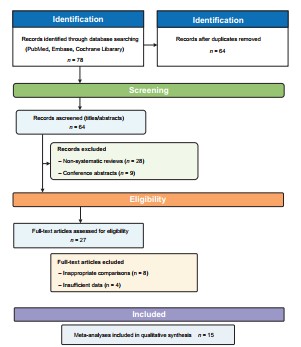
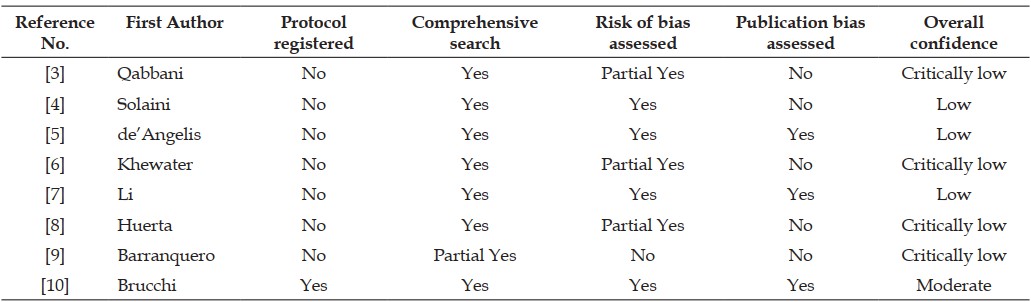
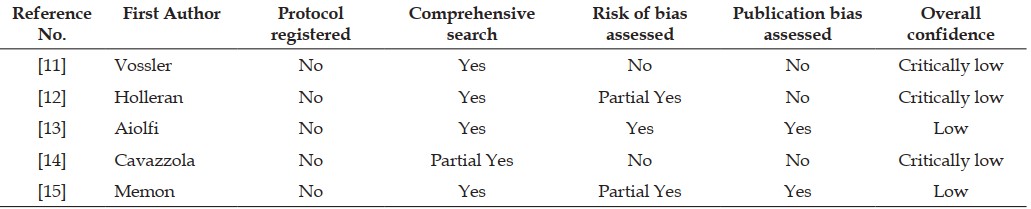
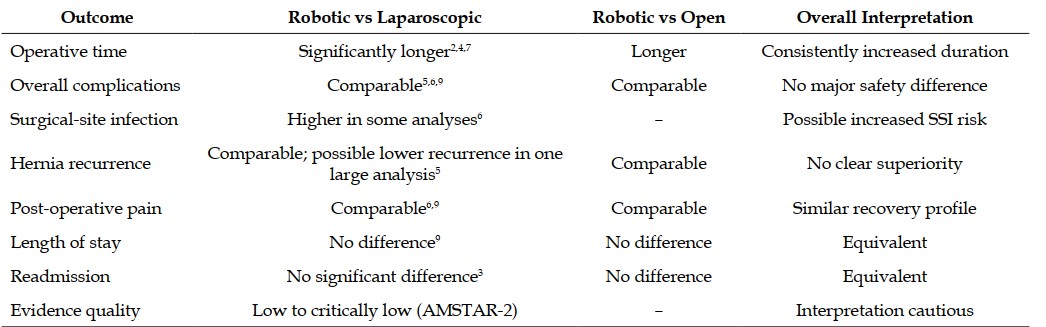
Background: Robotic inguinal hernia repair (RIHR) has gained increasing adoption in minimally invasive surgery; however, its clinical advantages over conventional laparoscopic and open techniques remain uncertain. Methods: This review was conducted in accordance with PRISMA 2020 guidelines. Published systematic reviews and meta-analyses comparing robotic, laparoscopic, and open inguinal hernia repair in adult patients were identified. Methodological quality was assessed using the AMSTAR-2 tool. Outcomes evaluated included operative time, postoperative complications, hernia recurrence, postoperative pain, length of hospital stay, and readmission. Results: Fifteen meta-analyses encompassing more than 200,000 patients were included. Robotic inguinal hernia repair was consistently associated with longer operative times compared with laparoscopic and open techniques. Overall complication rates, hernia recurrence, postoperative pain, and readmission were largely comparable between robotic and conventional approaches. Some analyses reported a higher incidence of surgical-site infection following robotic repair. All included reviews were rated as low or critically low quality using AMSTAR-2. Conclusion: Current meta-analytic evidence suggests that robotic inguinal hernia repair is a safe and effective alternative to established techniques, with comparable clinical outcomes but longer operative duration. High-quality randomized trials and cost-effectiveness studies are required to define its definitive role in clinical practice.
References
- 1. Page M.J., McKenzie J.E., Bossuyt P.M., et al. The PRISMA 2020 statement: an updated guideline for reporting systematic reviews. Int J Surg 2021; 88: 105906. DOI: 10.1016/j.ijsu.2021.105906.
- 2. Abdullah A., Saeed H., Ahmad M.H. Enhancing clarity and methodological rigor in umbrella reviews. Ann Med Surg (Lond) 2024; 86: 6352–4. DOI:10.1097/MS9.0000000000002536.
- 3. Qabbani A., Aboumarzouk O.M., ElBakry T., et al. Robotic inguinal hernia repair: systematic review and meta-analysis. ANZ J Surg 2021; 91(11): 2277–87. DOI: 10.1111/ans.16505.
- 4. Solaini L., Cavaliere D., Avanzolini A, Rocco G, Ercolani G. Robotic versus laparoscopic inguinal hernia repair: an updated systematic review and meta-analysis. J Robot Surg 2022; 16(4): 775–81. DOI: 10.1007/s11701-021-01312-6.
- 5. de’Angelis N., Schena C.A., Moszkowicz D., et al. Robotic surgery for inguinal and ventral hernia repair: A systematic review and metaanalysis. Surg Endosc 2024; 38(1): 24–46. DOI: 10.1007/s00464-023-10545-5.
- 6. Khewater T., Al Madshush A.M., Altidlawi M.I., et al. Comparing robot-assisted and laparoscopic inguinal hernia repair: a systematic review and meta-analysis. Cureus 2024; 16(5): e60959. DOI: 10.7759/cureus.60959.
- 7. Li X., Li Y.J., Dong H., Wang D.C., Wei J. Meta-analysis of the effectiveness and safety of robotic-assisted versus laparoscopic transabdominal preperitoneal repair for inguinal hernia. PLoS One 2024; 19(2): e0298989. DOI: 10.1371/journal.pone.0298989.
- 8. Huerta S. A systematic review of open, laparoscopic, and robotic inguinal hernia repair: management of inguinal hernias in the 21st century. J Clin Med 2025; 14(3): 990. DOI: 10.3390/jcm14030990.
- 9. Barranquero A.G., Martín Ferrero L, González A. Robotic or laparoscopic inguinal hernia repair? A narrative review of the current literature. Laparosc Endosc Robot Surg 2025; DOI: 10.1016/j.lers.2025.12.001.
- 10. Brucchi F., Sassun R., Lauricella S., et al. Robotic vs. laparoscopic TAPP: systematic review and meta-analysis of randomized trials on shortterm outcomes. Hernia 2026; 30(1): 36. DOI: 10.1007/s10029-025-03550-1.
- 11. Vossler J., Pavlosky C., Patel N., et al. Predictors of robotic versus laparoscopic inguinal hernia repair: analysis of 29000 cases. J Surg Res 2019; 241: 247–53. DOI: 10.1016/j.jss.2019.03.056.
- 12. Holleran T.J., Napolitano M.A., Sparks A.D., El-Sayed I.H. Trends and outcomes of open, laparoscopic, and robotic inguinal hernia repair in the Veterans Affairs system. Hernia 2022; 26(2): 313–21. DOI: 10.1007/s10029-021-02419-3.
- 13. Aiolfi A., Cavalli M., Micheletto G., et al. Primary inguinal hernia: systematic review and Bayesian network meta-analysis comparing open, laparoscopic TAPP, TEP, and robotic preperitoneal repair. Hernia 2019; 23(3): 473–84. DOI: 10.1007/s10029-019-01964-2.
- 14. Cavazzola E.J. Inguinal hernia repair: is there a benefit to using the robot? Surg Endosc 2018; 32(4): 2131–6. DOI: 10.1007/s00464-017-5911-4.
- 15. Memon M.A., Cooper N.J., Memon B., et al. Comparison of open mesh versus laparoscopic mesh repair of inguinal hernias: systematic review and meta-analysis of randomized and nonrandomized controlled trials. Br J Surg 2003; 90(5): 450–6. DOI: 10.1002/bjs.4134.
Data Sharing Statement
There are no additional data available. All raw data and code are available upon request.
Funding
This research received no funding.
Author Contributions
All authors contributed significantly to the work and approve its publication.
Ethics Declaration
This article does not involve any human or animal subjects, and therefore does not require ethics approval.
Acknowledgements
We would like to express our gratitude to the patients, their families, and all those who have contributed to this study.
Conflicts of Interest
No conflicts of interest in this work.
About this article

Cite this article
Arjun C., Abhijith M.H. Robotic Inguinal Hernia Repair: A Review of Meta-Analyses Comparing Operative Outcomes and Safety. New Indian J Surg. 2025; 17(2): 65-70.
Licence:
Attribution-Non-commercial 4.0 International (CC BY-NC 4.0)This license
enables reusers to distribute, remix, adapt, and build upon the material in any
medium or format for noncommercial purposes only, and only so long as
attribution is given to the creator.
| Received | Accepted | Published |
|---|---|---|
| February 21, 2026 | March 23, 2026 | June 30, 2026 |
DOI: https://doi.org/10.21088/nijs.0976.4747.17226.4
Keywords
Robotic surgeryInguinal herniaUmbrella reviewMeta-analysisLaparoscopic hernia repairSearch for Similar Articles
Similar Articles
- Laparoscopy-Guided Bilateral Oblique Subcostal Transversus Abdominis Plane Bloc...
- Recognizing the Columnar Cell Subtype of Papillary Thyroid Carcinoma: A Case Rep...
- Randomized Controlled Study To Compare Intraperitoneal Plus Port-Site Instillat...
- Single Preoperative Dose Versus Conventional Multidose Antibiotic Prophylaxis In...
- To Compare the Dissection of Gallbladder by Ultrasonic Harmonic Scalpel Versus...
Article Level Metrics
Last UpdatedWednesday 30 September 2026, 14:45:52 (IST)
5309
Accesses
22
438
00
Citations
NA
NA
NA
Download citation
Article Keywords
Keyword Highlighting
Highlight selected keywords in the article text.
Timeline
| Received | February 21, 2026 |
| Accepted | March 23, 2026 |
| Published | June 30, 2026 |
licence
Attribution-Non-commercial 4.0 International (CC BY-NC 4.0)
This license
enables reusers to distribute, remix, adapt, and build upon the material in any
medium or format for noncommercial purposes only, and only so long as
attribution is given to the creator.