Full Text (PDF)
New Indian Journal of Surgery 17(3):p 115-120, July - Sept. 2026. | DOI: https://doi.org/10.21088/nijs.0976.4747.17326.4
Original Article
Single Preoperative Dose Versus Conventional Multidose Antibiotic Prophylaxis In Elective Laparoscopic Cholecystectomy
Arnav Kumar Dayal, R.K. Kajla, Sanjay Choudhary
Author Information
Licence:
Attribution-Non-commercial 4.0 International (CC BY-NC 4.0)This license enables reusers to distribute, remix, adapt, and build upon the material in any medium or format for noncommercial purposes only, and only so long as attribution is given to the creator.
New Indian Journal of Surgery 17(3):p 115-120, July - Sept. 2026. | DOI: https://doi.org/10.21088/nijs.0976.4747.17326.4
How Cite This Article:
Arnav Kumar Dayal, R. K. Kajla, Sanjay Choudhary. Single Preoperative Dose Versus Conventional Multidose Antibiotic Prophylaxis In Elective Laparoscopic Cholecystectomy. New Indian J Surg. 2026; 17(3): 115-120.Timeline
Received : July 07, 2026
Accepted : August 15, 2026
Published : September 30, 2026
Abstract
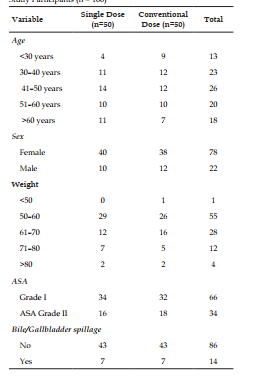
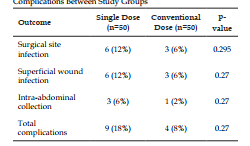
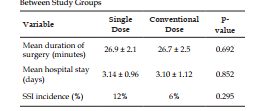
Introduction: Even with all the progress made in minimally invasive surgery, surgical site infection (SSI) still ranks among the more troublesome complications following laparoscopic cholecystectomy. Antibiotic prophylaxis is standard practice, but how long it should be continued is still up for debate. Giving more antibiotics than necessary only adds to healthcare costs, raises the chance of adverse drug reactions, and feeds into the wider problem of antimicrobial resistance which is why it’s worth asking whether a single preoperative dose can hold its own against the conventional multidose approach. Objectives: To compare rates of surgical site infection and other postoperative outcomes between patients given a single preoperative antibiotic dose and those given the conventional multidose regimen during elective laparoscopic cholecystectomy. Methods: This randomized controlled comparative study was carried out in the Department of General Surgery, Sardar Patel Medical College and Associated Group of Hospitals, Bikaner, Rajasthan. One hundred patients undergoing elective laparoscopic cholecystectomy were enrolled and split evenly into two groups of 50. Group A was given a single preoperative intravenous dose of cefotaxime and sulbactam (1.5 g), while Group B received the conventional multidose prophylaxis regimen. Patients were tracked for four weeks after surgery to catch any surgical site infection or other complications. Data were analysed in SPSS, with p<0.05 taken as significant. Results: Baseline age and clinical characteristics were similar across both groups. Surgical site infection turned up in 12% of the single-dose group compared with 6% of the multidose group, though this gap didn’t reach statistical significance (p=0.295). Surgery took an average of 26.9 ± 2.1 minutes in the single-dose group versus 26.7 ± 2.5 minutes in the multidose group (p=0.692), and hospital stays averaged 3.14 ± 0.96 days and 3.10 ± 1.12 days respectively (p=0.852). Postoperative complications were much the same in both groups (p=0.27). Conclusion: A single preoperative antibiotic dose held up just as well as conventional multidose therapy in terms of both efficacy and safety in elective laparoscopic cholecystectomy. In uncomplicated cases, there seems little reason to continue antibiotics after surgery, since skipping the extra doses doesn’t appear to raise the risk of surgical site infection.
References
- 1. Asad U, Wang CF, Jones MW. Laparoscopic cholecystectomy. In: StatPearls [Internet]. Treasure Island (FL): StatPearls Publishing; 2026.
- 2. Pak M, Lindseth G. Risk factors for cholelithiasis. Gastroenterol Nurs. 2016;39(4):297-309.
- 3. Mannam R, Sankara Narayanan R, Bansal A, Yanamaladoddi VR, Sarvepalli SS, Vemula SL, et al. Laparoscopic cholecystectomy versus open cholecystectomy in acute cholecystitis: a literature review. Cureus. 2023;15(9):e45704.
- 4. Prakash P, Jaiswal S, Choudhary S, Kumar B. Comparative outcomes of laparoscopic versus open cholecystectomy in an Indian tertiary center. Int J Acad Med Pharm. 2025;7(4): 156-159.
- 5. Rezaei AR, Zienkiewicz D, Rezaei AR. Surgical site infections: a comprehensive review. J Trauma Inj. 2025;38(2):71-81.
- 6. Kirkland KB, Briggs JP, Trivette SL, Wilkinson WE, Sexton DJ. The impact of surgical-site infections in the 1990s: attributable mortality, excess length of hospitalization, and extra costs. Infect Control Hosp Epidemiol. 1999;20(11):725-730.
- 7. Tahir MF, Mughal S, Nadeem A, Khan M, Hannat R, Amin MHJ. Reducing the burden of surgical site infections in low- and middle-income countries: challenges and recommendations. Ann Med Surg (Lond). 2025;87(8):5335-5337.
- 8. Eckmann C, Aghdassi SJS, Brinkmann A, Pletz M, Rademacher J. Perioperative antibiotic prophylaxis—indications and modalities for the prevention of postoperative wound infection. Dtsch Arztebl Int. 2024;121(7):233- 242.
- 9. Crader MF, Varacallo MA. Preoperative antibiotic prophylaxis. In: StatPearls [Internet]. Treasure Island (FL): StatPearls Publishing; 2026.
- 10. Garnier M, Saint-Genis Q, Roger C, Guilhaumou R, Leone M, Boisson M. Perioperative antimicrobial prophylaxis and surgical site infection prevention: what clinicians and researchers must know. Anaesth Crit Care Pain Med. 2025;44(6):101600.
- 11. Patel D, Tripathi S, Dey A, Mittal T, Malik VK. Efficacy of single-dose versus tripledose perioperative antimicrobial prophylaxis in patients undergoing laparoscopic cholecystectomy. Curr Med Res Pract. 2024;14(3):111-116.
- 12. Zafar MA, Butt MQ, Ghani U, Azeem MT, Farooq MZ, Malik IF. Antibiotics in laparoscopic cholecystectomy: outcomes in single versus multiple dose prophylaxis in terms of surgical site infections. Pak Armed Forces Med J. 2024;74(6):1481-1485.
- 13. Islam M, Khan MMR, Anwar SM, Khan HA, Asifuddoula, Karim S. Single dose prophylactic versus multiple dose antibiotics for reducing surgical site infection in elective laparoscopic cholecystectomy. Chattagram Maa-O-Shishu Hosp Med Coll J. 2024;23(1):34-36.
- 14. Chaudhary R, Sharma S, Chaudhary S, Thakur S, Shukla A, Sharma M. A prospective study comparing single with multiple antibiotic prophylaxis dose in elective cholecystectomy. Ann Int Med Dent Res. 2015;1(1):29-33.
- 16. Bhargava S, Singh R, Banga P. To compare the effectiveness of a single dose of preventive antibiotic with the use of empirical postoperative antibiotics in preventing surgical site infection. Int J Life Sci Biotechnol Pharma Res. 2024;13(2):293-298.
- 17. Smith JP, Samra NS, Ballard DH, Moss JB, Griffen FD. Prophylactic antibiotics for elective laparoscopic cholecystectomy. Am Surg. 2018;84(4):576-580.
- 18. Ahmed NJ, Haseeb A, AlQarni A, AlGethamy M, Mahrous AJ, Alshehri AM, et al. Antibiotics for preventing infection at the surgical site: single dose versus multiple doses. Saudi Pharm J. 2023;31(12):101800.
- 19. Gupta KP, Singh DP. Efficacy of single dose versus multiple dose of pre-operative antibiotic: teaching hospital based study. Acad J Surg. 2020;3(2):25-29.
- 20. Sutariya PK, Thekdi PI. Single dose versus multiple dose prophylactic antibiotic in laparoscopic cholecystectomy: a comparative study. Int Surg J. 2016;3(6):2349-2353.
- 21. Naser SM, Banerjee A, De U, Mandal S, Mandal A. Single dose versus multiple dose prophylactic antibiotic to prevent early port-site infection in elective laparoscopic cholecystectomy. Int J Contemp Med Res. 2019;6(6):F28-F34.
- 22. Kumar S, Ranjan SK. A study to evaluate the efficacy of single dose versus multiple dose of pre-operative antibiotic. Academia Journal of Surgery. 2019;2(2):30-34.
Data Sharing Statement
There are no additional data available. All raw data and code are available upon request.
Funding
This research received no funding.
Author Contributions
All authors contributed significantly to the work and approve its publication.
Ethics Declaration
This article does not involve any human or animal subjects, and therefore does not require ethics approval.
Acknowledgements
We would like to express our gratitude to the patients, their families, and all those who have contributed to this study.
Conflicts of Interest
No conflicts of interest in this work.
About this article

Cite this article
Arnav Kumar Dayal, R. K. Kajla, Sanjay Choudhary. Single Preoperative Dose Versus Conventional Multidose Antibiotic Prophylaxis In Elective Laparoscopic Cholecystectomy. New Indian J Surg. 2026; 17(3): 115-120.
Licence:
Attribution-Non-commercial 4.0 International (CC BY-NC 4.0)This license enables reusers to distribute, remix, adapt, and build upon the material in any medium or format for noncommercial purposes only, and only so long as attribution is given to the creator.
| Received | Accepted | Published |
|---|---|---|
| July 07, 2026 | August 15, 2026 | September 30, 2026 |
DOI: https://doi.org/10.21088/nijs.0976.4747.17326.4
Keywords
Laparoscopic CholecystectomyAntibiotic ProphylaxisSurgical Site InfectionSingle-Dose AntibioticMultidose AntibioticPostoperative ComplicationsSearch for Similar Articles
Similar Articles
- Laparoscopic Repair of Large Recurrent Bochdalek Hernia: Case Report with Review...
- A Retrospective Evaluation of Superior Efficacy in Irrigation and Flushing of Sa...
- Implementation of Enhanced Recovery After Surgery (ERAS) Protocols in Elective C...
- Accuracy of TIRADS Classification in the Risk Stratification of Thyroid Swelling...
- Case Series Analysis of Medical Expulsive Therapy in Ureteric Calculi
Article Level Metrics
Last UpdatedSunday 18 October 2026, 07:46:03 (IST)
7249
Accesses
21
787
00
Citations
NA
NA
NA
Download citation
Article Keywords
Keyword Highlighting
Highlight selected keywords in the article text.
Timeline
| Received | July 07, 2026 |
| Accepted | August 15, 2026 |
| Published | September 30, 2026 |
licence
Attribution-Non-commercial 4.0 International (CC BY-NC 4.0)
This license enables reusers to distribute, remix, adapt, and build upon the material in any medium or format for noncommercial purposes only, and only so long as attribution is given to the creator.