Full Text (PDF)
New Indian Journal of Surgery 17(3):p 121-125, July - Sept. 2026. | DOI: https://doi.org/10.21088/nijs.0976.4747.17326.5
Original Article
Randomized Controlled Study To Compare Intraperitoneal Plus Port-Site Instillation Of Bupivacaine Versus No Local Anaesthetic For Reduction Of Postoperative Pain After Laparoscopic Cholecystectomy
Sanjay Choudhary, R.K. Kajla, Arnv Kumar Dayal
Author Information
Licence:
Attribution-Non-commercial 4.0 International (CC BY-NC 4.0)This license enables reusers to distribute, remix, adapt, and build upon the material in any medium or format for noncommercial purposes only, and only so long as attribution is given to the creator.
New Indian Journal of Surgery 17(3):p 121-125, July - Sept. 2026. | DOI: https://doi.org/10.21088/nijs.0976.4747.17326.5
How Cite This Article:
Sanjay Choudhary, R. K. Kajla, Arnv Kumar Dayal. Randomized Controlled Study To Compare Intraperitoneal Plus Port-Site Instillation Of Bupivacaine Versus No Local Anaesthetic For Reduction Of Postoperative Pain After Laparoscopic Cholecystectomy. New Indian J Surg. 2026; 17(3): 121-125.Timeline
Received : July 07, 2026
Accepted : August 09, 2026
Published : September 30, 2026
Abstract
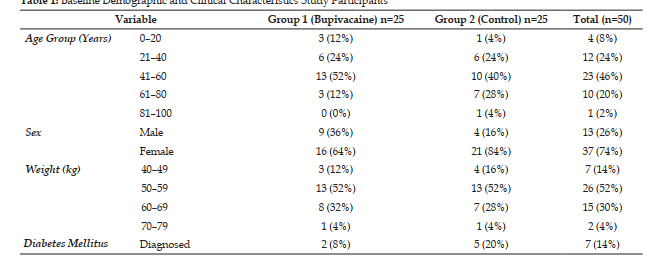
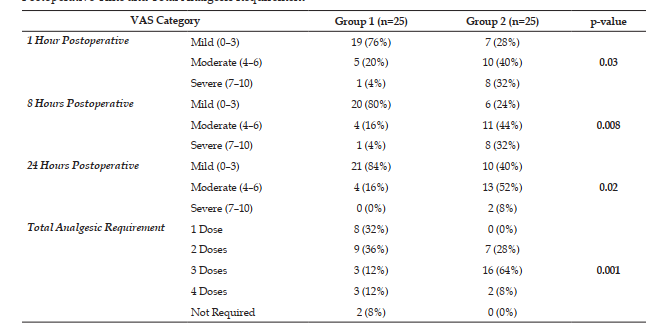
Introduction: Laparoscopic cholecystectomy causes less postoperative pain than the open procedure, yet pain in the first 24 hours still shapes how quickly patients recover and how much analgesia they end up needing. Instilling local anaesthetics into the peritoneal cavity and at the port sites has been put forward as a straightforward way to bring that pain down. Objectives: To find out whether intraperitoneal plus port-site instillation of bupivacaine works better than giving no local anaesthetic at all in controlling postoperative pain after laparoscopic cholecystectomy. Methods: This randomized controlled study was carried out in the Department of Surgery, Sardar Patel Medical College, Bikaner. Fifty patients scheduled for elective laparoscopic cholecystectomy were randomly split into two groups. Group 1 (n=25) received 0.5% bupivacaine both intraperitoneally and by portsite infiltration, while Group 2 (n=25) received no local anaesthetic. Pain after surgery was scored on the Visual Analogue Scale (VAS) at 1, 8, and 24 hours. The total analgesic dose needed, the time before the first analgesic was requested, postoperative complications, patient comfort, and length of hospital stay were all noted. Data were analysed in SPSS, with p<0.05 taken as significant. Results: Most participants were women (74%), and the largest share fell in the 41– 60 year bracket (46%). Group 1 had noticeably lower pain scores at 1 hour (p=0.03), 8 hours (p=0.008), and 24 hours (p=0.02) than Group 2. Patients in Group 1 also needed less analgesia over the first 24 hours (p=0.001) and went longer before asking for their first dose (p=0.04). Pain relief was rated adequate in 80% of the bupivacaine group compared with just 28% of controls (p<0.001), and satisfaction followed the same pattern (84% vs 28%, p<0.001). Rates of nausea and vomiting were similar in both groups (p=0.48). Conclusion: Combining intraperitoneal and port-site bupivacaine meaningfully lowers postoperative pain and analgesic use after laparoscopic cholecystectomy and leaves patients more satisfied, all without adding to the complication rate. Given how simple and safe it is, this technique deserves a routine place in perioperative pain protocols.
References
- 1. Mosimann F. Laparoscopic cholecystectomy has become the new gold standard for the management of symptomatic gallbladder stones. Hepatogastroenterology. 2006;53:1.
- 2. Soper NJ, Stockmann PT, Dunnegan DL, Ashley SW. Laparoscopic cholecystectomy: the new gold standard? Arch Surg. 1992;127(8):917-23.
- 3. Bisgaard T, Klarskov B, Rosenberg J, Kehlet H. Characteristics and prediction of early pain after laparoscopic cholecystectomy. Pain. 2001;90(3):261-9.
- 4. Jensen K, Kehlet H, Lund CM. Postoperative recovery profile after laparoscopic cholecystectomy. Acta Anaesthesiol Scand. 2007;51(4):464-71.
- 5. Roy N. Assessment of effect of port site and intraperitoneal instillation of bupivacaine in reduction of post-operative pain after laparoscopic cholecystectomy. Mapsci JASR. 2019;1(1):1-9.
- 6. Barazanchi AWH, MacFater WS, Rahiri JL, et al. Evidence-based management of pain after laparoscopic cholecystectomy. Br J Anaesth. 2018;121(4):787-803.
- 7. Akter MB, Bahar MAA, Ahmed J, et al. Portsite infiltration of bupivacaine in reduction of postoperative pain after laparoscopic cholecystectomy. Int J Surg Sci. 2021;5(2):135-8.
- 8. Kahokehr A, Sammour T, Soop M, Hill AG. Intraperitoneal use of local anesthetic in laparoscopic cholecystectomy: systematic review and meta-analysis of randomized controlled trials. J Hepatobiliary Pancreat Sci. 2010;17:637-56.
- 9. Ahuja R, Inamdar SD, Ketkar MN. Analgesic effect of intraperitoneal and port-site instillation of bupivacaine in post laparoscopic cholecystectomy. Asian J Med Res. 2022; 11(2): 26-30.
- 10. Das NT, Deshpande C. Effects of intraperitoneal local anesthetics bupivacaine and ropivacaine versus placebo on postoperative pain after laparoscopic cholecystectomy. J Clin Diagn Res. 2017;11(7):UC08-UC12.
- 11. Manish S, Ram M, Shahid M. A prospective randomized controlled study of intraoperative bupivacaine with standard analgesia for postoperative pain management in laparoscopic cholecystectomy. J Clin Case Pract. 2025;11(8):546-52.
Data Sharing Statement
There are no additional data available. All raw data and code are available upon request.
Funding
This research received no funding.
Author Contributions
All authors contributed significantly to the work and approve its publication.
Ethics Declaration
This article does not involve any human or animal subjects, and therefore does not require ethics approval.
Acknowledgements
We would like to express our gratitude to the patients, their families, and all those who have contributed to this study.
Conflicts of Interest
No conflicts of interest in this work.
About this article

Cite this article
Sanjay Choudhary, R. K. Kajla, Arnv Kumar Dayal. Randomized Controlled Study To Compare Intraperitoneal Plus Port-Site Instillation Of Bupivacaine Versus No Local Anaesthetic For Reduction Of Postoperative Pain After Laparoscopic Cholecystectomy. New Indian J Surg. 2026; 17(3): 121-125.
Licence:
Attribution-Non-commercial 4.0 International (CC BY-NC 4.0)This license enables reusers to distribute, remix, adapt, and build upon the material in any medium or format for noncommercial purposes only, and only so long as attribution is given to the creator.
| Received | Accepted | Published |
|---|---|---|
| July 07, 2026 | August 09, 2026 | September 30, 2026 |
DOI: https://doi.org/10.21088/nijs.0976.4747.17326.5
Keywords
Laparoscopic cholecystectomyBupivacainePort-site infiltrationPostoperative painVisual Analogue ScaleIntraperitoneal instillationSearch for Similar Articles
Similar Articles
- Laparoscopic Repair of Large Recurrent Bochdalek Hernia: Case Report with Review...
- A Retrospective Evaluation of Superior Efficacy in Irrigation and Flushing of Sa...
- Implementation of Enhanced Recovery After Surgery (ERAS) Protocols in Elective C...
- Accuracy of TIRADS Classification in the Risk Stratification of Thyroid Swelling...
- Case Series Analysis of Medical Expulsive Therapy in Ureteric Calculi
Article Level Metrics
Last UpdatedSunday 18 October 2026, 07:49:23 (IST)
7250
Accesses
21
787
00
Citations
NA
NA
NA
Download citation
Article Keywords
Keyword Highlighting
Highlight selected keywords in the article text.
Timeline
| Received | July 07, 2026 |
| Accepted | August 09, 2026 |
| Published | September 30, 2026 |
licence
Attribution-Non-commercial 4.0 International (CC BY-NC 4.0)
This license enables reusers to distribute, remix, adapt, and build upon the material in any medium or format for noncommercial purposes only, and only so long as attribution is given to the creator.