Full Text (PDF)
Indian Journal of Forensic Medicine and Pathology 18(3):p 455-460, July-Sep 2025. | DOI: https://doi.org/10.21088/ijfmp.0974.3383.18325.4
Original Article
Profile of Head Injury Cases Reported in Western India: An Autopsy Study
Madhusudan R. Petkar, Reena A. Jain, Shweta Patel, Ashwinikumar B. Sapate, Vikrant Kalokhe
Author Information
Licence:
Attribution-Non-commercial 4.0 International (CC BY-NC 4.0)This license enables reusers to distribute, remix, adapt, and build upon the material in any medium or format for noncommercial purposes only, and only so long as attribution is given to the creator.
Indian Journal of Forensic Medicine and Pathology 18(3):p 455-460, July-Sep 2025. | DOI: https://doi.org/10.21088/ijfmp.0974.3383.18325.4
How Cite This Article:
Jain RA, Petkar MR, Patel S, et al. Profile of Head Injury Cases Reported in Western India: An Autopsy Study. Indian J Forensic Med Pathol. 2025;18(3):165-70.Timeline
Received : May 24, 2025
Accepted : July 26, 2025
Published : September 30, 2025
Abstract
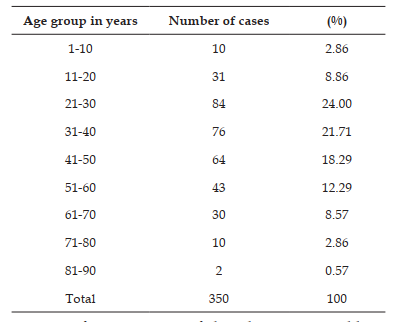
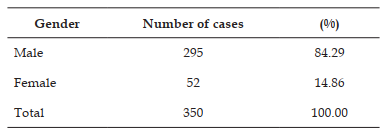
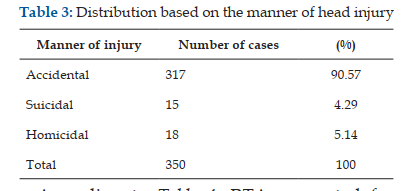
Introduction: Head injuries, especially those resulting from road traffic accidents (RTAs), are a significant public health concern in India, particularly among the young population. This autopsy-based study aimed to evaluate the demographic profile, causative factors, survival times, and the pattern of skull fractures in fatal head injury cases reported in a tertiary care hospital in Western India. Results: A total of 350 autopsied cases of fatal head injuries were analyzed over one year. The majority were males (84.29%), with the most affected age group being 21–30 years (24%). Accidental head injuries accounted for 90.57% of cases, and RTAs were the leading cause (67.14%). Two-wheeler occupants represented the most common victim group, with 82% of them not wearing helmets. Headon collisions were the most frequent RTA type. Most deaths (over 60%) occurred within 12 hours of injury. Skull base and vault fractures were significantly more common among non-helmeted riders. Discussion: The findings indicate a strong association between lack of helmet use and fatal skull fractures. Young adult males are at greater risk due to increased exposure to outdoor and vehicular activities. Delays in emergency response and limited trauma care infrastructure contribute to early mortality following head injury. Conclusion: This study underscores the urgent need for strict helmet laws, public awareness campaigns, improved pre-hospital care, and well-equipped trauma centers to reduce the incidence and severity of fatal head injuries in India.
References
- 1. Tedeschi C.G., Eckert W.G., Tedeschi L.G. The wound: assessment by organ systems. In: Tedeschi C.G., Eckert W.G., Tedeschi L.G.,editors. Forensic medicine: a study of trauma and environmental hazards. Philadelphia:W.B. Saunders; 1997. p. 29-30, 36, 42.
- 2. Skerr R.C., Maartens N.F. The cranium, scalp, skull, brain. In: Williams NS, Bulstrode C.J, O’Connell P.R., editors. Bailey & Love’s short textbook of surgery. 23rd ed. London: Arnold; 2001. pp. 548-52.
- 3. National Crime Records Bureau, Ministry of Home Affairs. Accidents in India. New Delhi: Ministry of Home Affairs, Government of India; 2020. Available from: (link unavailable)
- 4. Organisation for Economic Co-operation and Development. OECD Health Statistics 2017: definitions, sources and methods Internet. 2017 cited 2023 Jun 27. Available from: (link unavailable)
- 5. Parikh C.K. Regional injuries. In: Parikh’s textbook of medical jurisprudence, forensic medicine and toxicology for classrooms & courtrooms. 6th ed. New Delhi: CBS Publishers; 2007. p. 4.92.
- 6. Prajapati H., Patil V.R. A prospective study of pattern of head injuries in autopsy cases brought to SSG hospital, Vadodara. Indian J Forensic Med Toxicol. 2018; 12(2): 33-7.
- 7. Tse M.K., et al. A review of head injury and finite element head models. Am J Eng Technol Soc. 2014; 1(5): 28-52.
- 8. Udayashankar B.S., Girish Chandra Y.P., Harish S. Pattern of scalp injuries and its correlation with injuries to skull and brain amongst autopsies conducted at a tertiary care centre. J Indian Acad Forensic Med. 2017; 39(2): 141-5.
- 9. Pathak A., Vyas P.C., Gupta B.M. Autopsy finding of pattern of skull fractures and intracranial haemorrhages in cases of head trauma. J Indian Acad Forensic Med. 2006; 28(4): 187- 90.
- 10. Chourasia S., Rudra A. An autopsy study of pattern of fatal cranio-cerebral injuries due to blunt force trauma at medicolegal centre of a tertiary healthcare. J Med Sci Clin Res. 2017; 5(9): 27522-30.
- 11. Sahu G., Naik S. Study of skull fractures in fatal cranio-cerebral injuries in light with the manner of death. J Indian Acad Forensic Med. 2016; 38(2): 217-20.
- 12. Patil A.M., Vaz WF. Pattern of fatal blunt head injury: A two year retrospective prospective medico legal autopsy study. J Indian Acad Forensic Med. 2010; 32(2): 143-9.
- 13. Kumar A., Tandon S., Sharma S.K., Yadav A. Study of facial injuries sustained in cases of fatal accidents and intentional violence. J Indian Acad Forensic Med. 2020; 42(2): 114-9.
- 14. Keisham S., Singh S.B., Kamei R., Memchoubi P. A study of fatal internal injuries without significant external injuries in road traffic accidents in Imphal from 2009-2014. J Indian Acad Forensic Med. 2015; 37(1): 16-8.
- 15. Wagle V.G., Perkins C., Vallera A. Is helmet use beneficial to motorcyclist? J Trauma. 1993; 34(1): 120-2.
- 16. Singh V., Channabasappa S.R. A retrospective study of pattern of cranio-cerebral injuries due to road traffic accident in a tertiary care hospital. Indian J Forensic Med Toxicol. 2021; 15(2): 1771-7.
- 17. Meena S.K., Tatwal B., Joshi A. Pattern of head injuries in road traffic accidents cases brought to post mortem center. Indian J Forensic Med Pathol. 2020; 13(2): 291-6
Data Sharing Statement
There are no additional data available. All raw data and code are available upon request.
Funding
This research received no funding.
Author Contributions
All authors contributed significantly to the work and approve its publication.
Ethics Declaration
This article does not involve any human or animal subjects, and therefore does not require ethics approval.
Acknowledgements
We would like to express our gratitude to the patients, their families, and all those who have contributed to this study.
Conflicts of Interest
No conflicts of interest in this work.
About this article

Cite this article
Jain RA, Petkar MR, Patel S, et al. Profile of Head Injury Cases Reported in Western India: An Autopsy Study. Indian J Forensic Med Pathol. 2025;18(3):165-70.
Licence:
Attribution-Non-commercial 4.0 International (CC BY-NC 4.0)This license enables reusers to distribute, remix, adapt, and build upon the material in any medium or format for noncommercial purposes only, and only so long as attribution is given to the creator.
| Received | Accepted | Published |
|---|---|---|
| May 24, 2025 | July 26, 2025 | September 30, 2025 |
DOI: https://doi.org/10.21088/ijfmp.0974.3383.18325.4
Keywords
AutopsyHead injuryTraumatic brain injuryRoad traffic accidents • Two wheelersRoad traffic accidentsTwo wheelersSearch for Similar Articles
Similar Articles
- Diatom Analysis in Thermophilic water bodies: A Study on Hot Water Springs of Ma...
- Morphometric Study of Supra-meatal Triangle and Mastoid process in the Adult dry...
- Histopathological Spectrum of Autopsy Cases: A One Year Retrospective Observatio...
- Forensic Differentiation of Manner of Death in Railway Fatalities: A FourCase Se...
- Understanding assault Patterns: A Cross-sectional study of Cases at Chri, Kelamb...
Article Level Metrics
Last UpdatedSunday 18 October 2026, 15:54:12 (IST)
16279
Accesses
68
3209
00
Citations
NA
NA
NA
Download citation
Article Keywords
Keyword Highlighting
Highlight selected keywords in the article text.
Timeline
| Received | May 24, 2025 |
| Accepted | July 26, 2025 |
| Published | September 30, 2025 |
licence
Attribution-Non-commercial 4.0 International (CC BY-NC 4.0)
This license enables reusers to distribute, remix, adapt, and build upon the material in any medium or format for noncommercial purposes only, and only so long as attribution is given to the creator.