Full Text (PDF)
Indian Journal of Forensic Medicine and Pathology 19(2):p 179-185, April - June 2026. | DOI: https://doi.org/10.21088/ijfmp.0974.3383.19226.9
Original Article
Physicians’ Perspectives about Consent in Medical Practice: A Questionnaire-Based Study
Dipayan Deb Barman, Sherin Prabu Raja
Author Information
Licence:
Attribution-Non-commercial 4.0 International (CC BY-NC 4.0)This license enables reusers to distribute, remix, adapt, and build upon the material in any medium or format for noncommercial purposes only, and only so long as attribution is given to the creator.
Indian Journal of Forensic Medicine and Pathology 19(2):p 179-185, April - June 2026. | DOI: https://doi.org/10.21088/ijfmp.0974.3383.19226.9
How Cite This Article:
Sherin Prabu Raja, Dipayan Deb Barman. Physicians’ Perspectives about Consent in Medical Practice: A Questionnaire-Based Study. Indian J Forensic Med Pathol. 2026; 19(2): 179-185.Timeline
Received : March 23, 2026
Accepted : April 24, 2026
Published : June 30, 2026
Abstract
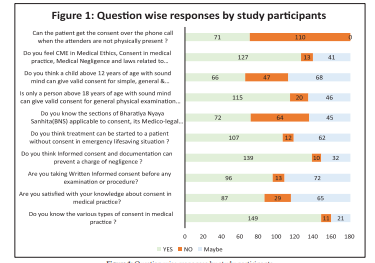
Background: Consent is an ethical and legal requirement in medical practice. Informed consent involves obtaining the patient’s permission and ensuring the patient’s complete understanding of the nature, purpose, risks, and alternatives of a medical procedure. In India, awareness and practice with consent among medical students and professionals vary. Aim: To assess understanding, attitudes, and practices regarding medical consent among medical students and trainees. Methodology: A questionnaire-based study was conducted among 181 practitioners and Interns with 11 questions on physicians’ perspectives on consent. Results: Awareness of various types of consent in medical practice was reported by 149 participants (82.32%). Regarding a child over 12 years of age giving valid consent for a simple examination, 36.46% agreed. In cases involving intoxicated individuals, 70.17% believed consent should be obtained from police and examination done with minimal force. About telephonic consent, 60.77% rejected it in the absence of attenders. Most participants (70.17%) supported regular CME sessions on consent and medical ethics. The majority (76.80%) agreed that proper consent and documentation prevent negligence charges. Conclusion: The study showed that while most participants have a good theoretical understanding of consent in medical practice, their knowledge of specific legal provisions and exceptional circumstances remains incomplete. The majority recognise the importance of written informed consent and documentation in preventing medical negligence, but uncertainty persists regarding consent from minors, intoxicated individuals, and consent obtained telephonically. We recommended incorporating structured teaching modules on medical ethics, consent, and medico-legal and conducting periodic Continuing Medical Education sessions.
References
- 1. Pallocci M., Treglia M., Passalacqua P., et al. Informed Consent: Legal Obligation or Cornerstone of the Care Relationship? Int J Environ Res Public Health. 2023; 20(3): 2118. doi:10.3390/ijerph20032118
- 2. Raab E.L. The Parameters of Informed Consent. Trans Am Ophthalmol Soc. 2004; 102: 225-232.
- 3. Pape T. Legal and ethical considerations of informed consent. AORN J. 1997;65(6):1122- 1127. doi:10.1016/s0001-2092(06)62955-4
- 4. Taylor K.M., Kelner M. Informed consent: the physicians’ perspective. Soc Sci Med. 1987; 24(2): 135-143. doi:10.1016/0277-9536(87)90246-2
- 5. (PDF) Role of Consent in Medical Practice: A Survey Amongst Registered Medical Practitioners. ResearchGate. Published online August 9, 2025. Accessed November 12, 2025. https://www.researchgate.net/ publication/317742804_Role_of_Consent_ in_Medical_Practice_A_Survey_Amongst_ Registered_Medical_Practitioners
- 6. Ng C.K. Perspectives of doctors on informed consent: findings of Singapore Medical Association survey. Singapore Med J. 2025; 66(9): 497-500. doi:10.4103/singaporemedj. SMJ-2025-132
- 7. Pietrzykowski T., Smilowska K. The reality of informed consent: empirical studies on patient comprehension—systematic review. Trials. 2021; 22(1): 57. doi:10.1186/s13063-020-04969-w
- 8. Zahra C., Kobua M., Kovic Ž., et al. Valid consent in the acute hospital setting: perspectives of nursing and medical professionals from a survey-based study. Ir J Med Sci. 2025; 194(3): 775-791. doi:10.1007/s11845-025-03952-1
- 9. Yousuf R.M., Fauzi ARM, How S.H., Rasool A.G., Rehana K. Awareness, knowledge and attitude toward informed consent among doctors in two different cultures in Asia: a cross-sectional comparative study in Malaysia and Kashmir, India. Singapore Med J. 2007; 48(6): 559-565.
- 10. Rahul null, Kumar A., Verma A., et al. A questionnaire-based study on quality and adequacy of clinical communication between physician and family members of admitted Covid-19 patients. Patient Educ Couns. 2022; 105(2): 304-310. doi:10.1016/j.pec.2021.09.013
- 11. Hegde P.R., Malik Y., Kumar C.N., Math S.B. The Bharatiya Nyaya Sanhita Act (BNSA) 2023: Implications for Forensic Psychiatry in India. Indian J Psychol Med. Published online October 3, 2024: 02537176241281465. doi:10.1177/02537176241281465185 IJFMP/Volume 19 Number 2 April–June 2026 Sherin Prabu, Dipayan Deb Barman. Physicians’ Perspectives about Consent in Medical Practice: A Questionnaire-Based Study.
- 12. Pai S.N., Jeyaraman M., Jeyaraman N., Yadav S. The New Bharatiya Nyaya Sanhita Laws: Progress or Pitfall for Doctors? Cureus. 16(9):e69925. doi:10.7759/cureus.69925
- 13. Singh O.P. Bhartiya Nyaya Samhita 2023, medical practice and psychiatrists. Indian J Psychiatry. 2024; 66(8): 755-757. doi:10.4103/ indianjpsychiatry.indianjpsychiatry_649_24
- 14. Raja W., Bhatti A., Raja K., Hayat B., Masood B, Chaudry Z.A. Evaluating the Significance of Implementing Experience-Based Clinical and Public Health Training in Medical Education Systems to Overcome the Curricular-Practice Gap in Tertiary Healthcare Settings. Cureus. 17(11):e95997. doi:10.7759/cureus.95997
- 15. Moreira C.F., Costa-Santos C., Moreira B.F., Nunes R., Duarte I. Informed Consent in Clinical Training: Perspectives from Medical Students and Faculty in Portugal. Healthcare (Basel). 2024; 12(18): 1818. doi:10.3390/ healthcare12181818
- 16. Gil-Santos I., Santos C.C., Duarte I. Medical Education: Patients’ Perspectives on Clinical Training and Informed Consent. Int J Environ Res Public Health. 2022; 19(13): 7611. doi:10.3390/ijerph19137611
- 17. Kumar A., Mullick P., Prakash S., Bharadwaj A. Consent and the Indian medical practitioner. Indian J Anaesth. 2015; 59(11): 695-700. doi:10.4103/0019-5049.169989
- 18. Mathiharan K. Law on consent and confidentiality in India: A need for clarity. Natl Med J India. 2014; 27(1): 39-42.
- 19. Bazzano L.A., Durant J., Brantley P.R. A Modern History of Informed Consent and the Role of Key Information. Ochsner J. 2021; 21(1): 81-85. doi:10.31486/toj.19.0105
- 20. Jameson L.M., Al-Tarawneh S.K. Informed Consent from a Historical, Societal, Ethical, Legal, and Practical Perspective. J Prosthodont. 2022; 31(6): 464-471. doi:10.1111/jopr.13493
- 21. Sarela A., Thomson M. Balancing law, ethics and reality in informed consent for surgery. Ann R Coll Surg Engl. 2014; 96(5): 329-330. doi:1 0.1308/003588414X13946184901803
- 22. Sugawara N., Yasui-Furukori N., Sumiyoshi T. Competence to Consent and its Relationship with Cognitive Function in Patients with Schizophrenia. Front Psychiatry. 2019;10:195. doi:10.3389/fpsyt.2019.00195
- 23. Larcher V. Consent, competence, and confidentiality. BMJ. 2005; 330(7487): 353-356. doi:10.1136/bmj.330.7487.353
- 24. Henwood S., Wilson M.A., Edwards I. The role of competence and capacity in relation to consent for treatment in adult patients. Br Dent J. 2006; 200(1): 18-21. doi:10.1038/sj.bdj.4813118
- 25. Welch B.M., Marshall E., Qanungo S., et al. Teleconsent: A novel approach to obtain informed consent for research. Contemp Clin Trials Commun. 2016; 3: 74-79. doi:10.1016/j. conctc.2016.03.002
- 26. Kituuka O., Munabi I., Galukande M., Twimukye A., Mwaka E. Informed consent practices among emergency staff for patients undergoing emergency surgery in the emergency surgical units of two tertiary teaching hospitals in Uganda: a qualitative study. BMC Med Ethics. 2025; 26: 176. doi:10.1186/s12910-025-01337-8
- 27. Atta I.S. Introducing professionalism and medical ethics in undergraduate integrative medical curriculum through a fourdimensional model. J Educ Health Promot. 2024; 13: 341. doi:10.4103/jehp.jehp_1767_23
Data Sharing Statement
There are no additional data available. All raw data and code are available upon request.
Funding
This research received no funding.
Author Contributions
All authors contributed significantly to the work and approve its publication.
Ethics Declaration
This article does not involve any human or animal subjects, and therefore does not require ethics approval.
Acknowledgements
We would like to express our gratitude to the patients, their families, and all those who have contributed to this study.
Conflicts of Interest
No conflicts of interest in this work.
About this article

Cite this article
Sherin Prabu Raja, Dipayan Deb Barman. Physicians’ Perspectives about Consent in Medical Practice: A Questionnaire-Based Study. Indian J Forensic Med Pathol. 2026; 19(2): 179-185.
Licence:
Attribution-Non-commercial 4.0 International (CC BY-NC 4.0)This license enables reusers to distribute, remix, adapt, and build upon the material in any medium or format for noncommercial purposes only, and only so long as attribution is given to the creator.
| Received | Accepted | Published |
|---|---|---|
| March 23, 2026 | April 24, 2026 | June 30, 2026 |
DOI: https://doi.org/10.21088/ijfmp.0974.3383.19226.9
Keywords
Informed consentMedical ethicsBharatiya Nyaya SanhitaMedico-legal aspectsSearch for Similar Articles
Similar Articles
- Diatom Analysis in Thermophilic water bodies: A Study on Hot Water Springs of Ma...
- Morphometric Study of Supra-meatal Triangle and Mastoid process in the Adult dry...
- Histopathological Spectrum of Autopsy Cases: A One Year Retrospective Observatio...
- Forensic Differentiation of Manner of Death in Railway Fatalities: A FourCase Se...
- Understanding assault Patterns: A Cross-sectional study of Cases at Chri, Kelamb...
Article Level Metrics
Last UpdatedWednesday 21 October 2026, 09:52:18 (IST)
16500
Accesses
82
3225
00
Citations
NA
NA
NA
Download citation
Article Keywords
Keyword Highlighting
Highlight selected keywords in the article text.
Timeline
| Received | March 23, 2026 |
| Accepted | April 24, 2026 |
| Published | June 30, 2026 |
licence
Attribution-Non-commercial 4.0 International (CC BY-NC 4.0)
This license enables reusers to distribute, remix, adapt, and build upon the material in any medium or format for noncommercial purposes only, and only so long as attribution is given to the creator.