Full Text (PDF)
Journal of Nurse Midwifery and Maternal Health 10(2):p 59-65, May - Aug 2024. | DOI: https://doi.org/10.21088/jnmmh.2454.7506.10224.2
Original Article
Non-modifiable Risk Factors for Breast and Cervical Cancer and their Association with Sample Characteristics
Author Information
Licence:
Attribution-Non-commercial 4.0 International (CC BY-NC 4.0)This license enables reusers to distribute, remix, adapt, and build upon the material in any medium or format for noncommercial purposes only, and only so long as attribution is given to the creator.
Journal of Nurse Midwifery and Maternal Health 10(2):p 59-65, May - Aug 2024. | DOI: https://doi.org/10.21088/jnmmh.2454.7506.10224.2
How Cite This Article:
Shobha Gusain. Non-modifiable Risk Factors for Breast and Cervical Cancer and their Association with Sample Characteristics. J Nurse Midwifery Matern Health. 2024;10(2):59–65.Timeline
Received : June 04, 2024
Accepted : July 28, 2024
Published : August 30, 2024
Abstract
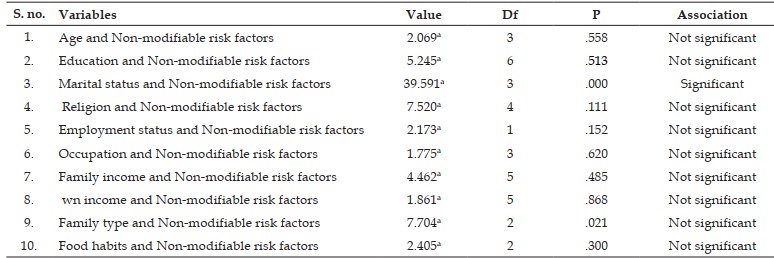
Background: Cancer was the second leading cause of death globally, responsible for 8.8 million deaths in 2015. The estimates of cancer incidence would increase to 1.87 million by the year 2026. New cancer cases in females are higher as compared to males at all time periods. Objectives: 1) To assess the Non-modifiable risk factors for breast & cervical cancer 2) To identify the association of Non-modifiable risk factors with selected sample characteristics. Methods: Using purposive sampling technique, a pre tested and structured interview schedule was administered to 426 women in gynae O.P.D. of Lok Nayak Hospital. Results: 86.85% of study subjects were in the Non-modifiable risk factor score category and most of them were in illiterate and primary educated group. Age, education, employment, occupation and income were significantly associated with Non-modifiable risk factor scores. Conclusion: Moderate Non-modifiable risk factors appeared to influence the risk status of women for breast and cervical cancer in this study.
References
- 1. Luckman J. Saunder’s Manual of Nursing Care. USA :W.B. Saunders Co; 1997
- 2. Forouzanfar MH, Foreman KJ, Delossantos AM, Lozano R, Lopez AD, Murray CJL, Naghavi M. Breast and cervical cancer in 187 countries between 1980 and 2010: a systematic analysis. Lancet 2011; 378: 1461-84. Published Online: 15 September 2011. Available from DOI: http:// dx.doi.org/10.1016/S0140-6736(11)61351-2
- 3. Cancer fact sheet. Estimated cancer incidence, mortality and prevalence worldwide in 2012. Globocan(IACR),WHO.2012; Available from globocan.iarc.fr/default.aspx.
- 4. WHO. Cancer fact sheet. [Internet]. available from www.who.nt/factsheets/fs297/en
- 5. American cancer society. Global cancer burden to nearly double in 2030. [Internet]. Available from: http://www. Cancer.org/acs/groups/ content/document/acspc-027766
- 6. Dsouza N, Murthy N S, Aras R. Projection of cancer incident cases for Indiatill 2026. Asian Pac. J. Cancer Prev. [Internet].2013 July; 14(7). Available from: https://www.researchgate. net/publication/ 264143909
- 7. Monahan F D, Sands J K, Neighbors M, Marek J F, Green C J . Phipps Medical Surgical Nursing: Health and Illness Perspective. 8th Edition. India:Elsevier; 2009
- 8. Agarwal G, Ramakant P. Breast cancer in India:The current scenario and the challenges for the future. Breast Care (Basel).2008 Mar;3(1):21-27. Published online 2008 Feb22. doi:10.1159/000115288
- 9. Agarwal G, Pradeep P V, Aggarwal V et al. Spectrum of breast cancer in Asian women. World J Surg. May 2007; 31(5):pg.1031-1040
- 10. Dinshaw KA, Shastri SS, Patil SS. Cancer Control Programme in India: Challenges for the New Millennium. Health Administrator.17(1): 10-13
- 11. Tsu VD, Jeronmo J, Anderson B O. Why the time is right to tackle breast and cervical cancer in low-resource settings. Bull. World Health Organ.2013;91:683-690. Available from doi:http://dx.doi.org/ 10.2471/ BLT.12.116020
- 12. Juneja A, Sehgal A, Mitra A B, Pandey A. A survey on risk factors associated with cervical cancer. Indian J Cancer. Jan-Mar 2003; 40(1):15-21
- 13. Janz NK, Becker MH. The Health Belief Model: a decade later. Health Educ Q. 1984 Spring;11(1):1-47. doi: 10.1177/109019818401100101. PMID: 6392204.
- 14. Kiefe C I, Funkhouser E, Fouad M N, May D S.Chronic disease as a barrier to breast and cervical cancer screening. J General Intern Med.1998;13(6):357-365
- 15. Saxena S, Rekhi B, Bansal A, Bagga A, Chintamani, Murthy N S. Clinicimorphological patterns of breast cancer including family history in a New Delhi hospital, India. World J Surg Oncol.2005;3:67.Doi:10.1186/1477-7819- 3-67
- 16. Jayaraman L K M, Khichi S K, Singh A, Goel S, Roy A K J, Goyal P. Self perceived risk and barriers to cervical cancer screening among patients seeking care at a tertiary care teaching hospital in Tamil Nadu. Int J Res Med Sci. 2016 May;4(3):766-769.doi:10.18203/2320-6012.ijrms 20160515
- 17. Thakur A, Gupta B, Gupta A, Chauhan R. Risk Factors for Cancer Cervix among Rural Women of a Hilly State: A Case-Control Study. Indian J Public Health [serial online] 2015 [cited 2016 May 24]; 59:45-8. Available from: http://www. ijph.in/ text.asp?2015/59/1/45/152862
- 18. Saseini P. Cervical cancer prevention and hormonal contraception. Lancet. 2007;370(9599):1609-1621.
- 19. Hunter D J, Colidtz GA, Hankinson S E et al. Oral Contraceptive use and Breast Cancer: A Prospective Study of Young Women. Cancer Epidemiol. Biomarkers Prev. October 2010:doi 10.1158/1055-9965.EPI-10-0747
- 20. Dumeaux V, Alasaker E, Lund E. Breast Cancer and Specific types of Oral Contraceptives: A large Norwegian cohort study. Int.J.Cancer. July2003;105(6)pg844-850
- 21. Dietrich C M, Felice J P, O’Sullivan E, Rasmussen K M. Breastfeeding and Health Outcomes for the Mother-Infant Dyad. Pediatr. Clin.North Am. 2013;60(1):31-48.doi:10.1016/j. pcl.2012.09.010
Data Sharing Statement
There are no additional data available. All raw data and code are available upon request.
Funding
This research received no funding.
Author Contributions
All authors contributed significantly to the work and approve its publication.
Ethics Declaration
This article does not involve any human or animal subjects, and therefore does not require ethics approval.
Acknowledgements
We would like to express our gratitude to the patients, their families, and all those who have contributed to this study.
Conflicts of Interest
No conflicts of interest in this work.
About this article

Cite this article
Shobha Gusain. Non-modifiable Risk Factors for Breast and Cervical Cancer and their Association with Sample Characteristics. J Nurse Midwifery Matern Health. 2024;10(2):59–65.
Licence:
Attribution-Non-commercial 4.0 International (CC BY-NC 4.0)This license enables reusers to distribute, remix, adapt, and build upon the material in any medium or format for noncommercial purposes only, and only so long as attribution is given to the creator.
| Received | Accepted | Published |
|---|---|---|
| June 04, 2024 | July 28, 2024 | August 30, 2024 |
DOI: https://doi.org/10.21088/jnmmh.2454.7506.10224.2
Keywords
Non-modifiable risk factorsFamily historySearch for Similar Articles
Similar Articles
- Psychological Distress and Quality of Life Among Parents of Children with Cancer...
- We Must be Aware about Water Birth: An Overview
- Digital Health Literacy Among Mothers and Its Impact on Neonatal Outcomes: An In...
- Effectiveness of Vedio assisted Technique Programme on knowledge regarding Techn...
- A Comprehensive review of Uterine Prolapse: Etiology, Diagnosis of Management
Article Level Metrics
Last UpdatedTuesday 29 September 2026, 16:32:11 (IST)
1780
Accesses
1
293
00
Citations
NA
NA
NA
Download citation
Article Keywords
Keyword Highlighting
Highlight selected keywords in the article text.
Timeline
| Received | June 04, 2024 |
| Accepted | July 28, 2024 |
| Published | August 30, 2024 |
licence
Attribution-Non-commercial 4.0 International (CC BY-NC 4.0)
This license enables reusers to distribute, remix, adapt, and build upon the material in any medium or format for noncommercial purposes only, and only so long as attribution is given to the creator.