Full Text (PDF)
Journal of Nurse Midwifery and Maternal Health 10(2):p 67-77, May - Aug 2024. | DOI: https://doi.org/10.21088/jnmmh.2454.7506.10224.3
Original Article
Empowering Tomorrow's Healers: A Creative Approach to Enhancing Female Nursing Students' Awareness of Cervical Cancer and Prevention Strategies through Structured Education
Usha Rani Kandula, Jeya Beulah D
Author Information
Licence:
Attribution-Non-commercial 4.0 International (CC BY-NC 4.0)This license enables reusers to distribute, remix, adapt, and build upon the material in any medium or format for noncommercial purposes only, and only so long as attribution is given to the creator.
Journal of Nurse Midwifery and Maternal Health 10(2):p 67-77, May - Aug 2024. | DOI: https://doi.org/10.21088/jnmmh.2454.7506.10224.3
How Cite This Article:
Usha Rani Kandula, Jeya Beulah D. Empowering Tomorrow's Healers: A Creative Approach to Enhancing Female Nursing Students' Awareness of Cervical Cancer and Prevention Strategies through Structured Education. J Nurse Midwifery Matern Health. 2024;10(2):67–77.Timeline
Received : June 10, 2024
Accepted : August 12, 2024
Published : August 30, 2024
Abstract
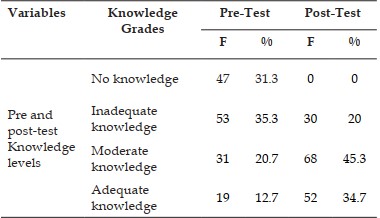
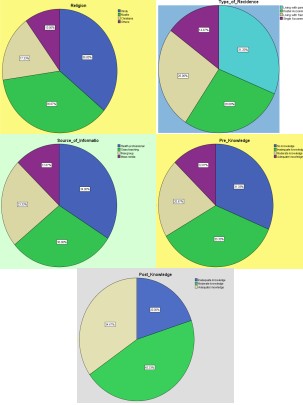
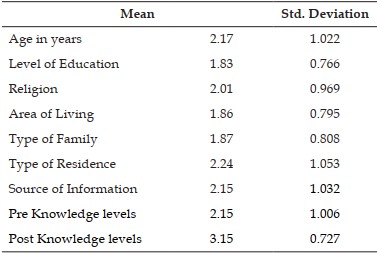
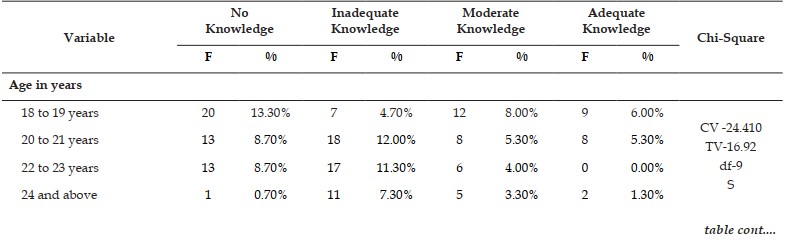
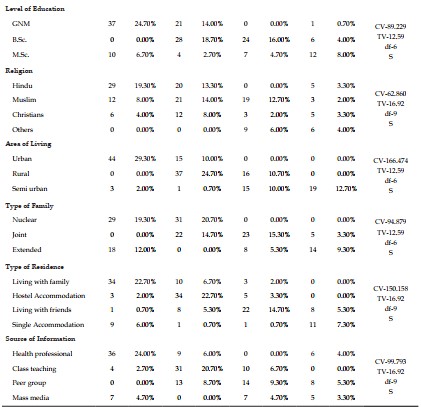
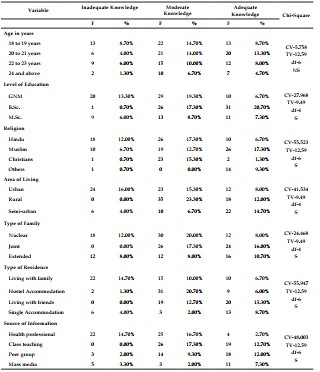
Background: Cervical cancer remains a significant public health issue, especially in regions with limited awareness and prevention strategies. Addressing this gap through targeted education can empower future healthcare providers, particularly female nursing students, with critical knowledge and preventive practices. Aim: This study aimed to enhance the awareness of cervical cancer and its prevention strategies among female nursing students through a structured educational program. Methods: A quantitative research approach with a quasi-experimental design was employed. The study was conducted at SCPM College of Nursing and Paramedical Sciences, Haripur, Gonda, involving a sample of 150 female nursing students selected via simple random sampling. Data were collected by trained BSc Nursing tutors and analyzed using SPSS version 22, with a significance level set at <0.05. Results: Pre-test knowledge assessment revealed that 31.3% of participants had no knowledge, 35.3% had inadequate knowledge, 20.7% had moderate knowledge, and 12.7% had adequate knowledge. Post-test results showed a significant improvement: 20% had inadequate knowledge, 45.3% had moderate knowledge, and 34.7% had adequate knowledge. The pre-test mean knowledge score was 2.15 (SD = 1.006), which increased to 3.15 (SD = 0.727) in the post-test. The paired t-test yielded a t-value of 12.289 (df = 149), indicating a significant enhancement in knowledge levels. Additionally, all variables showed a significant association with knowledge levels in the pre-test. Conclusion: The structured educational program significantly improved the awareness and knowledge of cervical cancer and prevention strategies among female nursing students. This underscores the effectiveness of targeted educational interventions in empowering future healthcare providers.
References
- 1. Bogdanova A, Andrawos C, Constantinou C. Cervical cancer, geographical inequalities, prevention and barriers in resource depleted countries. Oncol Lett. 2022 Apr;23(4):113.
- 2. Adedimeji A, Ajeh R, Pierz A, Nkeng R, NdenkehJJr, Fuhngwa N, et al. Challenges and opportunities associated with cervical cancer screening programs in a low income, high HIV prevalence context. BMC Womens Health. 2021 Feb 18;21:74.
- 3. Okolie EA, Barker D, Nnyanzi LA, Anjorin S, Aluga D, Nwadike BI. Factors influencing cervical cancer screening practice among female health workers in Nigeria: A systematic review. Cancer Rep (Hoboken 2021 Jul 27;5(5):e1514.
- 4. Moudatsou M, Vouyiouka P, KaragianniHatziskou E, Rovithis M, Stavropoulou A, Koukouli S. Knowledge and Use of Cervical Cancer Prevention Services among Social Work and Nursing University Students. Healthcare (Basel 2022 Jun 19;10(6):1140.
- 5. Mariño JM, Nunes LMP, Ali YCMM, Tonhi L do C, Salvetti M de G. Educational interventions for cervical cancer prevention: a scoping review. Rev Bras Enferm. 76(5):e20230018.
- 6. Dhanasekaran K, Verma C, Sriram L, Kumar V, Hariprasad R. Educational intervention on cervical and breast cancer screening: Impact on nursing students involved in primary care. J Family Med Prim Care. 2022 Jun;11(6):2846–51.
- 7. Mwaka AD, Orach CG, Were EM, Lyratzopoulos G, Wabinga H, Roland M. Awareness of cervical cancer risk factors and symptoms: cross-sectional community survey in post-conflict northern Uganda. Health Expect. 2016 Aug;19(4):854–67.
- 8. Singh E, Seth S, Rani V, Srivastava DK. Awareness of cervical cancer screening among nursing staff in a tertiary institution of rural India. J GynecolOncol. 2012 Jul;23(3):141–6.
- 9. Dangal G, Dhital R, Dwa YP, Poudel S, Pariyar J, Subedi K. Implementation of cervical cancer prevention and screening across five tertiary hospitals in Nepal and its policy implications: A mixed-methods study. PLOS Glob Public Health. 2024 Jan 18;4(1):e0002832.
- 10. Bendowska A, Baum E. The Significance of Cooperation in Interdisciplinary Health Care Teams as Perceived by Polish Medical Students. Int J Environ Res Public Health. 2023 Jan 5;20(2):954.
Data Sharing Statement
There are no additional data available. All raw data and code are available upon request.
Funding
This research received no funding.
Author Contributions
All authors contributed significantly to the work and approve its publication.
Ethics Declaration
This article does not involve any human or animal subjects, and therefore does not require ethics approval.
Acknowledgements
We would like to express our gratitude to the patients, their families, and all those who have contributed to this study.
Conflicts of Interest
No conflicts of interest in this work.
About this article

Cite this article
Usha Rani Kandula, Jeya Beulah D. Empowering Tomorrow's Healers: A Creative Approach to Enhancing Female Nursing Students' Awareness of Cervical Cancer and Prevention Strategies through Structured Education. J Nurse Midwifery Matern Health. 2024;10(2):67–77.
Licence:
Attribution-Non-commercial 4.0 International (CC BY-NC 4.0)This license enables reusers to distribute, remix, adapt, and build upon the material in any medium or format for noncommercial purposes only, and only so long as attribution is given to the creator.
| Received | Accepted | Published |
|---|---|---|
| June 10, 2024 | August 12, 2024 | August 30, 2024 |
DOI: https://doi.org/10.21088/jnmmh.2454.7506.10224.3
Keywords
Cervical cancerNursing educationPrevention strategiesQuasi-experimental designFemale nursing studentsstructured educationSearch for Similar Articles
Similar Articles
- Psychological Distress and Quality of Life Among Parents of Children with Cancer...
- We Must be Aware about Water Birth: An Overview
- Digital Health Literacy Among Mothers and Its Impact on Neonatal Outcomes: An In...
- Effectiveness of Vedio assisted Technique Programme on knowledge regarding Techn...
- A Comprehensive review of Uterine Prolapse: Etiology, Diagnosis of Management
Article Level Metrics
Last UpdatedWednesday 30 September 2026, 19:21:09 (IST)
1786
Accesses
2
293
00
Citations
NA
NA
NA
Download citation
Article Keywords
Keyword Highlighting
Highlight selected keywords in the article text.
Timeline
| Received | June 10, 2024 |
| Accepted | August 12, 2024 |
| Published | August 30, 2024 |
licence
Attribution-Non-commercial 4.0 International (CC BY-NC 4.0)
This license enables reusers to distribute, remix, adapt, and build upon the material in any medium or format for noncommercial purposes only, and only so long as attribution is given to the creator.