Full Text (PDF)
Journal of Nurse Midwifery and Maternal Health 10(2):p 43-57, May - Aug 2024. | DOI: https://doi.org/10.21088/jnmmh.2454.7506.10224.1
Original Article
Separated from their Little Bundle of Joy: Are Mothers and Fathers Equally Affected
Naseema Shafqat, Naresh Kumar Yadav, Mamta Verma, Mahendra Kumar Jain
Author Information
Licence:
Attribution-Non-commercial 4.0 International (CC BY-NC 4.0)This license enables reusers to distribute, remix, adapt, and build upon the material in any medium or format for noncommercial purposes only, and only so long as attribution is given to the creator.
Journal of Nurse Midwifery and Maternal Health 10(2):p 43-57, May - Aug 2024. | DOI: https://doi.org/10.21088/jnmmh.2454.7506.10224.1
How Cite This Article:
Naseema Shafqat, Naresh Kumar Yadav, Mamta Verma et al. Separated from their Little Bundle of Joy: Are Mothers and Fathers Equally Affected. J Nurse Midwifery Matern Health. 2024;10(2):43-57.Timeline
Received : July 22, 2024
Accepted : August 23, 2024
Published : August 30, 2024
Abstract
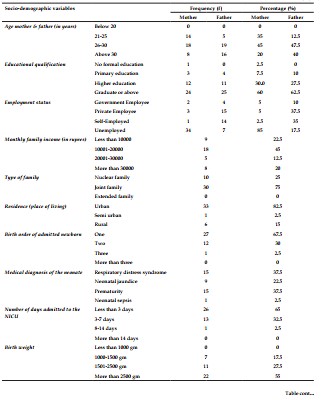
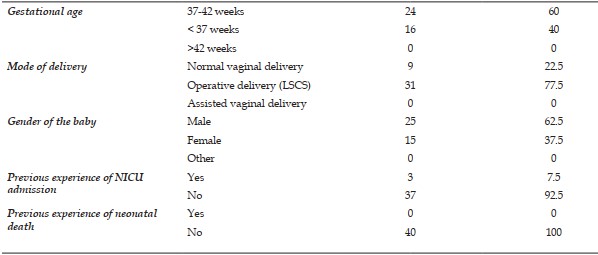
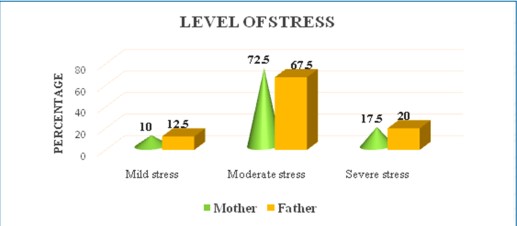
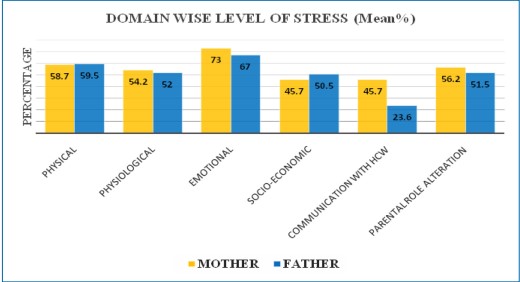
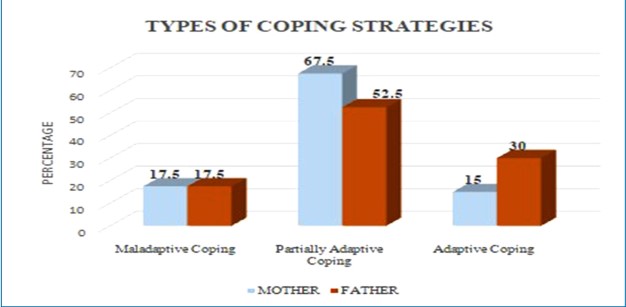
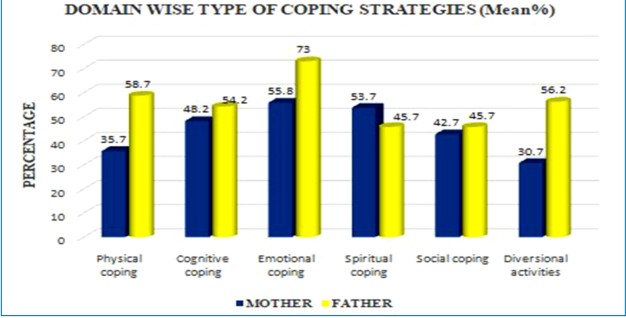
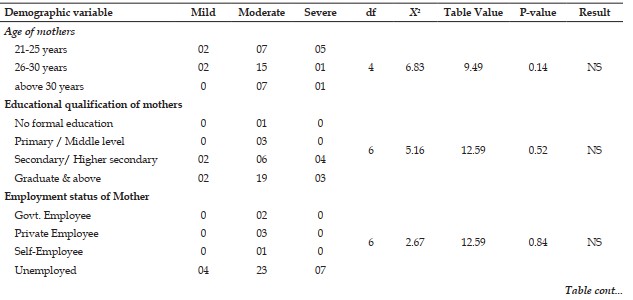
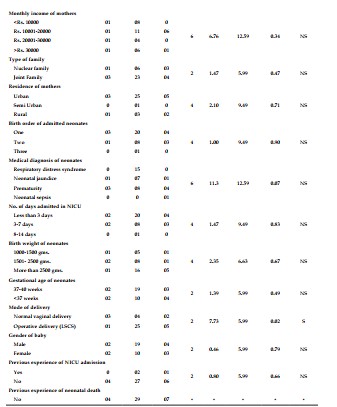
Objectives: The birth of a baby brings joy and the need for new family roles. However, few babies typically fail in their graceful perinatal transition requiring separation from parents in NICU leading to stressful situations. This study aimed to identify, correlate, and compare the stress levels and coping strategies of mothers and fathers with neonates in the NICU. Methods: A descriptive cross-sectional survey was conducted among 80 parents of NICUadmitted neonates, using purposive sampling. Data were collected through self-structured rating scales. Statistical analysis was performed using Spearman’s Rank Correlation Coefficients, MannWhitney U-test, and Chi-square test, with normality established by the Shapiro-Wilk test. Results: The findings revealed that the majority of mothers (45.0%) and fathers (47.5%) were aged 26-30 years. Most mothers (72.5%) and fathers (65.0%) experienced moderate stress. A significant number of mothers (67.5%) and fathers (52.5%) used partially adaptive coping strategies. Both mothers and fathers exhibited high stress and coping strategies in the emotional domain. The Spearman’s correlation coefficient was r= -0.33 for mothers and r= -0.47 for fathers, indicating a moderate negative correlation between stress levels and coping strategies. No significant difference was found in stress levels between mothers and fathers (Z=-.516, P=0.606), but a significant difference was noted in their coping strategies (Z=-2.348, P=0.019). Significant associations were found between stress, coping strategies, and socio-demographic variables such as mode of delivery (χ²=7.73, P=0.02), fathers’ employment status (χ²=15.3, P=0.01), neonates’ medical diagnosis (χ²=13.4, P=0.03), and length of stay in the NICU (χ²=11.3, P=0.02). Conclusion: While no significant gender difference was found in stress levels, fathers showed better coping strategies. Since stress is negatively correlated with coping, it suggests that healthcare professionals’ support can reduce parental stress and improve coping. Key Message:Parental stress in the NICU is significant, with fathers exhibiting better coping strategies. This study compares stress levels and coping mechanisms, revealing moderate stress and partially adaptive coping in parents. Enhanced healthcare support could mitigate stress and improve coping, benefiting the overall well-being of NICU families globally.
References
- 1. Curren, A., Brighton, J., & Murphy, V, Psycho emotional care of parents of children in a Neonatal Intensive Care Unit: Results of the questionnaire. Journal of Neonatal Nursing, 3(1), 25-29; 1997.
- 2. Cohan S, & Hoberman HM. Positive events and social supports as buffers of life change stress. Journal of Applied Social Psychology, 13(2), 99- 125; 1983.
- 3. Lefkowitz DS, Baxt C, Evans JR. Prevalence and correlates of posttraumatic stress and postpartum depression in parents of infants in the Neonatal Intensive Care Unit (NICU). J Clin Psychol Med Settings. 2010 Sep;17(3):230-7. doi: 10.1007/s10880-010-9202-7. PMID: 20632076.
- 4. Aylward GP. Cognitive and neuropsychological outcomes: more than IQ scores. Mental retardation and developmental disabilities research reviews. 2002;8(4):234-40.
- 5. Balluffi A, Kassam-Adams N, Kazak A, Tucker M, Dominguez T, Helfaer M. Traumatic stress in parents of children admitted to the pediatric intensive care unit. Pediatr Crit Care Med. 2004 Nov;5(6):547-53. doi: 10.1097/01. PCC.0000137354.19807.44. PMID: 15530191.
- 6. Beck CT. Recognizing and screening for postpartum depression in mothers of NICU infants. Adv Neonatal Care. 2003 Feb;3(1):37- 46. doi: 10.1053/adnc.2003.50013. PMID: 12882180.
- 7. Blanchard EB, Jones-Alexander J, Buckley TC, Forneris CA. Psychometric properties of the PTSD Checklist (PCL). Behav Res Ther. 1996 Aug;34(8):669-73. doi: 10.1016/0005- 7967(96)00033-2. PMID: 8870294.
- 8. Bronner MB, Kayser AM, Knoester H, Bos AP, Last BF, Grootenhuis MA. A pilot study on peritraumatic dissociation and coping styles as risk factors for posttraumatic stress, anxiety and depression in parents after their child’s unexpected admission to a Pediatric Intensive Care Unit. Child Adolesc Psychiatry Ment Health. 2009 Oct 15;3(1):33. doi: 10.1186/1753- 2000-3-33. PMID: 19832987; PMCID: PMC2770447.
- 9. Affleck G, Tennen H., & Rowe J. Infants in crisis: How parents coping with newborn intensive care and its aftermath. New York: Springerverlag, Child Heath Care.1991; 20:6-142.
- 10. Bronner, M. B., Peek, N., Knoester, H., Bos, A. P., Last, B. F., & Grootenhuis, M. A. (2010). Course and predictors of posttraumatic stress disorder in parents after pediatric intensive care treatment of their child. Journal of Pediatric Psychology, Advance Access, 1–10
- 11. Joseph RA, Mackley AB, Davis CG, Spear ML, Locke RG. Stress in fathers of surgical neonatal intensive care unit babies. Adv Neonatal Care. 2007 Dec;7(6):321-5. doi: 10.1097/01. ANC.0000304973.77202.1b. PMID: 18097216.
- 12. Kazak AE, Baxt C. Families of infants and young children with cancer: a post-traumatic stress framework. Pediatr Blood Cancer. 2007 Dec;49(7 Suppl):1109-13. doi: 10.1002/ pbc.21345. PMID: 17943959.
- 13. Bryant RA, Moulds ML, Guthrie RM. Acute Stress Disorder Scale: a self-report measure of acute stress disorder. Psychol Assess. 2000 Mar;12(1):61-8. PMID: 10752364.
- 14. Ganguly R, Patnaik L, Sahoo J, Pattanaik S, Sahu T. Assessment of stress among parents of neonates admitted in the neonatal intensive care unit of a tertiary care hospital in Eastern India. J Educ Health Promot. 2020 Oct 30;9:288. doi: 10.4103/jehp.jehp_169_20. PMID: 33282993; PMCID: PMC7709741.
- 15. Musabirema P, Brysiewicz P, Chipps J. Parents perceptions of stress in a neonatal intensive care unit in Rwanda. Curationis. 2015 Dec 3;38(2):1499. doi: 10.4102/curationis.v38i2.1499. PMID: 26842090; PMCID: PMC6091629.
- 16. Mamani Das KD. A Study to Assess the Level of Stress and Coping Mechanism among Mothers of Neonates Admitted in Neonatal Intensive Care Unit in Selected Hospitals of Guwahati, Assam. Religion. 2020;104:69-33.
- 17. Agrawal R, Gaur A. Parent stress in neonatal intensive care unit: an unattended aspect in medical care. International Journal of Contemporary Pediatrics. 2016 Dec 21;4(1):148-53.
- 18. Gurgani S, Jogi S. A Study to Estimate the Level of Stress and Coping Strategies among Mothers Whose Neonates are Admitted in Neonatal Intensive Care Unit (NICU) at Lalla Ded Hospital, Srinagar, Kashmir. International Journal of Midwifery Nursing. 2018 Sep 21;1(2):1-44.
- 19. Young Seideman R, Watson MA,Corff KE, Odle P. Parent stress andcoping in NICU and PICU. Journalof Pediatric Nursing. June 2003; 12(3): 169––177p.
- 20. Y Erdem. Anxiety levels of motherswhose infants have been cared for inunit level-I of neonatal intensive careunit. Journal of clinical nursing. June2012; 19 (11–12): 738–747p
- 21. Bhowmik T. Determine the stressors and coping strategies of parents whose children are admitted to neonatal intensive care unit. Unpublished M. Sc. Nursing dissertation. West Bengal University of Health Sciences, West Bengal;2006.
- 22. Thomas, Karen A. (2004). Use of the parenting stress index in mothers of preterm infants [Online]. Available from URL http://journals .lww. com/advances in neonatal care/ Abstract/2004 [Accessed on 15October 2015].
- 23. Patil S. Level of stress and coping strategies seen among parents of neonates. International Journal of Science and Research. 2014 Apr;3(4):579-85.
- 24. Sweet L, Mannix T. Identification of parental stressors in an Australian neonatal intensive care unit. Neonatal, Paediatric and Child Health Nursing. 2012 Jul 1;15:8–16.
- 25. Rajalakshmi S, Kalavathi S. A study to assess the level of stress and coping strategies among mothers of preterm infants admitted in neonatal intensive care unit. Int J Adv Nurs Manage 2017;5:45-50.
- 26. Chandrachood B, Sundar RK, KJayims B, Thomas S, John S. A Study to Assess the Stress and Coping Strategies Adopted among the Mothers of Babies Admitted in NICU of a Selected Hospital at Kollam. International Journal of Nursing Care. 2017;5(1):85.
- 27. Woodward LJ, Bora S, Clark CA, MontgomeryHönger A, Pritchard VE, Spencer C, Austin NC. Very preterm birth: maternal experiences of the neonatal intensive care environment. Journal of Perinatology. 2014 Jul;34(7):555-61.
- 28. Ghimire P. Stress and coping among the parents of children with congenital heart disease: A hospital based study. Journal of Health Education Research & Development. 2017;5(1).
- 29. K.P. Sudhana A Study To Assess The Level of Stress And Coping Strategies of Mothers of Neonates Admitted In NICU (unpublished) h t t p : / / 5 2 . 1 7 2 . 2 7 . 1 4 7 : 8 0 8 0 / j s p u i / bitstream/123456789/3039/1/Madhu%20 sudhana.pdf
- 30. Mamani Das KD. A Study to Assess the Level of Stress and Coping Mechanism among Mothers of Neonates Admitted in Neonatal Intensive Care Unit in Selected Hospitals of Guwahati, Assam. Religion. 2020;104:69-33.
- 31. Shanmugam V. Stress and Coping Strategies among Mothers’ of Neonates, admitted in Neonatal Intensive Care Unit. Asian Journal of Nursing Education and Research. 2015;5(3):363-5.
- 32. Steedman W. Stress Experienced by Parents From the Neonatal Intensive Care Unit. California: University of California Libraries; 2007. p. 1-2.
- 33. Ramezani T, Hadian Shirazi Z, Sabet Sarvestani R, Moattari M. Family-centered care in neonatal intensive care unit: A concept analysis. Int J Community Based Nurs Midwifery. 2014;2:268–78. [PMC free article] [PubMed] [Google Scholar]
- 34. Doering LV and Moser DK. Correlates of anxiety, hostility, depression and stress adjustment in mothers of NICU Infants, Neonatal Netw,2000 Aug; 19(5):15-23.
- 35. Lim CJ, Jayah KP, Soon LK. Parental stress and its influencing factors in the neonatal intensive care unit. International Journal of Public Health and Clinical Sciences. 2017 Apr 17;4(2):55-65.
- 36. Baia I, Amorim M, Silva S, Kelly-Irving M, de Freitas C, Alves E. Parenting very preterm infants and stress in Neonatal Intensive Care Units. Early Human Development. 2016 Oct 1;101:3-9.
- 37. Pichler-Stachl, E., Urlesberger, P., Mattersberger, C., Baik-Schneditz, N., Schwaberger, B., Urlesberger, B. and Pichler, G., 2019. Parental stress experience and age of mothers and fathers after preterm birth and admission of their neonate to neonatal intensive care unit; a prospective observational pilot study. Frontiers in pediatrics, 7, p.439.
- 38. Masumo M, Mwape L, Katowa-Mukwato P, Maimbolwa M, Chirwa E. Perception of stressors by mothers with babies admitted to the Neonatal Intensive Care Unit in Women and New Born Hospital, Lusaka, Zambia. IJNM. 2019 Apr 30;11(4):25–31.
Data Sharing Statement
There are no additional data available. All raw data and code are available upon request.
Funding
This research received no funding.
Author Contributions
All authors contributed significantly to the work and approve its publication.
Ethics Declaration
This article does not involve any human or animal subjects, and therefore does not require ethics approval.
Acknowledgements
We would like to express our gratitude to the patients, their families, and all those who have contributed to this study.
Conflicts of Interest
No conflicts of interest in this work.
About this article

Cite this article
Naseema Shafqat, Naresh Kumar Yadav, Mamta Verma et al. Separated from their Little Bundle of Joy: Are Mothers and Fathers Equally Affected. J Nurse Midwifery Matern Health. 2024;10(2):43-57.
Licence:
Attribution-Non-commercial 4.0 International (CC BY-NC 4.0)This license enables reusers to distribute, remix, adapt, and build upon the material in any medium or format for noncommercial purposes only, and only so long as attribution is given to the creator.
| Received | Accepted | Published |
|---|---|---|
| July 22, 2024 | August 23, 2024 | August 30, 2024 |
DOI: https://doi.org/10.21088/jnmmh.2454.7506.10224.1
Keywords
StressPsychologicalAdaptationParentsIntensive Care UnitsNeonatalInfantNewbornParental StressorsSearch for Similar Articles
Similar Articles
- Psychological Distress and Quality of Life Among Parents of Children with Cancer...
- We Must be Aware about Water Birth: An Overview
- Digital Health Literacy Among Mothers and Its Impact on Neonatal Outcomes: An In...
- Effectiveness of Vedio assisted Technique Programme on knowledge regarding Techn...
- A Comprehensive review of Uterine Prolapse: Etiology, Diagnosis of Management
Article Level Metrics
Last UpdatedTuesday 29 September 2026, 16:32:11 (IST)
1780
Accesses
1
293
00
Citations
NA
NA
NA
Download citation
Article Keywords
Keyword Highlighting
Highlight selected keywords in the article text.
Timeline
| Received | July 22, 2024 |
| Accepted | August 23, 2024 |
| Published | August 30, 2024 |
licence
Attribution-Non-commercial 4.0 International (CC BY-NC 4.0)
This license enables reusers to distribute, remix, adapt, and build upon the material in any medium or format for noncommercial purposes only, and only so long as attribution is given to the creator.