Full Text (PDF)
Journal of Microbiology and Related Research 10(2):p 57-62, July-December 2024. | DOI: https://doi.org/10.21088/jmrr.2395.6623.10224.1
Original Article
Nasal Carriage of Methicillin-resistant Staphylococcus aureus in Pediatric Patients Admitted during the COVID-19 Pandemic in a Tertiary Care Hospital
Vikas Saini, Kirti Nirmal, Ankit kumar Modi, Subhashree Mohapatra, Narendra Pal Singh, Shukla Das
Author Information
Licence:
Attribution-Non-commercial 4.0 International (CC BY-NC 4.0)This license enables reusers to distribute, remix, adapt, and build upon the material in any medium or format for noncommercial purposes only, and only so long as attribution is given to the creator.
Journal of Microbiology and Related Research 10(2):p 57-62, July-December 2024. | DOI: https://doi.org/10.21088/jmrr.2395.6623.10224.1
How Cite This Article:
Kirti Nirmal, Vikas Saini, et al., Nasal Carriage of Methicillin-resistant Staphylococcus aureus in Pediatric Patients Admitted during the COVID-19 Pandemic in a Tertiary Care Hospital. J Microbiol Relat Res. 2024;10(2):57–62.Timeline
Received : September 05, 2024
Accepted : November 21, 2024
Published : December 25, 2024
Abstract
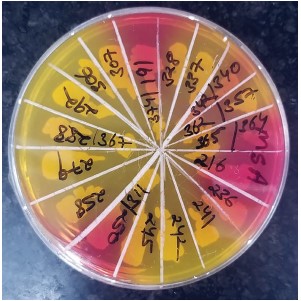
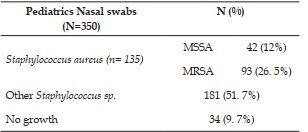
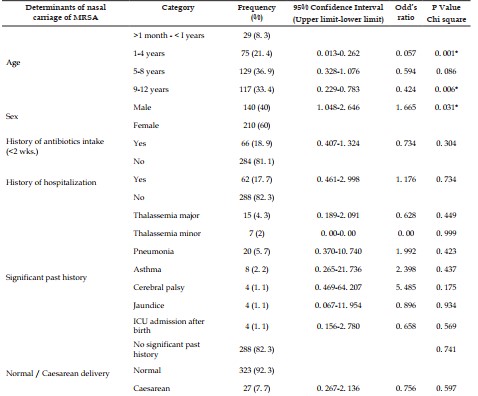
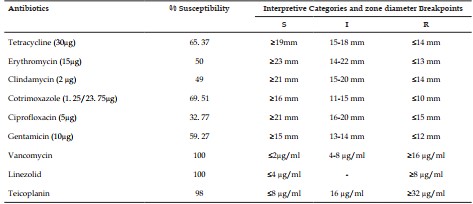
Background: Staphylococcus aureus is a foremost human pathogen that has been impeded from causing abundant clinical infections ranging from bacteremia, septicemia, infective endocarditis, skin and soft tissue, pulmonaryand device-related infections. Methicillinresistant Staphylococcus aureus (MRSA) is the cause of a growing number of hospital-acquired infections (HAIs) around the world. This has led to longer hospital stays, more prolonged antibiotic administration, and greater inpatient health care expenses. Objectives: To analyze the rate of nasal carriage of Methicillin-resistant Staphylococcus aureus by antimicrobial culture sensitivity among pediatric patients. Material and Methods: Within a year (July 2021–June 2022), 350 patients participated in a hospital-based cross-sectional study conducted in the pediatrics and microbiology departments of a tertiary care hospital in East Delhi. A sterile cotton swab dampened with regular saline will be used to take nasal swabs from patients. The Sample was subcultured on Mannitol salt agar and S. aureus was identified as per standard microbiological guidelines. The antibiotic susceptibility testing was performed by the Kirby–Bauer disc diffusion method on Muller-Hinton agar. Results: Among 350 pediatric nasal swab samples, the prevalence of S. aureus was 135 (38. 57%). Other Staphylococcus sp. were 181 (51. 7%) and no growth was noticed in 34 (9. 7%). Out of 135 (38. 57%) Methicillin-resistant Staphylococcus aureus isolated pediatric patients, 26 (19. 25%) had inducible clindamycin resistance. Conclusions: The study highlights MRSA’s persistent challenges in pediatric healthcare settings, including high prevalence, inducible clindamycin resistance, age, and antibiotic use. It calls for standardized infection control measures, cautious antibiotic prescription practices, and continuous surveillance.
References
- 1. Anderson KL, Stewart SD, Shearer R. (2018). Age as a Predictive Factor of MRSA Nasal Carriage in Pediatric Patients. Journal of Pediatric Infectious Diseases, 22(4):342-345.
- 2. Chambers H F. (2001). The changing epidemiology of Staphylococcus aureus. Emerging infectious diseases, 7(2):178-179.
- 3. Davis JS, Turnidge J. (2016). Rational Antibiotic Use in Pediatric Hospitals: The Role of Antibiotic Stewardship. Journal of the Pediatric Infectious Diseases Society, 5(1): S78-S83.
- 4. Diep BA, Otto Schreiber HL. (2019). The Inducible Clindamycin Resistance among MethicillinResistant Staphylococcus aureus. Infection Control and amp; Hospital Epidemiology, 30(12): 1168-1172.
- 5. Eriksen NHR, Espersen F, Rosdahl VT, Jensen K. (1995). Carriage of Staphylococcus aureus among 104 healthy persons during a 19-month period. Epidemiol. Infect. 115:51-60.
- 6. Fomda BA, Thokar MA, Khan A, Bhat JA, Zahoor D, Bashir G. (2014). Nasal carriage of methicillinresistant Staphylococcus aureus among healthy population of Kashmir, India. Indian journal of medical microbiology, 32(1):39-43.
- 7. George K, Abdulkader JK, Sugumar M, Rajagopal GK. (2016). Prevalence of MRSA nasal carriage in patients admitted to a tertiary care hospital in southern India. Journal of Clinical and Diagnostic Research: JCDR, 10(2):11-12.
- 8. Guo Y, Song G, Sun M, Wang J, Wang Y. (2020). Prevalence and therapies of antibiotic-resistance in Staphylococcus aureus. Frontiers in cellular and infection microbiology, 10:107-108.
- 9. Henderson DK (2006). Managing methicillinresistant staphylococci: a paradigm for preventing nosocomial transmission of resistant organisms. The American journal of medicine, 119(6):S45-S52.
- 10. Indian Network for Surveillance of Antimicrobial Resistance (INSAR) group (2013). India. Methicillin resistant Staphylococcus aureus (MRSA) in India: prevalence & susceptibility pattern. Indian J Med Res;137(2):363-9.
- 11. Lee S. O., Choi S. H., Lee H. J., Kim Y. K., Kim M. H., Kim Y. S. (2020). The Prevalence and Clinical Significance of Methicillin-Resistant Staphylococcus aureus in Korean Children. The Pediatric Infectious Disease Journal, 23(1):29-33.
- 12. Magnano San, Lio R, Favara G, Maugeri A, Barchitta M, Agodi A. (2023). How antimicrobial resistance is linked to climate change: an overview of two intertwined global challenges. International journal of environmental research and public health, 20(3):1681.
- 13. Mairi A, Touati A, Lavigne JP. (2020). Methicillinresistant Staphylococcus aureus ST80 clone: a systematic review. Toxins, 12(2):119-120.
- 14. Mistry RD (2020). Skin and soft tissue infections in ambulatory care settings: setting a new trend. Clinical Infectious Diseases, 70(12):2719-2720.
- 15. Mondal H, Gupta I, Nandi P, Ghosh P, Chattopadhyay S, Mitra GD. (2016). Nasal screening of healthcare workers for nasal carriage of methicillin resistance Staphylococcus aureus, vancomycin resistance Staphylococcus aureus and prevalence of nasal colonization with Staphylococcus aureus in Burdwan Medical College and Hospital. Int J Contemp Med Res, 3(11):3342-6.
- 16. Naing L, Winn T, Rusli BN. (2006). Practical issues in calculating the sample size for prevalence studies. Arch Orofac Sci;1:9-14.
- 17. Nurjadi D, Eichel VM, Tabatabai P, Klein S, Last K, Mutters NT. (2021). Surveillance for colonization, transmission, and infection with methicillinsusceptible Staphylococcus aureus in a neonatal intensive care unit. JAMA Network Open, 4(9): e2124938-e2124938.
- 18. Othman AM, Al-Huraibi BS, Assayaghi RM, AlShami HZ. (2021). Nasal carriage and methicillin resistance of Staphylococcus aureus among Schoolchildren in Sana’a City, Yemen. International Journal of Microbiology, 2021:1-6.
- 19. Patel BK, Sharma A. (2019). Antibiotic Susceptibility Profiles of Methicillin-Resistant Staphylococcus aureus Isolates in Pediatric Patients. Pediatric Infectious Disease Journal, 32(9):982-984.
- 20. Pathak A, Marothi Y, Iyer RV, Singh B, Sharma M, Eriksson B. (2010). Nasal Carriage and Antimicrobial Susceptibility of Staphylococcus aureus in healthy preschool children in Ujjain, India. BMC pediatrics, 10(1):1-8.
- 21. Schinasi L, Wing S, MacDonald PDM, Richardson DB, Stewart JR, Augustino KL. (2013). Medical and household characteristics associated with Methicillin-resistant Staphylococcus aureus nasal carriage among patients admitted to a rural tertiary care hospital. PloS one, 8(8): e73595.
- 22. Wayne PA. (2022). Clinical and Laboratory Standards Institute: Performance standards for antimicrobial susceptibility testing: 20th informational supplement. CLSI document M100-S32.
- 23. Wertheim HF, Melles DC, Vos MC, van Leeuwen W, van Belkum A, Verbrugh HA. (2005). The role of nasal carriage in Staphylococcus aureus infections. The Lancet Infectious Diseases, 5(12): 751-762.
Data Sharing Statement
There are no additional data available. All raw data and code are available upon request.
Funding
This research received no funding.
Author Contributions
All authors contributed significantly to the work and approve its publication.
Ethics Declaration
This article does not involve any human or animal subjects, and therefore does not require ethics approval.
Acknowledgements
We would like to express our gratitude to the patients, their families, and all those who have contributed to this study.
Conflicts of Interest
No conflicts of interest in this work.
About this article

Cite this article
Kirti Nirmal, Vikas Saini, et al., Nasal Carriage of Methicillin-resistant Staphylococcus aureus in Pediatric Patients Admitted during the COVID-19 Pandemic in a Tertiary Care Hospital. J Microbiol Relat Res. 2024;10(2):57–62.
Licence:
Attribution-Non-commercial 4.0 International (CC BY-NC 4.0)This license enables reusers to distribute, remix, adapt, and build upon the material in any medium or format for noncommercial purposes only, and only so long as attribution is given to the creator.
| Received | Accepted | Published |
|---|---|---|
| September 05, 2024 | November 21, 2024 | December 25, 2024 |
DOI: https://doi.org/10.21088/jmrr.2395.6623.10224.1
Keywords
S. aureusPediatricInducible clindamycin resistanceSearch for Similar Articles
Similar Articles
- Ochrobactrum anthropi Bacteremia in Immunocompromised Patients: A Unique Threat...
- A Survey of Current Research on the Green Synthesis of Silver Nanoparticles (AgN...
- Navigating the Global Obesity a Global Catastrophe: The Role of Pancreatic Lipas...
- Phenotypic Detection of MRSA from Conventional Methods and CHROM Agar Medium in...
- Isolation of Exopolysaccharides Producing Microorganisms from Garden Soils
Article Level Metrics
Last UpdatedMonday 21 September 2026, 14:27:32 (IST)
1469
Accesses
5
188
00
Citations
NA
NA
NA
Download citation
Article Keywords
Keyword Highlighting
Highlight selected keywords in the article text.
Timeline
| Received | September 05, 2024 |
| Accepted | November 21, 2024 |
| Published | December 25, 2024 |
licence
Attribution-Non-commercial 4.0 International (CC BY-NC 4.0)
This license enables reusers to distribute, remix, adapt, and build upon the material in any medium or format for noncommercial purposes only, and only so long as attribution is given to the creator.