Full Text (PDF)
Journal of Microbiology and Related Research 10(2):p 69-72, July-December 2024. | DOI: https://doi.org/10.21088/jmrr.2395.6623.10224.3
Original Article
Isolation of Exopolysaccharides Producing Microorganisms from Garden Soils
Kalavati Prajapati, Sreeja Bopin
Author Information
Licence:
Attribution-Non-commercial 4.0 International (CC BY-NC 4.0)This license enables reusers to distribute, remix, adapt, and build upon the material in any medium or format for noncommercial purposes only, and only so long as attribution is given to the creator.
Journal of Microbiology and Related Research 10(2):p 69-72, July-December 2024. | DOI: https://doi.org/10.21088/jmrr.2395.6623.10224.3
How Cite This Article:
Kalavati Prajapati, Sreeja Bopin, Isolation of Exopolysaccharides-Producing Microorganisms from Garden Soils. J Microbiol Relat Res. 2024;10(2):69–72.Timeline
Received : July 13, 2024
Accepted : October 21, 2024
Published : December 25, 2024
Abstract
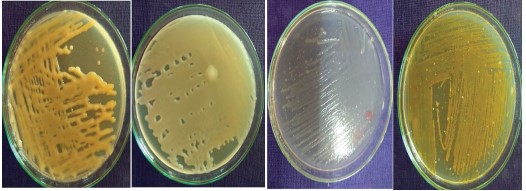
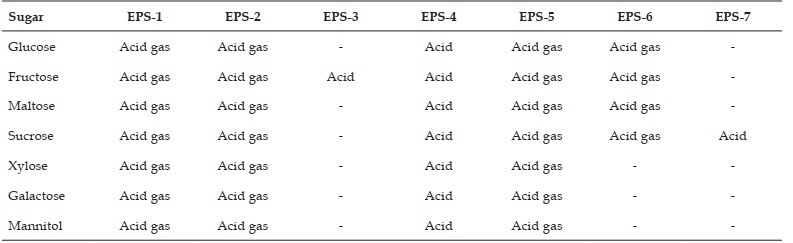
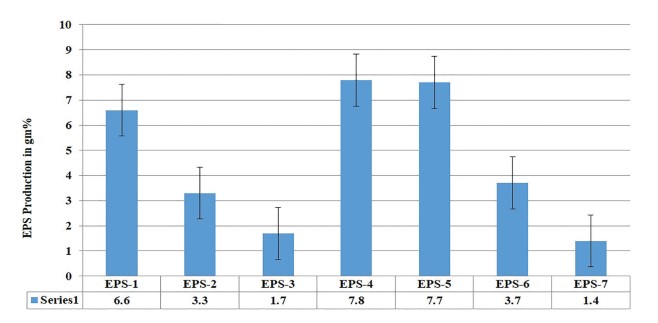
Diverse structural, functional, and valuable polysaccharides are synthesized by bacteria of all taxa and secreted into the external environment. These polysaccharides are referred to as exopolysaccharides (EPS) and they may either be homopolymeric or heteropolymeric in composition. So, the study aimed to isolate exopolysaccharide-producing microorganisms from the various samples. A total of 7 different exopolysaccharide-producing microorganisms were isolated from the garden soil samples. Among them, two are Gram-positive and five Gram-negative bacterial isolates. These EPS-producing isolates were further studied for their colonical, morphological, and biochemical characteristics and various enzyme productions. The ability of EPS producers in various raw carbon sources i. e. Rice flour, wheat starch, horse gram starch, maize starch, and potato extract were also checked. These EPS producers were further studied for their EPS production ability as well as the characterization and quantification of EPS.
References
- 1. Sutherland I.W. (1994). Structure-function relationships in microbial exopolysaccharides. Biotechnol. Adv. 12: 393-448.
- 2. Ahuja, V.; Bhatt, A.K.; Banu, J.R.; Kumar, V.; Kumar, G.; Yang, Y.H.; Bhatia, S. K. Microbial Exopolysaccharide Composites in Biomedicine and Healthcare: Trends and Advances. Polymers 2023, 15, 1801. [CrossRef] [PubMed].
- 3. Kaur, N.; Dey, P. Bacterial Exopolysaccharides as Emerging Bioactive Macromolecules: From Fundamentals to Applications. Res. Microbiol. 2022, 29, 104024. [CrossRef] [PubMed].
- 4. Mahmoud, Y.A.G.; El-Naggar, M.E.; AbdelMegeed, A.; El-Newehy, M. Recent Advancements in Microbial Polysaccharides: Synthesis and Applications. Polymers 2021, 13, 4136. [CrossRef] [PubMed].
- 5. Mohd Nadzir, M.; Nurhayati, R. W.; Idris, F. N.; Nguyen, M. H. Biomedical Applications of Bacterial Exopolysaccharides: A Review. Polymers 2021, 13, 530. [CrossRef] [PubMed].
- 6. Rana, S.; Upadhyay, L.S.B. Microbial exopolysaccharides: Synthesis pathways, types and their commercial applications. Int. J. Biol. Macromol. 2020, 157, 577–583. [CrossRef] [PubMed].
- 7. Barcelos, M.C.S.; Vespermann, K.A.C.; Pelissari, F.M.; Molina, G. Current status of biotechnological production and applications of microbial exopolysaccharides. Crit. Rev. Food Sci. Nutr. 2019, 60, 1475–1495. [CrossRef].
- 8. Osemwegie, O.O.; Adetunji, C.O.; Ayeni, E.A.; Adejobi, O.I.; Arise, R.O.; Nwonuma, C.O.; Oghenekaro, A.O. Exopolysaccharides from bacteria and fungi: Current status and perspectives in Africa. Heliyon 2020, 6, e04205. [CrossRef].
- 9. Sutherland, I.W. Bacterial exopolysaccharides. Adv. Microb. Physiol. 1972, 8, 143–213. [CrossRef].
- 10. Xiao, M.; Ren, X.; Yu, Y.; Gao, W.; Zhu, C.; Sun, H.; Kong, Q.; Fu, X.; Mou, H. Fucose-containing bacterial exopolysaccharides: Sources, biological activities, and food applications. Food Chem. X 2022, 13, 100233. [CrossRef].
- 11. Schmid, J.; Sieber, V.; Rehm, B. Bacterial exopolysaccharides: Biosynthesis pathways and engineering strategies. Front. Microbiol. 2015, 6, 496. [CrossRef].
- 12. Pereira, S.B.; Sousa, A.; Santos, M.; Araújo, M.; Serôdio, F.; Granja, P.; Tamagnini, P. Strategies to obtain designer polymers based on cyanobacterial extracellular polymeric substances (EPS). Int. J. Mol. Sci. 2019, 20, 5693. [CrossRef] [PubMed].
- 13. Manan, S.; Wajid Ullah, M.; Ul-Islam, M.; Shi, Z.; Gauthier, M.; Yang, G. Bacterial cellulose: Molecular regulation of biosynthesis, supramolecular assembly, and tailored structural and functional properties. Prog. Mater. Sci. 2022, 129, 100972. [CrossRef].
- 14. Aditya, T.; Allain, J.P.; Jaramillo, C.; Restrepo, A. M. Surface Modification of Bacterial Cellulose for Biomedical Applications. Int. J. Mol. Sci. 2022, 23, 610. [CrossRef] [PubMed].
- 15. Aziz, T.; Farid, A.; Haq, F.; Kiran, M.; Ullah, A.; Zhang, K.; Li, C.; Ghazanfar, S.; Sun, H.; Ullah, R.; et al. A Review on the Modification of Cellulose and Its Applications. Polymers 2022, 14, 3206. [CrossRef] [PubMed].
- 16. Angelin, J.; Kavitha, M. Exopolysaccharides from probiotic bacteria and their health potential. Int. J. Biol. Macromol. 2020, 162, 853–865. [CrossRef] [PubMed].
Data Sharing Statement
There are no additional data available. All raw data and code are available upon request.
Funding
This research received no funding.
Author Contributions
All authors contributed significantly to the work and approve its publication.
Ethics Declaration
This article does not involve any human or animal subjects, and therefore does not require ethics approval.
Acknowledgements
We would like to express our gratitude to the patients, their families, and all those who have contributed to this study.
Conflicts of Interest
No conflicts of interest in this work.
About this article

Cite this article
Kalavati Prajapati, Sreeja Bopin, Isolation of Exopolysaccharides-Producing Microorganisms from Garden Soils. J Microbiol Relat Res. 2024;10(2):69–72.
Licence:
Attribution-Non-commercial 4.0 International (CC BY-NC 4.0)This license enables reusers to distribute, remix, adapt, and build upon the material in any medium or format for noncommercial purposes only, and only so long as attribution is given to the creator.
| Received | Accepted | Published |
|---|---|---|
| July 13, 2024 | October 21, 2024 | December 25, 2024 |
DOI: https://doi.org/10.21088/jmrr.2395.6623.10224.3
Keywords
ExopolysaccharidesGarden soilRaw carbon sourcesPhysio chemical propertiesSearch for Similar Articles
Similar Articles
- Ochrobactrum anthropi Bacteremia in Immunocompromised Patients: A Unique Threat...
- A Survey of Current Research on the Green Synthesis of Silver Nanoparticles (AgN...
- Navigating the Global Obesity a Global Catastrophe: The Role of Pancreatic Lipas...
- Phenotypic Detection of MRSA from Conventional Methods and CHROM Agar Medium in...
- Isolation and Identification of Non-Fermenting Gram Negative Bacteria
Article Level Metrics
Last UpdatedMonday 21 September 2026, 13:47:44 (IST)
1463
Accesses
6
188
00
Citations
NA
NA
NA
Download citation
Article Keywords
Keyword Highlighting
Highlight selected keywords in the article text.
Timeline
| Received | July 13, 2024 |
| Accepted | October 21, 2024 |
| Published | December 25, 2024 |
licence
Attribution-Non-commercial 4.0 International (CC BY-NC 4.0)
This license enables reusers to distribute, remix, adapt, and build upon the material in any medium or format for noncommercial purposes only, and only so long as attribution is given to the creator.