Full Text (PDF)
Pediatric Education and Research 14(1):p 11-14, January 2026. | DOI: https://doi.org/10.21088/per.2320.0022.14126.2
Original Article
Moro Reflex in Newborns: Physiology, Clinical Relevance, and Diagnostic Value
Author Information
Licence:
Attribution-Non-commercial 4.0 International (CC BY-NC 4.0)This license enables reusers to distribute, remix, adapt, and build upon the material in any medium or format for noncommercial purposes only, and only so long as attribution is given to the creator.
Pediatric Education and Research 14(1):p 11-14, January 2026. | DOI: https://doi.org/10.21088/per.2320.0022.14126.2
How Cite This Article:
Chakradhar Maddela. Moro Reflex in Newborns: Physiology, Clinical Relevance, and Diagnostic Value. Pediatr. Edu. Res. 2026;14(1): 11-14Timeline
Received : April 30, 2026
Accepted : May 03, 2026
Published : June 26, 2026
Abstract
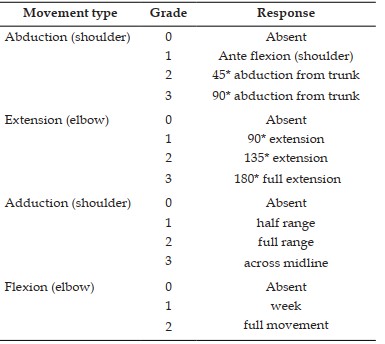
The Moro reflex is one of the most recognizable primitive reflexes in early neonatal life and provides important information about the functional status of the central and peripheral nervous systems. It is routinely assessed in newborns and reflects brainstem activity, motor pathway integrity, and developmental maturity. This review summarizes the physiological basis, method of elicitation, normal and abnormal patterns, and differences between preterm and term infants. Literature from standard neonatal references and indexed medical databases was reviewed. The reflex consists of a two‑phase sequence initial abduction and extension of the upper limbs followed by adduction and flexion mediated mainly through brainstem circuits. Abnormalities such as absence, asymmetry, or sluggishness may indicate neurological dysfunction, peripheral nerve injury, or systemic illness. The reflex appears during late gestation, is well developed at term, and typically disappears by 4–6 months of age. Accurate assessment of the Moro reflex aids in early identification of neurological abnormalities and guides further evaluation.
References
- 1. Nelson Textbook of Pediatrics. 21st ed. Elsevier; 2020.
- 2. Cloherty and Stark’s Manual of Neonatal Care. 8th ed. Wolters Kluwer; 2017.
- 3. Volpe JJ. Neurology of the Newborn. 6th ed. Elsevier; 2018.
- 4. Prechtl HF R. The Neurological Examination of the Full-Term Newborn Infant. Clin Dev Med. 1977; 63:1-173.
- 5. Pattnaik P, Al Khalili Y. Moro Reflex. In: StatPearls [Internet]. Treasure Island (FL): StatPearls Publishing; 2025 Jan.
- 6. Griswold K, Srinivas GL. Physical examination of the healthy newborn. In: Martin RJ, Fanaroff AA, Walsh MC, editors. Fanaroff and Martin’s Neonatal-Perinatal Medicine. 12th ed. Philadelphia: Elsevier; 2025. p. 453-474.
- 7. Holler-Managan YF. Neurologic evaluation. In: Kliegman RM, St. Geme JW, Blum NJ, Shah SS, Tasker RC, Wilson KM, editors. Nelson Textbook of Pediatrics. 22nd ed. Philadelphia: Elsevier; 2025.
- 8. Volpe JJ, El-Dib M. Neurological examination: normal and abnormal features. In: Volpe JJ, editor. Volpe’s Neurology of the Newborn. 7th ed. Philadelphia: Elsevier; 2025. p. 293-323.
- 9. Futagi Y, Toribe Y, Suzuki Y. The grasp reflex and Moro reflex in infants: hierarchy of primitive reflex responses. Int J Pediatr. 2012; 2012:191562.
- 10. Chaves-Gneco D, Feldman HM. Developmental/behavioral pediatrics. In: Zitelli BJ, McIntire SC, Nowalk AJ, Garrison J, editors. Zitelli and Davis’ Atlas of Pediatric Physical Diagnosis. 8th ed. Philadelphia: Elsevier; 2023. p. 71-99.
- 11. Modrell AK, Tadi P. Primitive Reflexes. In: StatPearls [Internet]. Treasure Island (FL): StatPearls Publishing; 2025 Jan.
- 12. Pecuch A, Gieysztor E, Telenga M, Wolańska E, Kowal M, Paprocka-Borowicz M. Primitive reflex activity in relation to sensory profile in healthy preschool children. Int J Environ Res Public Health. 2020;17(21):8210.
- 13. Overvelde S. Guiding parents of children with persistent primitive reflexes. J Nurse Pract. 2024;20(6):105021
- 14. Hormann MD. Birth injury. In: Zaoutis LB, Chiang VW, editors. Comprehensive ediatric Hospital Medicine. 2nd ed. New York: McGraw-Hill Education; 2017.
- 15. Kaneshiro NK. Moro reflex. In: MedlinePlus Medical Encyclopedia [Internet]. Bethesda (MD): National Library of Medicine; 2025.
- 16. Edelman HE, Stratton MJ. Neurology. In: Anderson CC, Kapoor S, Mark TE, editors. The Harriet Lane Handbook. 23rd ed. Philadelphia: Elsevier; 2024.
- 17. Futagi Y, Toribe Y, Suzuki Y. Clinical significance of the Moro reflex in infants. Brain Dev. 1999;21(5):301-307.
- 18. Moro E. Über den sogenannten Moro’schen Reflex der Neugeborenen. Monatsschr Kinderheilkd. 1918; 17:84-86.
- 19. Amiel-Tison C, Grenier A. Neurological Assessment of the Preterm and Full-Term Newborn Infant. Baltimore: Johns Hopkins University Press; 1986.
- 20. Hadders-Algra M. Early human motor development: from variation to the ability to vary and adapt. Neurosci Biobehav Rev. 2018; 90:411-427.
Data Sharing Statement
There are no additional data available. All raw data and code are available upon request.
Funding
This research received no funding.
Author Contributions
All authors contributed significantly to the work and approve its publication.
Ethics Declaration
This article does not involve any human or animal subjects, and therefore does not require ethics approval.
Acknowledgements
We would like to express our gratitude to the patients, their families, and all those who have contributed to this study.
Conflicts of Interest
No conflicts of interest in this work.
About this article

Cite this article
Chakradhar Maddela. Moro Reflex in Newborns: Physiology, Clinical Relevance, and Diagnostic Value. Pediatr. Edu. Res. 2026;14(1): 11-14
Licence:
Attribution-Non-commercial 4.0 International (CC BY-NC 4.0)This license enables reusers to distribute, remix, adapt, and build upon the material in any medium or format for noncommercial purposes only, and only so long as attribution is given to the creator.
| Received | Accepted | Published |
|---|---|---|
| April 30, 2026 | May 03, 2026 | June 26, 2026 |
DOI: https://doi.org/10.21088/per.2320.0022.14126.2
Keywords
Included Moro ReflexPrimitive ReflexesNeonatal Neurological ExaminationAnd Brainstem Reflexes.Search for Similar Articles
Similar Articles
Article Level Metrics
Last UpdatedSaturday 24 October 2026, 15:51:08 (IST)
3118
Accesses
31
241
00
Citations
NA
NA
NA
Download citation
Article Keywords
Keyword Highlighting
Highlight selected keywords in the article text.
Timeline
| Received | April 30, 2026 |
| Accepted | May 03, 2026 |
| Published | June 26, 2026 |
licence
Attribution-Non-commercial 4.0 International (CC BY-NC 4.0)
This license enables reusers to distribute, remix, adapt, and build upon the material in any medium or format for noncommercial purposes only, and only so long as attribution is given to the creator.