Full Text (PDF)
Indian Journal of Forensic Medicine and Pathology 18((2 Suppl)):p 292-300, April-June 2025. | DOI: https://doi.org/10.21088/ijfmp.0974.3383.18225.31
Review Article
Modelling the Dynamics of Crime Against Women by Incorporating Role of Technology
Shelly Khurana, Anil Kumar Nishad, Sushant Shekhar
Author Information
Licence:
Attribution-Non-commercial 4.0 International (CC BY-NC 4.0)This license enables reusers to distribute, remix, adapt, and build upon the material in any medium or format for noncommercial purposes only, and only so long as attribution is given to the creator.
Indian Journal of Forensic Medicine and Pathology 18((2 Suppl)):p 292-300, April-June 2025. | DOI: https://doi.org/10.21088/ijfmp.0974.3383.18225.31
How Cite This Article:
Khurana S, Nishad AK, Shekhar S. Modelling the Dynamics of Crime Against Women by Incorporating the Role of Technology. Indian J Forensic Med Pathol. 2025;18(2 Suppl):292-300.Timeline
Received : July 17, 2024
Accepted : June 16, 2025
Published : June 30, 2025
Abstract
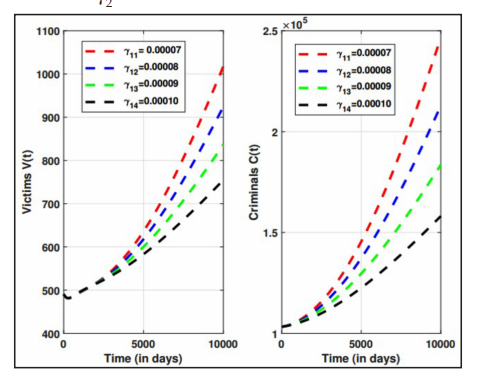
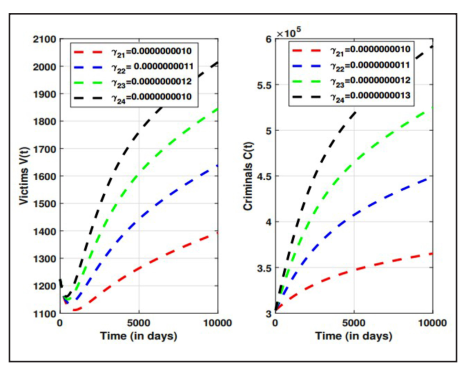
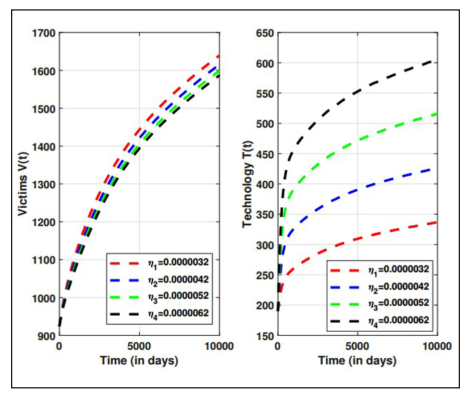
Background: Crime against women in India is a complicated and ubiquitous issue that, despite attempts, remains a substantial challenge. It can have serious and long-term consequences for their physical, emotional, and psychological wellbeing. Technology can help combat crime against women by providing tools and resources for preventing, reporting, and dealing with abuse and harassment. Aim: To combat crime against women in India and create a safe environment for them. Objectives: To investigate the effectiveness of technology in lowering crime against women. Material: A nonlinear mathematical model has been constructed taking into account five interacting variables namely, targeted, susceptible, criminals, victims, and technology. Result: Our model shows the presence of two equilibria: crime-free and crimepersistent. The crime-free equilibria (CFE) always exist, while crime-persistent equilibria (CPE) exist when criminality reproduction number (R0c) is greater than 1. Further, stability analysis has been carried out. Analysis demonstrated that when c0 R >1, crime-persistent equilibria is nonlinearly asymptotically stable under some restrictions on parameters. The impact of key parameters on the dynamics of crime against women is also investigated through numerical simulation. Conclusion: According to the model study, the use of technology like installing Safetipin or another emergency app, addressing areas with poor safety, introducing wearable tech etc can effectively minimize crime against women in society.
References
- 1. Gordon M.B., A random walk in the literature on criminality: a partial and critical view on some statistical analyses and modelling approaches. Eur J Appl Math. 2010; 21: 283-306.
- 2. Khurana S. and Shekhar S., Mathematical Models Studying Crime Dynamics: A Review on Adopted Approaches. Indian J Forensic Med Pathol. 2022; 14 (3 Special): 223-230.
- 3. Gordon M.B., Iglesias J.R., Semeshenko V., Nadal J.P., Crime and punishment: the economic burden of impunity. Eur Phys J B. 2009; 68(1): 13344.
- 4. Fernandez A., Crime prevention. Wilan Publishing, New York; 2005.
- 5. Levitt S., The effect of prison population size on crime rates: Evidence from overcrowding litigation. Q J Econ. 1996; 111(2): 31951.
- 6. Phan D., Gordon M.B., Nadal J.P., Social interactions in economic theory: an in-sight from statistical mechanics. Cognit Econ. 2004: 335-58.
- 7. Becker G.S., Crime and punishment: An economic approach. Journal of Political Economy. 1968; 76(2): 169-217.
- 8. McMillon D., Simon C.P., Morenoff J., Modeling the Underlying Dynamics of the Spread of Crime. PLoS ONE. 2014; 9(4): e88923.
- 9. Campbell M. and Ormerod P., Social Interactions and the Dynamics of Crime. Tech. Rep., Volterra Consulting. 1998.
- 10. Srivastav A.K., Ghosh M., Chandra P., Modeling dynamics of the spread of crime in a society. Stochastic Analysis and Applications. 2019; 37(6): 991-1011.
- 11. Gonzlez-Parra G., Chen-Charpentier B., Kojouharov H.V., Mathematical modelling of crime as a social epidemic. Journal of Interdisciplinary Mathematics. 2018; 21(3): 623-643.
- 12. Glaeser E.L., Sacerdote B., Scheinkman J. A., Crime and Social Interactions. Quarterly Journal of Economics. 1996; 111(2): 507-48.
- 13. Athithan S., Ghosh M., Li X. Z., Mathematical modelling and optimal control of corruption dynamics. Asian Eur J Math. 2018; 11(6): 1850090.
- 14. Zhao H., Feng Z., Chavez C.C., The Dynamics of Poverty and Crime. Journal of Shanghai Normal University. 2015; 43(5): 486-495
- 15. Misra A.K., Modeling the effect of police deterrence on the prevalence of crime in the society, Applied Mathematics and Computation. 2014; 237: 531–545.
- 16. Chiu W. H., Madden P., Burglary and income inequality. Journal of Public Economics. 1998; 69(1): 123-141.
- 17. Curtis J.P., Smith F.T., Ye X., Modelling Burglaries in Streets, Mathematics in Industry. 2010; 15(3): 777-783.
- 18. Shukla J.B., Goyal A., Agrawal K., Kushwa H., Role of technology in combating social crimes: A modeling study. European Journal of Applied Mathematics. 2013; 24(4): 501-514.
- 19. NCRB Report, https://ncrb.gov.in/en.
- 20. Shukla J.B., Singh V., Misra A.K., Modeling the spread of an infectious disease with bacteria and carriers in the environment. Nonlinear Anal. RWA. 2011; 12: 2541–2551.
- 21. United Nations - World Population Prospects. https://population.un.org/wpp/.
Data Sharing Statement
There are no additional data available. All raw data and code are available upon request.
Funding
This research received no funding.
Author Contributions
All authors contributed significantly to the work and approve its publication.
Ethics Declaration
This article does not involve any human or animal subjects, and therefore does not require ethics approval.
Acknowledgements
We would like to express our gratitude to the patients, their families, and all those who have contributed to this study.
Conflicts of Interest
No conflicts of interest in this work.
About this article

Cite this article
Khurana S, Nishad AK, Shekhar S. Modelling the Dynamics of Crime Against Women by Incorporating the Role of Technology. Indian J Forensic Med Pathol. 2025;18(2 Suppl):292-300.
Licence:
Attribution-Non-commercial 4.0 International (CC BY-NC 4.0)This license enables reusers to distribute, remix, adapt, and build upon the material in any medium or format for noncommercial purposes only, and only so long as attribution is given to the creator.
| Received | Accepted | Published |
|---|---|---|
| July 17, 2024 | June 16, 2025 | June 30, 2025 |
DOI: https://doi.org/10.21088/ijfmp.0974.3383.18225.31
Keywords
Mathematical modelCrime against WomenStability analysisRole of technologyDynamical systemSearch for Similar Articles
Similar Articles
- Diatom Analysis in Thermophilic water bodies: A Study on Hot Water Springs of Ma...
- Morphometric Study of Supra-meatal Triangle and Mastoid process in the Adult dry...
- Histopathological Spectrum of Autopsy Cases: A One Year Retrospective Observatio...
- Forensic Differentiation of Manner of Death in Railway Fatalities: A FourCase Se...
- Understanding assault Patterns: A Cross-sectional study of Cases at Chri, Kelamb...
Article Level Metrics
Last UpdatedSunday 18 October 2026, 19:25:30 (IST)
16288
Accesses
84
3209
00
Citations
NA
NA
NA
Download citation
Article Keywords
Keyword Highlighting
Highlight selected keywords in the article text.
Timeline
| Received | July 17, 2024 |
| Accepted | June 16, 2025 |
| Published | June 30, 2025 |
licence
Attribution-Non-commercial 4.0 International (CC BY-NC 4.0)
This license enables reusers to distribute, remix, adapt, and build upon the material in any medium or format for noncommercial purposes only, and only so long as attribution is given to the creator.