Full Text (PDF)
Indian Journal of Forensic Medicine and Pathology 16(3):p 185-190, July-September 2023. | DOI: https://doi.org/10.21088/ijfmp.0974.3383.16323.3
Original Article
Lip Prints as an Early Indicator of Different Malocclusions
Seema Gupta, Eenal Bhambri, Manish Sharma, Deepak V. Gowda, Shivam Agrawal, Chetan V. Deshmukh
Author Information
Licence:
Attribution-Non-commercial 4.0 International (CC BY-NC 4.0)This license enables reusers to distribute, remix, adapt, and build upon the material in any medium or format for noncommercial purposes only, and only so long as attribution is given to the creator
Indian Journal of Forensic Medicine and Pathology 16(3):p 185-190, July-September 2023. | DOI: https://doi.org/10.21088/ijfmp.0974.3383.16323.3
How Cite This Article:
Bhambri E, Sharma M, Gupta S, et al. Lip prints as an early indicator of different malocclusions. Indian J Forensic Med Pathol. 2023;16(3):185-190.Timeline
Received : March 13, 2023
Accepted : June 16, 2023
Published : September 30, 2023
Abstract
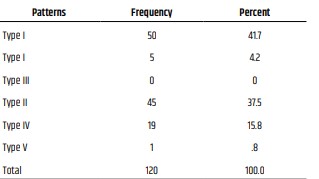
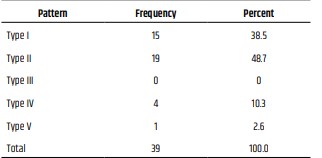
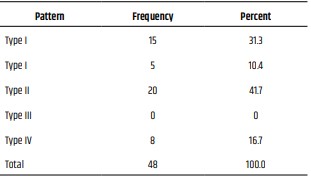
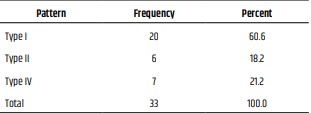
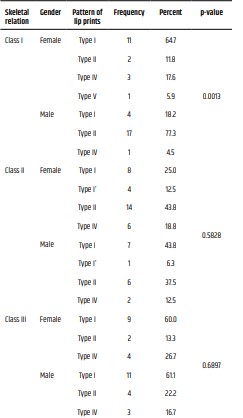
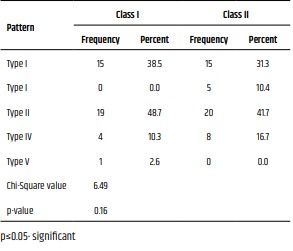
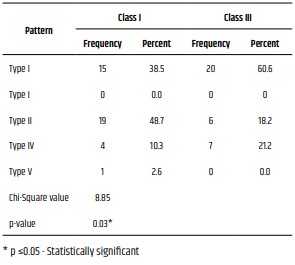
The goal of the current investigation was to see if there was any correlation between skeletal malocclusions and lip print patterns. Hospital based, prospective, observational, cross-sectional study. The study was conducted on 120 subjects, divided into 3 groups Skeletal Class I, Class II, and Class III based on ANB angle, Beta angle, and Wits. For the assessment of lip print patterns, they were classifi ed according to the Tsuchihashi classifi cation system. The chi-square test was used to study diff erences in the groups. It was noted that the most prevalent lip pattern was Type I while; the least was the Type V pattern. A Type III lip pattern was absent. There was a signifi cant correlation between Type I lip pattern and Skeletal Class III malocclusion. Also, there were signifi cant gender diff erences in lip print patterns in skeletal class I malocclusion with no diff erences in skeletal class II and class III malocclusion. Lip prints can be a useful aid in predicting the type of skeletal malocclusion as they develop early in life, therefore, can be successfully used for preventative and interceptive orthodontic procedures. Hence, lip prints can be used as early detectors of skeletal malocclusions
References
- 1. Vahanwala SP, Parekh BK. Study of lip prints as an aid to forensic methodology. J Indian Dent Assoc. 2000; 71:269–271.
- 2. Sivapathasundharam B, Prakash PA, Sivakumar G. Lipprints (cheiloscopy). Indian J Dent Res. 2001; 149:129 132.
- 3. Sharma P, Saxena S, Rathod V. Cheiloscopy; the study of lip prints in sex identification. J Forensic Dent Sci. 2009;1:24-27.
- 4. Hirth L, Gottsche H, Goedde HW. Lip prints—Variability and genetics.J Human Evol. 1977;6:709-710.
- 5. King L, Harris EF, Tolley EA. Heritability of cephalometric and occlusal variables as assessed from siblings with overt malocclusions. Am J Orthod Dentofacial Orthop. 1993;104:121–131.
- 6. Kulkarni N, Vasudevan S, Shah R, Rao P, Balappanavar AY. Cheiloscopy: A new role as a marker of sagittal jaw relation. J Forensic Dent Sci. 2012;4:6 12.
- 7. Baik CY, Ververidou M. A new approach of assessing sagittal discrepancies: The Beta Angle. Am J Orthod Dentofacial Orthop. 2004;126:100-105.
- 8. Tsuchihashi Y. Studies on personal identification by means of lip prints. Forensic Sci. 1974;3:233 248.
- 9. Verghese AJ, Vidyullatha VS, Shashidhar CM. A comparison of the methods for the recording of lip prints. Medico Legal Update –An Int J. 2010;10:62 63.
- 10. Raghav P, Kumar N, Shingh S, Ahuja NK, Ghalaut P. Lip prints: The barcode of skeletal malocclusion. J Forensic Dent Sci. 2013;5:110 117.
- 11. Kaushal B, Mittal S, Aggarwal I. Association of Lip Print Patterns with Sagittal Malocclusions in District Solan Population. Int J Res Health Allied Sci. 2018;4(1):75-81.
- 12. Verghese AJ, Somasekar M, Babu RU. A study on Lip prints types among the people of Kerala. J Indian Acad Forensic Med. 2010;32:6 7.
- 13. Babu NC, Premalatha BR, Jude.J. Cheiloscopy: A new aid for sex identification in forensic science. Indian J Forensic Odontol. 2009; 3: 131 136.
- 14. Gondivkar SM, Indurkar A, Degvekar S, Bhowate R. Cheilosopy for sex determination. J Forensic Dent Sci. 2009;1:56 60.
- 15. Jain S, Saifee A. Comparative Evaluation of Lip Prints Patterns in Gender and Different Musculoskeletal Malocclusion. Saudi J Oral Dent Res.2019; 4: 738-741.
- 16. Aditi S, Tikku T, Khanna R, Maurya RP, Verma SL, Srivastava K, et al. Cheiloscopy: Association of lip prints in different skeletal malocclusions. Int J Orthod Rehab. 2019;10:156-60.
- 17. Sindura A, Setty JV, Srinivasan I, Jawa A. Determination of Relationship between Lip Prints and Skeletal Malocclusion in Children of Age 9–14 Years. Int J ClinPed Dent. 2019;12:494-499.
Data Sharing Statement
There are no additional data available. All raw data and code are available upon request.
Funding
This research received no funding.
Author Contributions
All authors contributed significantly to the work and approve its publication.
Ethics Declaration
This article does not involve any human or animal subjects, and therefore does not require ethics approval.
Acknowledgements
We would like to express our gratitude to the patients, their families, and all those who have contributed to this study.
Conflicts of Interest
No conflicts of interest in this work.
About this article

Cite this article
Bhambri E, Sharma M, Gupta S, et al. Lip prints as an early indicator of different malocclusions. Indian J Forensic Med Pathol. 2023;16(3):185-190.
Licence:
Attribution-Non-commercial 4.0 International (CC BY-NC 4.0)This license enables reusers to distribute, remix, adapt, and build upon the material in any medium or format for noncommercial purposes only, and only so long as attribution is given to the creator
| Received | Accepted | Published |
|---|---|---|
| March 13, 2023 | June 16, 2023 | September 30, 2023 |
DOI: https://doi.org/10.21088/ijfmp.0974.3383.16323.3
Keywords
Lip printsSkeletal malocclusionForensicsSearch for Similar Articles
Similar Articles
- Diatom Analysis in Thermophilic water bodies: A Study on Hot Water Springs of Ma...
- Morphometric Study of Supra-meatal Triangle and Mastoid process in the Adult dry...
- Histopathological Spectrum of Autopsy Cases: A One Year Retrospective Observatio...
- Forensic Differentiation of Manner of Death in Railway Fatalities: A FourCase Se...
- Understanding assault Patterns: A Cross-sectional study of Cases at Chri, Kelamb...
Article Level Metrics
Last UpdatedSunday 18 October 2026, 12:27:10 (IST)
16263
Accesses
22
3205
00
Citations
NA
NA
NA
Download citation
Article Keywords
Keyword Highlighting
Highlight selected keywords in the article text.
Timeline
| Received | March 13, 2023 |
| Accepted | June 16, 2023 |
| Published | September 30, 2023 |
licence
Attribution-Non-commercial 4.0 International (CC BY-NC 4.0)
This license enables reusers to distribute, remix, adapt, and build upon the material in any medium or format for noncommercial purposes only, and only so long as attribution is given to the creator