Full Text (PDF)
Indian Journal of Pathology: Research and Practice 15(1):p 13-19, Jan-Apr 2026. | DOI: 10.21088/ijprp.2278.148X.15126.2
Original Article
Limitations and Difficulties in Convalescent Plasma Collection in the Context of the Covid 19 Pandemic: Experience from a Tertiary Care Teaching Hospital in North India
Parul Garg, Harjot Kaur, Ishwer Tayal
Author Information
Licence:
Attribution-Non-commercial 4.0 International (CC BY-NC 4.0)This license enables reusers to distribute, remix, adapt, and build upon the material in any medium or format for noncommercial purposes only, and only so long as attribution is given to the creator.
Indian Journal of Pathology: Research and Practice 15(1):p 13-19, Jan-Apr 2026. | DOI: 10.21088/ijprp.2278.148X.15126.2
How Cite This Article:
Kaur H, Garg P, Tayal I. Limitations and Difficulties in Convalescent Plasma Collection in the Context of the Covid 19 Pandemic: Experience from a Tertiary Care Teaching Hospital in North India. Ind Jr of Path: Res and Practice. 2026;15(1):13-19.Timeline
Received : February 09, 2025
Accepted : March 05, 2025
Published : April 30, 2026
Abstract
Background: COVID-19 was caused by a virus (SARS-COV-2). On January 30, 2020, the WHO designated the COVID-19 outbreak as a Public Health Emergency of International Concern, and on March 11, 2020, the organization designated the illness as a pandemic. Various medications were tried including Convalescent plasma (CP).CP trials, were initiated based on the principle of viral neutralization and passive immunotherapy. Therefore, it was hypothesized that CP obtained from the blood of recovered patients of COVID-19 may contain immunoglobulins that could neutralize SARS-CoV-2 and thereby improve the course of disease in COVID-19 infection patients. This led to established protocols at various blood centres worldwide to collect plasma from earlier COVID-19 infected patients who had made a full recovery. But little emphasis was paid to the challenges in collecting CP from donors, particularly in Punjab, India, even though numerous studies have focused on the effectiveness of CP as a treatment for COVID-19. The pandemic’s scope led to the assumption that there would be many donors. In real practice, it was difficult to find and choose COVID-19 CP donors who were willing to give and were qualified, fulfilled the inclusion criteria, and had appropriate antibody titers. The current study was undertaken to analyze the challenges and difficulties encountered in collection of plasma from COVID-19 recovered patients in a tertiary care hospital in Northwest Punjab.
Aim: To analyse the challenges and difficulties encountered in collection of convalescent plasma.
Materials and Methods: A prospective cross-sectional survey-based study was done in the COVID-19 recovered blood donors who visited for convalescent plasma (CP) donation at our tertiary care teaching hospital of Punjab. The study was conducted for a period of one year from 01 May 2020 to 30 April 2021.
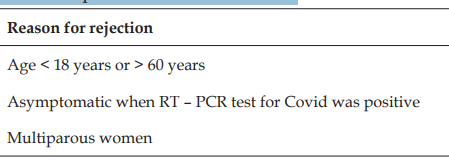
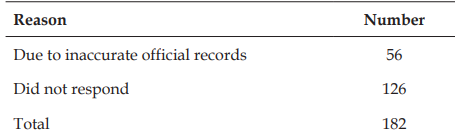
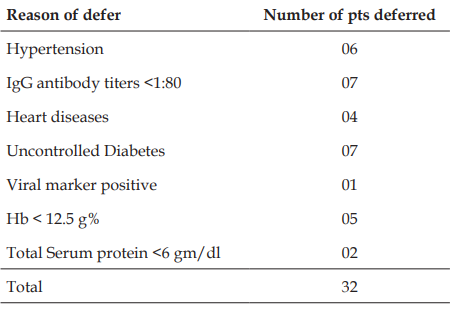
Results: A total 1050 COVID-19 recovered patients were screened. Out of which 690 were rejected and only 360 patients were recruited for the study. The individuals who fulfilled the inclusion criteria were telephonically contacted and explained the details of the procedure and the benefits of the procedure. They were motivated to come for further tests and they were provided transport for the same. Once they were found to be fit, they were further requested to undergo plasma donation. Out of 360, 182 (50.56%) could not be contacted telephonically and 178(49.44% were contacted telephonically. Out of 178,84(23.33% of total recruited) refused to donate plasma on telephone only, 62(17.22%of total recruited) agreed for Plasma Donation. Rest (32,08.89%) was deferred due to various reasons. Out of 62 only 58 came to the blood Centre. But only 26 donated plasmas. Rest of the patients did not donate plasma due to fear of donation.
Out of 360, 182 (50.56%) could not be contacted telephonically and 178(49.44% were contacted telephonically. Out of 178,84(23.33% of total recruited) refused to donate plasma on telephone only, 62(17.22%of total recruited) agreed for Plasma Donation. Rest (32,08.89%) was deferred due to various reasons. Out of 62 only 58 came to the blood Centre. But only 26 donated plasmas. Rest of the patients did not donate plasma due to fear of donation. Out of 26 patients,22 were males and 4 were females, of which 24 donated plasmas for first time.
Conclusion: Blood donation is inherently an altruistic act and in normal times, donors are healthy individuals who volunteer to donate. In a global on-going pandemic, the “Fear Factor of contracting the disease” acted as a major challenge to motivate and convince a COVID recovered patient for plasma donation. But, with the help of targeted publicity and motivation on the benefits of plasma donation which can save two precious lives with a single donation, we could have increased the plasma donation drive. But the challenge was to motivate, convince, and educate the potential donors and society about the likely benefits of COVID convalescent plasma.
References
- 1. Polak SB, Van Gool IC, Cohen D, von der Thusen JH, van Paassen J. A systematic review of pathological findings in COVID-19: a pathophysiological timeline and possible mechanisms of disease progression. Mod Pathol. 2020;33(11):2128–2138.
- 2. Mahapatra S, Pati S. Constraints and challenges in convalescent plasma collection amidst the Covid 19 pandemic- strategies and recommendations to overcome these. Transfus Clin Biol. 2021;28(2):175-179.
- 3. Wang XM, Mannan R, Xiao L, Abdulfatah E, Qiao Y, Farver C, et al. Characterization of SARS-CoV-2 and host entry factors distribution in a COVID-19 autopsy series. Commun Med (Lond). 2021;1:24.
- 4. Qiao Y, Wang XM, Mannan R, Pitchiaya S, Zhang Y, Wotring JW, et al. Targeting transcriptional regulation of SARS-CoV-2 entry factors ACE2 and TMPRSS2. Proc Natl Acad Sci U S A. 2021;118(1):e2021450118.
- 5. Shen C, Wang Z, Zhao F, et al. Treatment of 5 Critically Ill Patients With COVID-19 With Convalescent Plasma. JAMA. 2020;323(16):1582–1589.
- 6. Duan K, Liu B, Li C, Zhang H, Yu T, Qu J, et al. Effectiveness of convalescent plasma therapy in severe COVID-19 patients. Proc Natl Acad Sci U S A. 2020;117(17):9490-9496.
- 7. Ye M, Fu D, Ren Y, et al. Treatment with convalescent plasma for COVID-19 patients in Wuhan, China. J Med Virol. 2020;92(10):1890-1901.
- 8. Ruggiero HA, Pérez Isquierdo F, Milani HA, et al. [Treatment of Argentine hemorrhagic fever with convalescent’s plasma. 4433 cases]. Presse Med. 1986;15(45):2239-2242. French.
- 9. Cheng Y, Wong R, Soo YOY, et al. Use of convalescent plasma therapy in SARS patients in Hong Kong. Eur J Clin Microbiol Infect Dis. 2005;24(1):44–46.
- 10. Luke TC, Kilbane EM, Jackson JL, Hoffman SL. Meta-analysis: convalescent blood products for Spanish influenza pneumonia: a future H5N1 treatment? Ann Intern Med. 2006;145(8):599-609.
- 11. Agarwal A, Mukherjee A, Kumar G, Chatterjee P, Bhatnagar T, Malhotra P, et al. Convalescent plasma in the management of moderate covid-19 in adults in India: open label phase II multicenter randomized controlled trial (PLACID Trial). BMJ. 2020;371:m3939.
- 12. Central Drugs Standard Control Organization. Gazette Notifications [Internet]. New Delhi: CDSCO; [cited 2026 Mar 12]..
- 13. Marano G, Vaglio S, Pupella S. Convalescent plasma: new evidence for an old therapeutic tool? Blood Transfus. 2016;14(2):152–157.
- 14. Joyner AM, Wright RS, Fairweather D, et al. Effect of Convalescent Plasma on Hospitalized Patients with COVID-19: Initial Three-Month Experience. medRxiv [Preprint]. 2020 [cited 2026 Mar 12]..
- 15. Agarwal A, Mukherjee A, Kumar G, et al. Convalescent plasma in the management of moderate covid-19 in adults in India: open label phase II multicenter randomized controlled trial (PLACID Trial). BMJ. 2020;371:m3939.
- 16. Garraud O, Lacombe K, Tiberghien P. A look-back at convalescent plasma to treat COVID-19. Transfus Apher Sci. 2021;60(1):103064.
- 17. Libster R, Pérez Marc G, Wappner D, Coviello S, et al. Early High-Titer Plasma Therapy to Prevent Severe Covid-19 in Older Adults. N Engl J Med. 2021;384(7):610-618.
- 18. Indian Council of Medical Research. Evidence based advisory to address Inappropriate Use of Convalescent Plasma in COVID-19 Patients. New Delhi: Ministry of Health & Family Welfare; 2020.
- 19. Li G, Chen X, Xu A. Profile of specific antibodies to the SARS-associated coronavirus. N Engl J Med. 2003;349(5):508–509.
Data Sharing Statement
There are no additional data available. All raw data and code are available upon request.
Funding
This research received no funding.
Author Contributions
Whether all authors contributed significantly to the work and approve its publication.
Ethics Declaration
This article does not involve any human or animal subjects, and therefore does not require ethics approval.
Acknowledgements
We would like to express our gratitude to the patients, their families, and all those who have contributed to this study.
Conflicts of Interest
The authors report no conflicts of interest in this work.
About this article

Cite this article
Kaur H, Garg P, Tayal I. Limitations and Difficulties in Convalescent Plasma Collection in the Context of the Covid 19 Pandemic: Experience from a Tertiary Care Teaching Hospital in North India. Ind Jr of Path: Res and Practice. 2026;15(1):13-19.
Licence:
Attribution-Non-commercial 4.0 International (CC BY-NC 4.0)This license enables reusers to distribute, remix, adapt, and build upon the material in any medium or format for noncommercial purposes only, and only so long as attribution is given to the creator.
| Received | Accepted | Published |
|---|---|---|
| February 09, 2025 | March 05, 2025 | April 30, 2026 |
DOI: 10.21088/ijprp.2278.148X.15126.2
Keywords
Convalescent plasma (CP)Altruistic actCOVID-19 infectionNeutralizationSearch for Similar Articles
Similar Articles
- Clinico-Pathological and Immunohistochemical Study of Primary CNS Tumors in a Te...
- The Role of SGLT2 Inhibitors in Cardiovascular Protection Beyond Diabetes: A Co...
- Epidermal Inclusion Cyst Presenting as 4th Ventricle Space Occupying Lesion: A R...
- Silent Retroperitoneal Seminoma Arising from an Occult Undescended Testis: Diagn...
- Scapular Metastasis of Oral Squamous Cell Carcinoma: A Case Report of an Unusual...
Article Level Metrics
Last UpdatedSunday 20 September 2026, 22:04:19 (IST)
3662
Accesses
19
541
00
Citations
NA
NA
NA
Download citation
Article Keywords
Keyword Highlighting
Highlight selected keywords in the article text.
Timeline
| Received | February 09, 2025 |
| Accepted | March 05, 2025 |
| Published | April 30, 2026 |
licence
Attribution-Non-commercial 4.0 International (CC BY-NC 4.0)
This license enables reusers to distribute, remix, adapt, and build upon the material in any medium or format for noncommercial purposes only, and only so long as attribution is given to the creator.