Full Text (PDF)
Indian Journal of Forensic Medicine and Pathology 19(1):p 53-61, Jan - March 2026. | DOI: https://doi.org/10.21088/ijfmp.0974.3383.19126.8
Original Article
Knowledge, Attitude and Perception of BNS and BNSS, 2023 among Medical Professionals in a Tertiary Healthcare Centre: A Cross-Sectional Study
Rahul. A. Patil,, Aravindan Vijayakumar, Haris V.R., Swati Sonawane, Preshit Gupta
Author Information
Licence:
Attribution-Non-commercial 4.0 International (CC BY-NC 4.0)This license enables reusers to distribute, remix, adapt, and build upon the material in any medium or format for noncommercial purposes only, and only so long as attribution is given to the creator.
Indian Journal of Forensic Medicine and Pathology 19(1):p 53-61, Jan - March 2026. | DOI: https://doi.org/10.21088/ijfmp.0974.3383.19126.8
How Cite This Article:
Patil Rahul A., Vijayakumar Aravindan, Haris V.R., et al. Knowledge, Attitude and Perception of BNS and BNSS, 2023 among Medical Professionals in a Tertiary Healthcare Centre: A Cross-Sectional Study. Indian J Forensic Med Pathol. 2026; 19(1): 53-61.Timeline
Received : September 03, 2025
Accepted : December 17, 2025
Published : March 30, 2026
Abstract
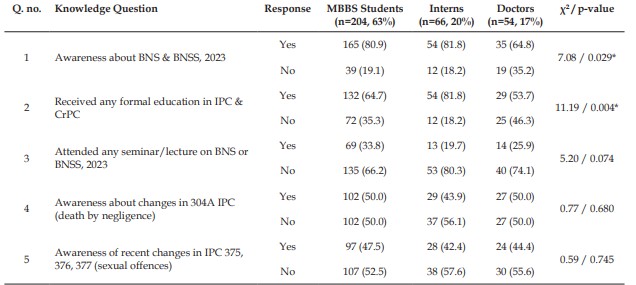
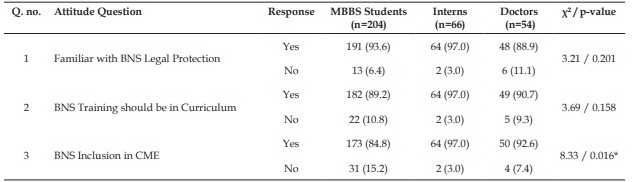
Background: The Indian Penal Code, Criminal Procedure Code, and Indian Evidence Act have now been substituted by the Bharatiya Nyaya Sanhita (BNS), Bharatiya Nagarik Suraksha Sanhita (BNSS), and Bharatiya Sakshya Adhiniyam (BSA). These legislative changes hold considerable importance for medical practitioners, especially in medicolegal contexts like cases of medical negligence and sexual offences. Objective: To evaluate the knowledge, attitude, and perception of medical professionals regarding new legal codes of Bharatiya Nyaya Sanhita (BNS) and Bharatiya Nagarik Suraksha Sanhita (BNSS). Material and Methods: A cross-sectional survey was conducted at a tertiary care medical college over six months (August 2024 – January 2025) to assess knowledge, attitude, and perception regarding BNS and BNSS. Participants included MBBS students (second year onwards), interns, postgraduates, and practising doctors. Data were collected using a validated, self- dministered online questionnaire. Out of 354 responses received, 30 were excluded for incompleteness or non-consent, yielding a final sample of 324 participants. Statistical analysis was performed using descriptive statistics, Chi-square tests, and logistic regression, with significance set at p<0.05. Results: Interns and MBBS students showed more awareness on most of the questions compared to practising doctors because of a lack of adequate continuing medical education among practising doctors and a lack of postgraduate-level training on practical legal issues. About 65% of the participants perceived that the new codes could improve the doctor-patient relationship. Conclusion: The overall positive outlook among MBBS students and interns is encouraging, but knowledge gaps in practising doctors highlight the need for additional medicolegal education and training.
References
- 1. Negi Advocate C. Legal Evolution in India: Transitioning from Colonial Legacies to New Frontiers-An In-depth Analysis of Bharatiya Nyaya Sanhita, Bharatiya Nagarik Suraksha Sanhita, and Bharatiya Sakshya Bill in 2023. Bharatiya Nagarik Suraksha Sanhita, and Bharatiya Sakshya Bill in. 2023.
- 2. Ministry of Home Affairs (India). The Bharatiya Nyaya Sanhita, 2023 [Internet]. New Delhi: Govt of India; 2023 Dec 25 [cited 2025 Sep 13]. Available from: https://www.mha.gov.in/ sites/default/files/250883_english_01042024. pdf
- 3. Ministry of Home Affairs (India). The Bharatiya Nagarik Suraksha Sanhita, 2023 [Internet]. New Delhi: Govt of India; 2023 Dec 25 [cited 2025 Sep 13]. Available from: https://www.mha. gov.in/sites/default/files/2024-04/250884_2_ english_01042024.pdf
- 4. Ministry of Home Affairs (India). The Bharatiya Sakshya Adhiniyam, 2023 [Internet]. New Delhi: Govt of India; 2023 Dec 25 [cited 2025 Sep 13]. Available from: https://www.mha. gov.in/sites/default/files/2024-04/250882_ english_01042024_0.pdf
- 5. Mittal P. Bharatiya nagarik suraksha sanhita, 2023 & criminal procedure code: a comparison61 IJFMP/Volume 19 Number 1 January–March 2026 Patil Rahul A., Vijayakumar Aravindan, Haris V.R., et al. Knowledge, Attitude and Perception of BNS and BNSS, 2023 among Medical Professionals in a Tertiary Healthcare Centre: A Cross-Sectional Study. of arrest and investigation procedure. Journal of Research Administration. 2023 Dec 20; 5(2): 9468-73.
- 6. Moti S. Passing of new criminal law bills: A missed opportunity for reform?. Bar and Bench. 2024 Jan 6.
- 7. Mahajan R., Gupta K. Periodically Modified Regulatory Reforms for Implementation of Competency-driven Undergraduate Medical Curriculum in India: A Comparative Analysis. International Journal of Applied and Basic Medical Research. 2024 Apr 1; 14(2): 71-7.
- 8. Gupta R.K., Shah A. Legal Literacy in Medical Education: A Systematic Review. Indian J Med Ethics. 2021; 6(3): 214-9.
- 9. Bhatnagar N., Singh A. Reforms in Undergraduate Medical Education in India: A Step toward Competency-Based Training. J Educ Health Promot. 2022; 11: 1-5.
- 10. Rees C.E., Knight L.V. Medical Education and the Law: Learning Needs of Tomorrow’s Doctors. Med Teach. 2007; 29(4): 400–405.
- 11. Jain A., Goel A. Legal Knowledge of Practicing Doctors: A Cross-sectional Study. Med Leg J. 2020; 88(1): 3-8.
- 12. George R., Devnani M., Singh A. Knowledge of Medicolegal Aspects among Practicing Clinicians. Indian J Forensic Med Toxicol. 2019; 13(2): 58–63.
- 13. Kumar N., Thomas A. Gaps in Legal Knowledge Among Indian Doctors: A Wake-up Call. J Clin Diagn Res. 2018; 12(9): LE01-LE04.
- 14. Singhal V., Das S., Shah M. Awareness of Legal Responsibilities among Indian Medical Graduates. Med Educ Online. 2020; 25(1): 1748322.
- 15. Wilson S., Pope C., Roberts C. Legal Preparedness in Foundation Year Doctors in the UK. BMC Med Educ. 2019; 19(1): 88.
- 16. Dey P.K., Jaiswal V. Violence Against Doctors in India: Legal Aspects and Preventive Measures. Indian J Public Health. 2021; 65(1): 10-14.
- 17. Garg R., Kumar R., Singh A., Mehra S. Knowledge, attitude, and practices of medical professionals regarding medical negligence and legal aspects in India: a cross-sectional study. Indian J Forensic Community Med. 2019; 6(2): 84–89.
- 18. Tripathi R., Gupta P. Legal Literacy in Emergency Medicine: An Overlooked Priority. J Emerg Trauma Shock. 2021; 14(4): 237–241.
- 19. Chatterjee A., Pandey S. Medicolegal Aspects of Emergency Medical Care. Med J Armed Forces India. 2023; 79(1): 11-18.
- 20. Sharma A. BNS and BNSS: Legal Reforms or Cosmetic Surgery? Indian J Law Soc. 2024; 15(1): 40-53.
- 21. Rajan A., Abraham S. Understanding the Bharatiya Nyaya Sanhita: Implications for Health Law. Natl Med J India. 2024; 37(2): 102- 106.
- 22. Vasudevan V. Bridging the Gap: Legal and Medical Professionals Must Collaborate. Med Law Int. 2020; 20(1): 45-52.
- 23. Brennan T.A., Mello M.M. Medical Liability Reform: A Call for Interdisciplinary Solutions. N Engl J Med. 2003;349:207-210.
Data Sharing Statement
There are no additional data available. All raw data and code are available upon request.
Funding
This research received no funding.
Author Contributions
All authors contributed significantly to the work and approve its publication.
Ethics Declaration
This article does not involve any human or animal subjects, and therefore does not require ethics approval.
Acknowledgements
We would like to express our gratitude to the patients, their families, and all those who have contributed to this study.
Conflicts of Interest
No conflicts of interest in this work.
About this article

Cite this article
Patil Rahul A., Vijayakumar Aravindan, Haris V.R., et al. Knowledge, Attitude and Perception of BNS and BNSS, 2023 among Medical Professionals in a Tertiary Healthcare Centre: A Cross-Sectional Study. Indian J Forensic Med Pathol. 2026; 19(1): 53-61.
Licence:
Attribution-Non-commercial 4.0 International (CC BY-NC 4.0)This license enables reusers to distribute, remix, adapt, and build upon the material in any medium or format for noncommercial purposes only, and only so long as attribution is given to the creator.
| Received | Accepted | Published |
|---|---|---|
| September 03, 2025 | December 17, 2025 | March 30, 2026 |
DOI: https://doi.org/10.21088/ijfmp.0974.3383.19126.8
Keywords
Bharatiya Nyaya SanhitaBharatiya Nagarik Suraksha SanhitaIndian Penal CodeMedical educationLegal educationSearch for Similar Articles
Similar Articles
- Diatom Analysis in Thermophilic water bodies: A Study on Hot Water Springs of Ma...
- Morphometric Study of Supra-meatal Triangle and Mastoid process in the Adult dry...
- Histopathological Spectrum of Autopsy Cases: A One Year Retrospective Observatio...
- Forensic Differentiation of Manner of Death in Railway Fatalities: A FourCase Se...
- Understanding assault Patterns: A Cross-sectional study of Cases at Chri, Kelamb...
Article Level Metrics
Last UpdatedSaturday 17 October 2026, 05:50:45 (IST)
16164
Accesses
54
3204
00
Citations
NA
NA
NA
Download citation
Article Keywords
Keyword Highlighting
Highlight selected keywords in the article text.
Timeline
| Received | September 03, 2025 |
| Accepted | December 17, 2025 |
| Published | March 30, 2026 |
licence
Attribution-Non-commercial 4.0 International (CC BY-NC 4.0)
This license enables reusers to distribute, remix, adapt, and build upon the material in any medium or format for noncommercial purposes only, and only so long as attribution is given to the creator.