Full Text (PDF)
Indian Journal of Forensic Medicine and Pathology 18(2):p 87-93, Jan-June 2025. | DOI: https://doi.org/10.21088/ijfmp.0974.3383.18225.1
Original Article
Knowledge and Perception of Medical Negligence in Medical Students
Sapate A.B., Biradar V.R., Band R.M., Petkar M.R., Ghangale A.L.
Author Information
Licence:
Attribution-Non-commercial 4.0 International (CC BY-NC 4.0)This license enables reusers to distribute, remix, adapt, and build upon the material in any medium or format for noncommercial purposes only, and only so long as attribution is given to the creator.
Indian Journal of Forensic Medicine and Pathology 18(2):p 87-93, Jan-June 2025. | DOI: https://doi.org/10.21088/ijfmp.0974.3383.18225.1
How Cite This Article:
Sapate AB, Biradar VR, Band RM, Petkar MR, Ghangale AL. Knowledge and Perception of Medical Negligence in Medical Students. Indian J Forensic Med Pathol. 2025;18(2):87-93.Timeline
Received : April 12, 2025
Accepted : June 08, 2025
Published : June 20, 2025
Abstract
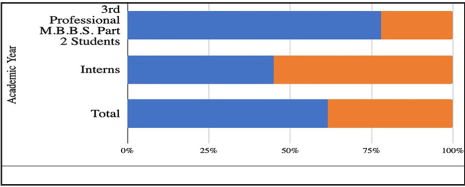
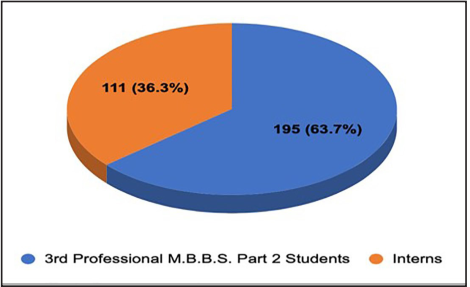
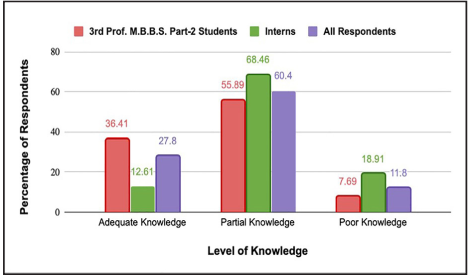
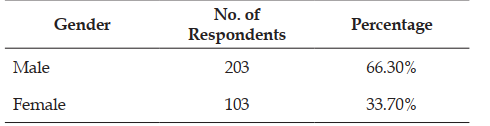
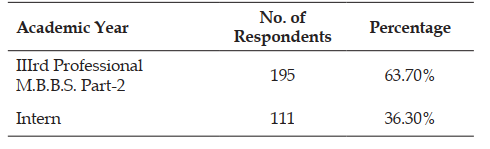
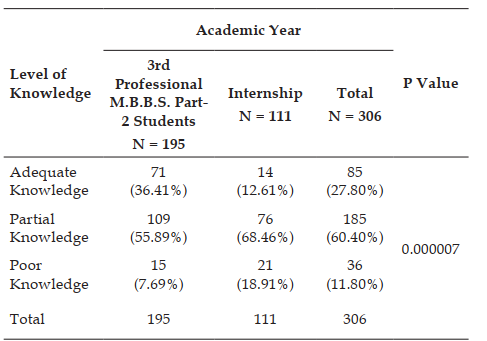
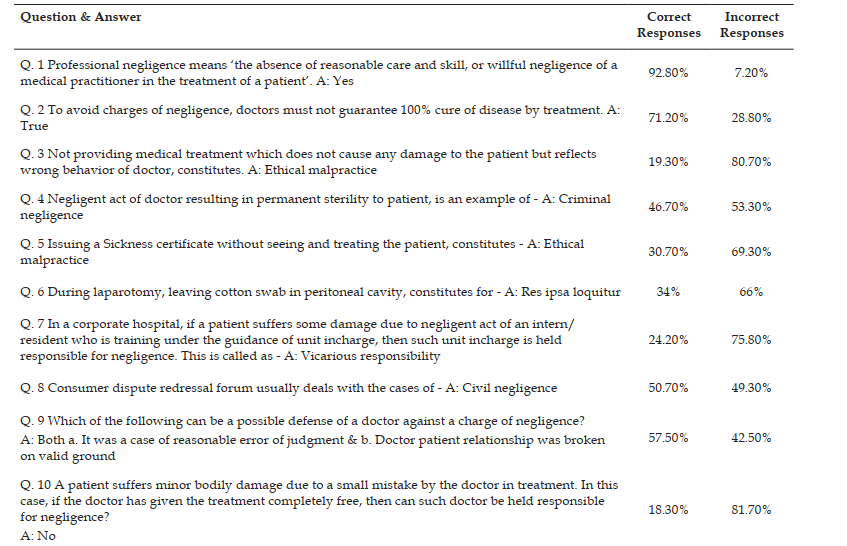
Introduction: Absence of reasonable care and skill, or willful negligence by medical practitioner in the treatment of a patient resulting in bodily/psychological injury or death of the patient is medical negligence. This survey was conducted to assess the knowledge and awareness of medical students and interns in a medical college. Materials & Methods: It is an observational cross-sectional study in which 306 IIIrd Professional M.B.B.S. Part-2 students & Interns participated in 10 multiplechoice questions based on different aspects of negligence in medical practice and its prevention. The data collected were tabulated and statistically analyzed to draw conclusions. Results: Out of 306 total respondents, 27.80% (n=85) had adequate knowledge, while 60.50% (n=185) had partial knowledge, and 11.80% (n=36) had poor knowledge. It was found that adequate knowledge was present in 36.41% (n=71) of IIIrd Professional M.B.B.S. Part-2 students, and 12.61% (n=14) of Interns. Conclusion: IIIrd Professional M.B.B.S. had better knowledge about medical negligence when compared to Interns showing labile memory of lessons taught in UG curriculum. A reasonable approach to tackle this issue could be to ensure better medico-legal training for medical students.
References
- 1. Reddy KSN, Murty OP. Medical law and ethics. In: The Essentials of Forensic Medicine and Toxicology. 35th ed. New Delhi: Jaypee Brothers Medical Publishers Ltd; 2022. p. 26-29.
- 2. Jena AB, Seabury S, Lakdawalla D, Chandra A. Malpractice risk according to physician specialty. N Engl J Med. 2011;365(7):629-636. doi: 10.1056/NEJMsa1012370
- 3. Nath A, Ropmay AD, Slong D, Patowary AJ, Rao AJ. A cross-sectional study on knowledge of registered medical practitioners, regarding management of medico-legal cases in Meghalaya. J Family Med Prim Care. 2022;11(3):904-907. doi: 10.4103/jfmpc.jfmpc_49_21
- 4. Mathew S, Samant N, Cooksey C, Ramm O. Knowledge, attitudes, and perceptions about medicolegal education: a survey of OB/GYN residents. Perm J. 2020;24:1-7. doi: 10.7812/TPP/19.217
- 5. Saltstone SP, Saltstone R, Rowe BH. Knowledge of medical-legal issues. Survey of Ontario family medicine residents. Can Fam Physician. 1997;43:669-673.
- 6. Shah HH, Gjelsvik A, Kobayashi L, Clyne B. Views of emergency medicine trainees on adverse events and negligence: survey results from an emergency medicine training program in a regional health care system following the national standard of care. In: Advances in Patient Safety: New Directions and Alternative Approaches (Vol. 2: Culture and Redesign). Rockville (MD): Agency for Healthcare Research and Quality (US); 2008.
- 7. Chatterjee B, Sarkar J. Awareness of medical ethics among undergraduates in a West Bengal medical college. Indian J Med Ethics. 2012;9(2):93-100.
- 8. Chandra MS, Math SB. Progress in medicine: compensation and medical negligence in India: does the system need a quick fix or an overhaul? Ann Indian Acad Neurol. 2016;19(Suppl 1):S21-S27. doi: 10.4103/0972-2327.192887
- 9. Banait S, Jain J, Bokariya P, Khan S. Effectiveness of healthcare ethics training in the undergraduate medical curriculum: A quasi-experimental study from rural India. Indian J Med Ethics. 2022;-:1-8. doi: 10.20529/IJME.2022.012
- 10. Nash L, Daly M, Johnson M, Walter G, Walton M, Willcock S, et al. Psychological morbidity in Australian doctors who have and have not experienced a medico-legal matter: cross-sectional survey. Aust N Z J Psychiatry. 2007;41(11):917-925. doi: 10.1080/00048670701634960
- 11. Limentani AE. The role of ethical principles in health care and the implications for ethical codes. J Med Ethics. 1999;25(5):394-398. doi: 10.1136/jme.25.5.394
Data Sharing Statement
There are no additional data available.
Funding
Self
Author Contributions
All authors contributed significantly to the work and approve its publication.
Ethics Declaration
Mandatory permission from Institutional ethics sub-committee obtained vide Ref. No. IESC/107/2022 dated 8/8/2022.
Acknowledgements
We sincerely thank our departmental staff for support during survey and data collection.
Conflicts of Interest
The authors report no conflicts of interest in this work.
About this article

Cite this article
Sapate AB, Biradar VR, Band RM, Petkar MR, Ghangale AL. Knowledge and Perception of Medical Negligence in Medical Students. Indian J Forensic Med Pathol. 2025;18(2):87-93.
Licence:
Attribution-Non-commercial 4.0 International (CC BY-NC 4.0)This license enables reusers to distribute, remix, adapt, and build upon the material in any medium or format for noncommercial purposes only, and only so long as attribution is given to the creator.
| Received | Accepted | Published |
|---|---|---|
| April 12, 2025 | June 08, 2025 | June 20, 2025 |
DOI: https://doi.org/10.21088/ijfmp.0974.3383.18225.1
Keywords
Medical negligenceKnowledgePerceptionMedical studentsSearch for Similar Articles
Similar Articles
- Diatom Analysis in Thermophilic water bodies: A Study on Hot Water Springs of Ma...
- Morphometric Study of Supra-meatal Triangle and Mastoid process in the Adult dry...
- Histopathological Spectrum of Autopsy Cases: A One Year Retrospective Observatio...
- Forensic Differentiation of Manner of Death in Railway Fatalities: A FourCase Se...
- Understanding assault Patterns: A Cross-sectional study of Cases at Chri, Kelamb...
Article Level Metrics
Last UpdatedMonday 19 October 2026, 11:59:18 (IST)
16330
Accesses
74
3216
00
Citations
NA
NA
NA
Download citation
Article Keywords
Keyword Highlighting
Highlight selected keywords in the article text.
Timeline
| Received | April 12, 2025 |
| Accepted | June 08, 2025 |
| Published | June 20, 2025 |
licence
Attribution-Non-commercial 4.0 International (CC BY-NC 4.0)
This license enables reusers to distribute, remix, adapt, and build upon the material in any medium or format for noncommercial purposes only, and only so long as attribution is given to the creator.