Full Text (PDF)
Physiotherapy and Occupational Therapy Journal 18(2):p 121-124, April- June 2025. | DOI: 10.21088/potj.0974.5777.18225.2
Original Article
Impact of Chronic Non-Specific Low Back Pain on Psychosocial Effects of Different Age Groups
Deptee Warikoo, Diksha Bhatt, Indu Raj
Author Information
Licence:
Attribution-Non-commercial 4.0 International (CC BY-NC 4.0)This license enables reusers to distribute, remix, adapt, and build upon the material in any medium or format for noncommercial purposes only, and only so long as attribution is given to the creator.
Physiotherapy and Occupational Therapy Journal 18(2):p 121-124, April- June 2025. | DOI: 10.21088/potj.0974.5777.18225.2
How Cite This Article:
Bhatt D, Warikoo D, Amutha ID. Impact of Chronic Non-Specific Low Back Pain on Psychosocial Effects of Different Age Groups. Physiotherapy Occup Ther J. 2025;18(2):121-124.Timeline
Received : February 13, 2025
Accepted : May 24, 2025
Published : June 16, 2025
Abstract
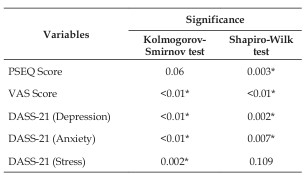
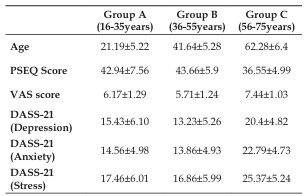
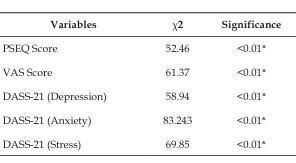
Introduction: Non-specific low back pain is common cause of disability, with up to 90% of population experiencing pain at some stage in their lives. Psychosocial factors measure the psychological phenomena to the social environment and to pathophysiological changes within body. Psychosocial factors influence pain, disability, and response to treatment, Depression Anxiety Stress Scale (DASS-21) assessed the psychological and emotional states of the subject before and after the onset of pain. Methodology: 201 participants were selected for the study. Subjects were classified in 3 groups, group A – (young)- 16-35 years, group B (adults) - 36-55 years & group C (gediatrics) - 56-75 years. DASS-21 was assessed for levels of stress, anxiety & depression and PSEQ was evaluated for level of confidence to perform ADLs while in pain in different age groups. Result: Highest level of self-efficacy was seen in the participants of group B followed. The participants of group C showed low self-efficacy. VAS score was found to be lowest in the participants of group B. The participants of group B also exhibited lowest scores in all three domains of DASS-21 compared to group A and group B. Conclusion: The study concluded that measures across the groups A, B & C revealed presence of statistically significant difference in the scores of PSEQ, DASS-21 & VAS, among all three groups, group C showed lowest self-efficacy & lowest scores in all three domains of DASS-21 compared to group A and group B.
References
- 1. Maher C., Underwood M., Buchbinder R. Non specific lowback pain.TheLancet.2017Feb18; 389(10070): 736-47.
- 2. Iles R.A., Davidson M., Taylor N.F. Psychosocial predictors of failure to return toworkinnon-chronicnon-speciclowback pain: a systematic review. Occupational and environmental medicine. 2008 Aug 1; 65(8): 507-17.
- 3. Hurwitz E.L., Morgenstern H., Chiao C. Effects of recreational physical activity and back exercises on low back pain and psychological distress: ndings fromtheUCLALowBack Pain Study. American journal of public health. 2005 Oct; 95(10): 1817-24.
- 4. Yilmaz E., Dedeli O. Effect of physical and psychosocial factors on occupational low back pain. Health Science Journal. 2012 Oct 1; 6(4): 598.
- 5. Hartvigsen J., Lings S., Leboeuf-Yde C., Bakketeig L. Psychosocial factors at work in relation to low back pain and consequences of low back pain; a systematic, critical review of prospective cohort studies. Occupational and environmental medicine. 2004 Jan 1; 61(1): e2-.
- 6. Alhowimel A., Alotaibi M., Coulson N., Radford K. Psychosocial consequences of diagnosing nonspecic low-back pain radiologically: a qualitative study. Physiotherapy Theory and Practice. 2022 Jul 3; 38(7): 890-6.
- 7. Hill J.C., Fritz J.M. Psychosocial in uences on low back pain, disability, and response to treatment. Physical therapy. 2011 May 1; 91(5): 712-21.
- 8. Paolucci T., Morone G., Iosa M., Fusco A., Alcuri R., Matano A., Bureca I., Saraceni VM, Paolucci S. Psychological features and outcomes of the Back School treatment in patients with chronic non-specic lowback pain. A randomized controlled study. Eur J Phys Rehabil Med. 2012 Jun 1; 48(2):245-53
- 9. Ferrari S., Vanti C., Pellizzer M., Dozza L., Monticone M., Pillastrini P. Is there a relationshipbetween self-efcacy, disability, pain and sociodemographic characteristics in chronic low back pain? A multicenter retrospective analysis. Physiotherapy. 2019 Dec;9:1-9. Archives of
- 10. Abberger B., Kieselbach K. Rasch analysis of the Depression, Anxiety, and Stress Scale in patients with chronic pain. Journal of psychosomatic research. 2024 Mar 1;178:111597.
- 11. Sathya P., Ramakrishnan K.S., Shah P.P. Prevalence of depression, anxiety & stress in patients with mechanical low back pain. International Journal of Therapies and Rehabilitation Research. 2015 Jun;4(4):67-72.
- 12. Grasaas E., Helseth S., Fegran L., Stinson J., Småstuen M., Haraldstad K. Health-related quality of life in adolescents with persistent painandthemediatingroleofself-efdicacy:a cross-sectional study. Health and Quality of Life Outcomes. 2020 Dec;18:1-0
Data Sharing Statement
There are no additional data available. All raw data and code are available upon request.
Funding
This research received no funding.
Author Contributions
All authors contributed significantly to the work and approve its publication.
Ethics Declaration
This article does not involve any human or animal subjects, and therefore does not require ethics approval.
Acknowledgements
No Imformation Provided
Conflicts of Interest
No conflicts of interest in this work.
About this article

Cite this article
Bhatt D, Warikoo D, Amutha ID. Impact of Chronic Non-Specific Low Back Pain on Psychosocial Effects of Different Age Groups. Physiotherapy Occup Ther J. 2025;18(2):121-124.
Licence:
Attribution-Non-commercial 4.0 International (CC BY-NC 4.0)This license enables reusers to distribute, remix, adapt, and build upon the material in any medium or format for noncommercial purposes only, and only so long as attribution is given to the creator.
| Received | Accepted | Published |
|---|---|---|
| February 13, 2025 | May 24, 2025 | June 16, 2025 |
DOI: 10.21088/potj.0974.5777.18225.2
Keywords
PsychosocialfactorsChronicNon-specificLowBackPainSearch for Similar Articles
Similar Articles
- Digital Healthcare Revolution: Role of E-Health Systems in Modern Society
- Evidence-Based Teaching in Physiotherapy: An Academic Review
- Secondary Versus Primary Persistent Postural-Perceptual Dizziness (PPPD): A Narr...
- Digital Transformation of Healthcare: E-Health Systems and their Impact
- To Compare the Effectiveness of Static Stretch versus Post Isometric Relaxation...
Article Level Metrics
Last UpdatedSunday 21 June 2026, 22:25:00 (IST)
1120
Accesses
3
304
00
Citations
NA
NA
NA
Download citation
Article Keywords
Keyword Highlighting
Highlight selected keywords in the article text.
Timeline
| Received | February 13, 2025 |
| Accepted | May 24, 2025 |
| Published | June 16, 2025 |
licence
Attribution-Non-commercial 4.0 International (CC BY-NC 4.0)
This license enables reusers to distribute, remix, adapt, and build upon the material in any medium or format for noncommercial purposes only, and only so long as attribution is given to the creator.