Full Text (PDF)
Physiotherapy and Occupational Therapy Journal 19(1):p 73-77, Jan - March 2026. | DOI: 10.21088/potj.0974.5777.19126.9
Original Article
Evidence-Based Teaching in Physiotherapy: An Academic Review
Author Information
Licence:
Attribution-Non-commercial 4.0 International (CC BY-NC 4.0)This license enables reusers to distribute, remix, adapt, and build upon the material in any medium or format for noncommercial purposes only, and only so long as attribution is given to the creator.
Physiotherapy and Occupational Therapy Journal 19(1):p 73-77, Jan - March 2026. | DOI: 10.21088/potj.0974.5777.19126.9
How Cite This Article:
Ranjeet Singha. Evidence-Based Teaching in Physiotherapy: An Academic Review. Therapy Jr. 2026; 19(1): 70-74.Timeline
Received : January 16, 2026
Accepted : February 22, 2026
Published : March 30, 2026
Abstract
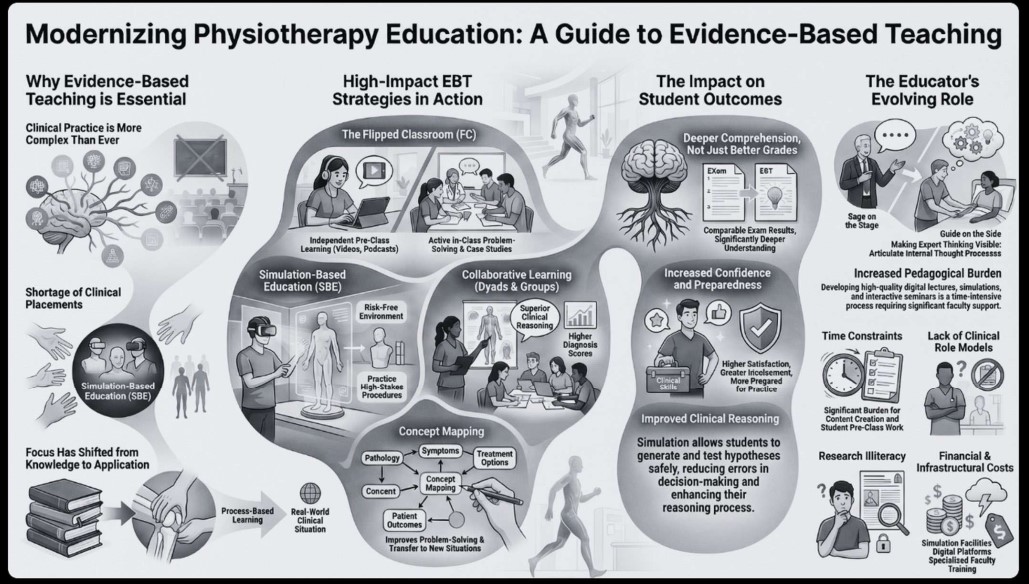
Physiotherapy education is increasingly moving away from traditional lecturedominated approaches toward teaching models that prioritise active learning, clinical reasoning, and the effective use of educational technology. This shift reflects growing recognition that contemporary physiotherapy practice requires graduates to integrate theoretical knowledge with complex decision-makingin diverse clinical contexts. Evidence-based teaching (EBT) offers a structured approach to curriculum design by drawing on educational research to support thedevelopment of professional competence, reflective practice, and patient-centredreasoning.This review examines current evidence related to evidence-based teaching inphysiotherapy, with particular attention to curriculum frameworks, instructional strategies, and the evolving role of educators. Educational models that emphasise process-oriented learning, such as structured curriculum planning and explicit demonstration of expert thinking, are discussed alongside commonly used teaching strategies, including flipped classrooms, simulation-based education, collaborative learning, and concept mapping. Collectively, these approaches are associated with improved learner engagement, deeper conceptual understanding, and enhanced preparedness for clinical practice. Although examination outcomes are often comparable to those achieved through traditional methods, evidence suggests that evidence-based teaching supports greater confidence, autonomy, and clinical reasoning ability among students. Persistent challenges including time constraints, limited research literacy, and resource demands continue to influence implementation. Overall, the literature supports evidence-based teaching as a necessary foundation for preparing physiotherapy graduates to meet the demands of modern healthcare practice.
References
- 1. Boshnjaku, A., Arnadottir, S.A., Pallot, A., Wagener, M., & Äijö, M. (2023). Improving the evidence-based practice skills of entry-level physiotherapy students through educational interventions: A scoping review of literature. International Journal of Environmental Research and Public Health, 20(16), Article 6605.
- 2. Cencetti, M., Brogan, L., Carusotto, A. F., & Karnish, K. (2023). What methods are being used to teach clinical reasoning in physical therapy education and are they effective? A systematic review of literature. Physiotherapy Quarterly, 31(3), 20–29.
- 3. Choudhary, Y. Q., O’Shea, O., French, H. P., Condron, C., Heery, H., McDonough, S., & Eppich, W. (2024). Current educational practice in physiotherapy simulation-based education: A scoping review protocol. Protocols.io.
- 4. Gokulakrishnan, J., John Franklin, C. V., Krishnaraja, K., & Muruganandam, P. (2023). Teaching–learning methods in physiotherapyeducation: Merits and demerits. International Journal of Health Sciences and Research, 13(10), 220–224.
- 5. Shinde, S., & Verma, C. V. (2025). Innovative learning in physiotherapy: A narrative review on the effectiveness of flipped classroom models. International Journal of Multidisciplinary Education and Research, 10(3), 63–69. (Advance online publication)
- 6. World Physiotherapy. (2021). Physiotherapist education framework.
Data Sharing Statement
There are no additional data available. All raw data and code are available upon request.
Funding
This research received no funding.
Author Contributions
All authors contributed significantly to the work and approve its publication.
Ethics Declaration
This article does not involve any human or animal subjects, and therefore does not require ethics approval.
Acknowledgements
We would like to express our gratitude to the patients, their families, and all those who have contributed to this study.
Conflicts of Interest
No conflicts of interest in this work.
About this article

Cite this article
Ranjeet Singha. Evidence-Based Teaching in Physiotherapy: An Academic Review. Therapy Jr. 2026; 19(1): 70-74.
Licence:
Attribution-Non-commercial 4.0 International (CC BY-NC 4.0)This license enables reusers to distribute, remix, adapt, and build upon the material in any medium or format for noncommercial purposes only, and only so long as attribution is given to the creator.
| Received | Accepted | Published |
|---|---|---|
| January 16, 2026 | February 22, 2026 | March 30, 2026 |
DOI: 10.21088/potj.0974.5777.19126.9
Keywords
Evidence-Based TeachingPhysiotherapy EducationClinical ReasoningSimulationBased EducationFlipped Classroom •Active LearningCurriculum DevelopmentSearch for Similar Articles
Similar Articles
- Leadership in Physiotherapy: A Narrative Review
- Effectiveness of Low Level Laser Theapy in the Management of Temporomandibular J...
- The Impact of Air Pollution on Cardiopulmonary Health: Molecular Mechanisms, Pre...
- Efectiveness of Physiotherapy in Postpartum Women with Diastasis Recti: A Review
- Pain Neuroscience Education: Transforming Physiotherapy Practice
Article Level Metrics
Last UpdatedSaturday 24 October 2026, 16:06:57 (IST)
4389
Accesses
37
739
00
Citations
NA
NA
NA
Download citation
Article Keywords
Keyword Highlighting
Highlight selected keywords in the article text.
Timeline
| Received | January 16, 2026 |
| Accepted | February 22, 2026 |
| Published | March 30, 2026 |
licence
Attribution-Non-commercial 4.0 International (CC BY-NC 4.0)
This license enables reusers to distribute, remix, adapt, and build upon the material in any medium or format for noncommercial purposes only, and only so long as attribution is given to the creator.