Full Text (PDF)
Physiotherapy and Occupational Therapy Journal 19(2):p 138-148, April-June 2026. | DOI: https://doi.org/10.21088/potj.0974.5777.19226.6
Original Article
Cross-Cultural Adaptation, Reliability, and Validity of the Gujarati Version of the Back Bournemouth Questionnaire in Adults with Chronic Low Back Pain
Bid Dibyendunarayan Dhrubaprasad, Shaikh Rumaisa Kosar
Author Information
Licence:
Attribution-Non-commercial 4.0 International (CC BY-NC 4.0)This license enables reusers to distribute, remix, adapt, and build upon the material in any medium or format for noncommercial purposes only, and only so long as attribution is given to the creator.
Physiotherapy and Occupational Therapy Journal 19(2):p 138-148, April-June 2026. | DOI: https://doi.org/10.21088/potj.0974.5777.19226.6
How Cite This Article:
Shaikh Rumaisa Kosar, Bid Dibyendunarayan Dhrubaprasad. Cross-Cultural Adaptation, Reliability, and Validity of the Gujarati Version of the Back Bournemouth Questionnaire in Adults with Chronic Low Back Pain. Therapy Jr. 2026; 19(2): 138-149Timeline
Received : April 30, 2026
Accepted : May 15, 2026
Published : June 30, 2026
Abstract
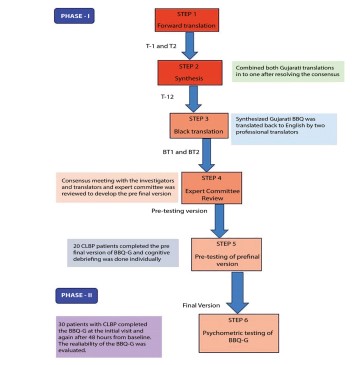
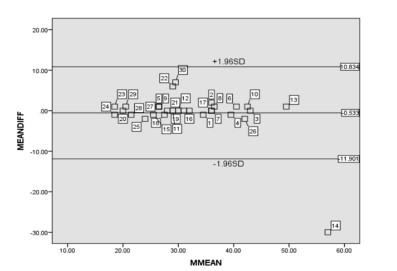
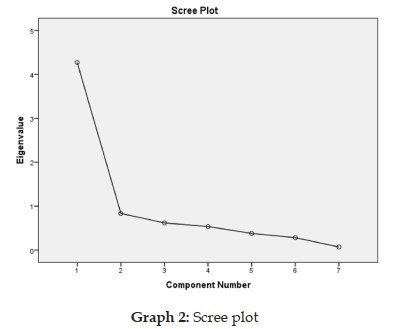
Background: The biopsychosocial model shows that chronic low back pain (CLBP) is maintained by physical, psychological, and social factors, necessitating comprehensive assessment tools. The Back Bournemouth Questionnaire (BBQ), a validated seven-item measure, has been adapted into multiple languages; however, there is no Gujarati version available for India’s large linguistic community. Objective: To cross-culturally adapt the Back Bournemouth Questionnaire into Gujarati (BBQ-G) and evaluate its psychometric properties in adults with CLBP. Methods: We conducted a two-phase methodological study. Phase I involved crosscultural adaptation following Beaton et al.’s five-step guidelines. Phase II assessed psychometric properties in 150 Gujarati-speaking adults (aged 25–60 years) with confirmed CLBP. Content validity was evaluated using a 20-expert panel. Internal consistency (Cronbach’s alpha), test-retest reliability (intraclass correlation coefficient; n=30, 48-hour interval), and agreement (Bland–Altman analysis) were determined. Construct validity was assessed via Pearson’s correlations with the Numerical Pain Rating Scale (NPRS), Fear-Avoidance Beliefs QuestionnaireGujarati (FABQ-G), Roland-Morris Disability Questionnaire-Gujarati (RMDQ-G), and Patient Health Questionnaire-9-Gujarati (PHQ-9-G). Exploratory factor analysis was used to examine the underlying structure. Results: The BBQ-G demonstrated excellent content validity (S-CVI/Ave=0.95; I-CVI: 0.80-1.00), good internal consistency (Cronbach’s alpha=0.82), and acceptable test-retest reliability (ICC=0.820; 95% CI: 0.656-0.910). Bland-Altman analysis revealed minimal bias (mean difference=-0.53; limits of agreement: -11.90 to 10.83), and the minimal detectable change at the 95% confidence level (MDC95) was approximately 12 points. Significant moderate-to-strong correlations were identified with the NPRS (r=0.679), PHQ-9-G (r=0.495), FABQ-G (r=0.431), and RMDQ-G (r=0.415; all p<0.001). EFA yielded a single dominant component (eigenvalue=4.272) explaining 61.03% of the total variance (KMO=0.839). Conclusion: The BBQ-G is a reliable, valid, and culturally appropriate biopsychosocial instrument for assessing chronic low back pain in Gujaratispeaking adult and is suitable for both clinical practice and research.
References
- 1. Hartvigsen J., Hancock M.J., Kongsted A, Louw Q., Ferreira M.L., Genevay S., et al. What low back pain is and why we need to pay attention. Lancet (London, England). 2018; 391(10137): 2356-67.
- 2. Wu A., March L., Zheng X., Huang J., Wang X., Zhao J., et al. Global low back pain prevalence and years lived with disability from 1990 to 2017: estimates from the Global Burden of Disease Study 2017. Annals of translational medicine. 2020; 8(6): 299.
- 3. Maher C., Underwood M., Buchbinder R. Non-specific low back pain. The Lancet. 2017; 389(10070): 736-47.
- 4. Chou R. Low Back Pain. Annals of internal medicine. 2021; 174(8): Itc113-itc28.
- 5. Kamper S.J., Apeldoorn A.T., Chiarotto A., Smeets R.J., Ostelo R.W., Guzman J., et al. Multidisciplinary biopsychosocial rehabilitation for chronic low back pain. The Cochrane database of systematic reviews. 2014; 2014(9): Cd000963.
- 6. Loeser J.D., editor Perspectives on pain1980: Springer.
- 7. Vlaeyen J.W.S., Linton S.J. Fear-avoidance and its consequences in chronic musculoskeletal pain: A state of the art. Pain. 2000; 85(3): 317-32.
- 8. Bolton J.E., Breen A.C. The Bournemouth Questionnaire: a short-form comprehensive outcome measure. I. Psychometric properties in back pain patients. J Manipulative Physiol Ther. 1999; 22(8): 503-10.
- 9. Blum-Fowler C., Peterson C., McChurch J.F., Le Clech Y., Humphreys B.K. Translation and validation of the German version of the Bournemouth questionnaire for low back pain. Chiropractic & manual therapies. 2013; 21(1):32.
- 10. Hartvigsen J., Lauridsen H., Ekström S., Nielsen M.B., Lange F., Kofoed N, et al. Translation and validation of the danish version of the Bournemouth questionnaire. J Manipulative Physiol Ther. 2005;28(6):402-7.
- 11. Kamonseki D.H., Fonseca C.L., Calixtre L.B. The Brazilian version of the Bournemouth questionnaire for low back pain: translation and cultural adaptation. Sao Paulo medical journal = Revista paulista de medicina. 2019; 137(3): 262-9.
- 12. Calixtre L.B., Fonseca C.L., Gruninger BLdS, Kamonseki D.H. Psychometric properties of the Brazilian version of the Bournemouth questionnaire for low back pain: validity and reliability. Brazilian journal of physical therapy. 2021; 25(1): 70-7.
- 13. Gunaydin G., Citaker S., Meray J., Cobanoglu G., Gunaydin O.E., Hazar Kanik Z. Reliability, Validity, and Cross-Cultural Adaptation of the Turkish Version of the Bournemouth Questionnaire. Spine. 2016; 41(21): E1292-e7.
- 14. Elerian A.E., Abdel-Aal N.M., Abdelhay M.I. Bournemouth questionnaire Arabic version: Cross-cultural adaptation, validity, and reliability for patients with low back pain. Physiotherapy research international : the journal for researchers and clinicians in physical therapy. 2020; 25(3): e1834.
- 15. Guillemin F., Bombardier C., Beaton D. Crosscultural adaptation of health-related quality of life measures: Literature review and proposed guidelines. Journal of clinical epidemiology. 1993; 46(12): 1417-32.
- 16. Beaton D.E., Bombardier C., Guillemin F., Ferraz M.B. Guidelines for the process of crosscultural adaptation of self-report measures. Spine. 2000; 25(24): 3186-91.
- 17. General R. C-16 Population by Mother Tongue: Census Commissioner of India, Census of India 2001. Provisional Population Totals, Paper. New Delhi: Government of India; 2011.
- 18. Shah S., Balaganapathy M. Reliability and validity study of the Gujarati version of the Oswestry Disability Index 2.1a. Journal of back and musculoskeletal rehabilitation. 2017; 30(5): 1103-9.
- 19. Nambi S.G. Reliability, validity, sensitivity and specificity of Guajarati version of the RolandMorris Disability Questionnaire. Journal of back and musculoskeletal rehabilitation. 2013; 26(2): 149-53.
- 20. Bid D.D., Soni N.C., Rathod P.V., Ramalingam A.T., Sinha R.K. Cross Cultural Adaptation, Reliability and Validity of Gujarati Version of Fear Avoidance Belief Questionnaire in Chronic Low Back Pain. NJIRM. 2016; 7(6): 1-8.
- 21. Kroenke K., Spitzer R.L., Williams J.B. The PHQ-9: validity of a brief depression severity measure. Journal of general internal medicine. 2001; 16(9): 606-13.
- 22. Faul F., Erdfelder E., Buchner A., Lang A.G. Statistical power analyses using G*Power 3.1: Tests for correlation and regression analyses. Behavior Research Methods. 2009; 41(4): 1149-60.
- 23. Childs J.D., Piva S.R., Fritz J.M. Responsiveness of the numeric pain rating scale in patients with low back pain. Spine. 2005; 30(11): 1331-4.
- 24. Terwee C.B., Bot S.D., de Boer M.R., van der Windt D.A., Knol D.L., Dekker J., et al. Quality criteria were proposed for measurement properties of health status questionnaires. Journal of clinical epidemiology. 2007; 60(1):34-42.
- 25. Nunnally J.C., Bernstein I.H. Psychometric Theory, 3r ed., McGraw-Hill, New York, NY. 1994.
- 26. Shrout P.E., Fleiss J.L.. Intraclass correlations: uses in assessing rater reliability. Psychological bulletin. 1979; 86(2): 420.
- 27. Mukaka M.M. A guide to appropriate use of correlation coefficient in medical research. Malawi medical journal: the journal of Medical Association of Malawi. 2012; 24(3): 69.
- 28. Kaiser H.F. The application of electronic computers to factor analysis. Educational and psychological measurement. 1960; 20(1): 141-51.
- 29. Vos T., Flaxman A.D., Naghavi M., Lozano R., Michaud C., Ezzati M., et al. Years lived with disability (YLDs) for 1160 sequelae of 289 diseases and injuries 1990–2010: a systematic analysis for the Global Burden of Disease Study 2010. The lancet. 2012; 380(9859): 2163-96.
- 30. Hoy D., Bain C., Williams G., March L., Brooks P., Blyth F., et al. A systematic review of the global prevalence of low back pain. Arthritis and rheumatism. 2012; 64(6): 2028-37.
- 31. Woolf A.D., Pfleger B. Burden of major musculoskeletal conditions. Bull World Health Organ. 2003; 81(9): 646-56.
- 32. Organization W.H., Use WECoPSt, Anthropometry Io. Physical Status: The Use and Interpretation of Anthropometry: Report of a WHO Expert Committee: World Health Organization; 1995.
- 33. Bland J.M., Altman D.G. Statistical methods for assessing agreement between two methods of clinical measurement. Lancet (London, England). 1986; 1(8476): 307-10.
- 34. Seamon B.A., Kautz S.A., Bowden M.G., Velozo C.A. Revisiting the Concept of Minimal Detectable Change for Patient-Reported Outcome Measures. Physical therapy. 2022; 102(8).
- 35. Bolton J.E. Sensitivity and specificity of outcome measures in patients with neck pain: detecting clinically significant improvement. Spine. 2004; 29(21): 2410-7; discussion 8.
- 36. Wright A., Hannon J., Hegedus E.J., Kavchak A.E. Clinimetrics corner: a closer look at the minimal clinically important difference (MCID). J Man Manip Ther. 2012; 20(3): 160-6.
- 37. Portney L.G., Watkins M.P. Foundations of clinical research: applications to practice: Pearson/Prentice Hall Upper Saddle River, N.J.; 2009.
Data Sharing Statement
There are no additional data available. All raw data and code are available upon request.
Funding
This research received no funding.
Author Contributions
All authors contributed significantly to the work and approve its publication.
Ethics Declaration
This article does not involve any human or animal subjects, and therefore does not require ethics approval.
Acknowledgements
We would like to express our gratitude to the patients, their families, and all those who have contributed to this study.
Conflicts of Interest
No conflicts of interest in this work.
About this article

Cite this article
Shaikh Rumaisa Kosar, Bid Dibyendunarayan Dhrubaprasad. Cross-Cultural Adaptation, Reliability, and Validity of the Gujarati Version of the Back Bournemouth Questionnaire in Adults with Chronic Low Back Pain. Therapy Jr. 2026; 19(2): 138-149
Licence:
Attribution-Non-commercial 4.0 International (CC BY-NC 4.0)This license enables reusers to distribute, remix, adapt, and build upon the material in any medium or format for noncommercial purposes only, and only so long as attribution is given to the creator.
| Received | Accepted | Published |
|---|---|---|
| April 30, 2026 | May 15, 2026 | June 30, 2026 |
DOI: https://doi.org/10.21088/potj.0974.5777.19226.6
Keywords
Chronic low back painBournemouth QuestionnaireCross-cultural adaptationReliabilityValidityGujaratiSearch for Similar Articles
Similar Articles
- Cross-Cultural Adaptation, Reliability, and Validity of the Gujarati Version of...
- Physiotherapy Management of Multiple Sclerosis: An Overview of Recent Technologi...
- Converging Technologies in Cardiopulmonary Physiotherapy: A Review of VR, AR, AI...
- Effects of Kinesiotaping in Lateral Epicondylitis: A Narrative Review
- Redefining Multidisciplinary Care: Evidence-Based Approaches for Advanced Health...
Article Level Metrics
Last UpdatedMonday 17 August 2026, 18:25:21 (IST)
2304
Accesses
22
464
00
Citations
NA
NA
NA
Download citation
Article Keywords
Keyword Highlighting
Highlight selected keywords in the article text.
Timeline
| Received | April 30, 2026 |
| Accepted | May 15, 2026 |
| Published | June 30, 2026 |
licence
Attribution-Non-commercial 4.0 International (CC BY-NC 4.0)
This license enables reusers to distribute, remix, adapt, and build upon the material in any medium or format for noncommercial purposes only, and only so long as attribution is given to the creator.