Full Text (PDF)
Physiotherapy and Occupational Therapy Journal 19(2):p 113-116, April-June 2026. | DOI: https://doi.org/10.21088/potj.0974.5777.19226.3
Original Article
Redefining Multidisciplinary Care: Evidence-Based Approaches for Advanced Healthcare and Rehabilitation
Banty T.S., Vivek B., Subodh B., Nilesh H.
Author Information
Licence:
Attribution-Non-commercial 4.0 International (CC BY-NC 4.0)This license
enables reusers to distribute, remix, adapt, and build upon the material in any
medium or format for noncommercial purposes only, and only so long as
attribution is given to the creator.
Physiotherapy and Occupational Therapy Journal 19(2):p 113-116, April-June 2026. | DOI: https://doi.org/10.21088/potj.0974.5777.19226.3
How Cite This Article:
Vivek B., Subodh B., Nilesh H., et al. Redefining Multidisciplinary Care: Evidence-Based Approaches for Advanced Healthcare and Rehabilitatio. Therapy Jr. 2026; 19(2): 113-116.Timeline
Received : April 29, 2026
Accepted : May 30, 2026
Published : June 30, 2026
Abstract
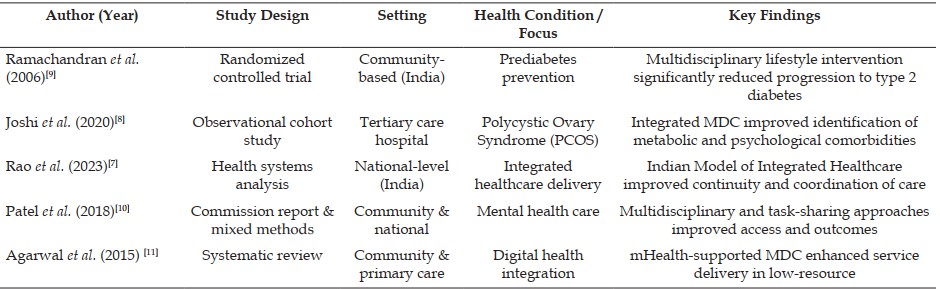
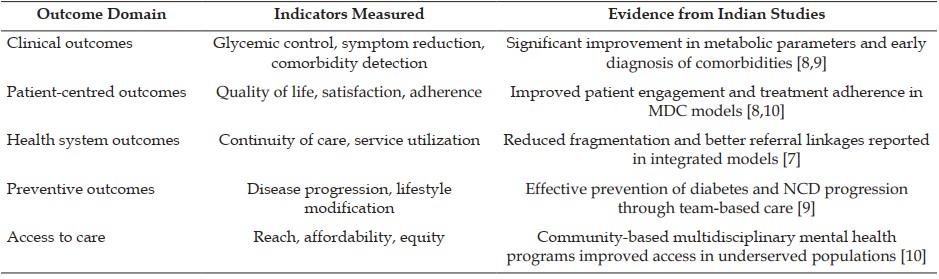
Advanced healthcare and rehabilitation increasingly require coordinated multidisciplinary approaches to address complex, chronic, and disabling conditions. The objective of this paper was to review evidence-based multidisciplinary care (MDC) models, with specific emphasis on Indian studies relevant to healthcare and rehabilitation sciences. A narrative review of Indian and global literature was conducted using PubMed, Scopus, and Google Scholar. Studies focusing on multidisciplinary healthcare, rehabilitation, chronic disease management, and integrated care in Indian settings were included. Indian studies demonstrate that MDC improves clinical outcomes, functional recovery, patient adherence, and continuity of care. Lifestyle-based multidisciplinary interventions reduced progression to diabetes by nearly 30%, while integrated PCOS and mental health models enhanced comorbidity detection and service utilization. Rehabilitation-oriented team models improved functional outcomes and long-term self-management. Multidisciplinary care represents an effective and scalable strategy for advanced healthcare and rehabilitation in India. Strengthening interprofessional collaboration, digital integration, and community-based rehabilitation is essential for sustainable impact.
References
- 1. World Health Organization. Integrated peoplecentred health services. Geneva: WHO; 2016.
- 2. Epstein R.M., Street R.L. The values and value of patient-centered care. Ann Fam Med. 2011; 9(2): 100-103.
- 3. Smith S.M., Wallace E., O’Dowd T., Fortin M. Interventions for improving outcomes in patients with multimorbidity. Cochrane Database Syst Rev. 2016; (3): CD006560.
- 4. Nancarrow S.A., Booth A., Ariss S., Smith T., Enderby P., Roots A. Ten principles of good interdisciplinary team work. Hum Resour Health. 2013; 11: 19.
- 5. Reeves S., Pelone F., Harrison R., Goldman J., Zwarenstein M. Interprofessional collaboration to improve professional practice and healthcare outcomes. Cochrane Database Syst Rev. 2017; (6): CD000072.
- 6. Bodenheimer T., Wagner E.H., Grumbach K. Improving primary care for patients with chronic illness. JAMA. 2002; 288(14): 1775-1779.
- 7. Rao K.D., Kumar S., Bhatnagar A., Gupta G. Strengthening health systems through integrated care: Indian model. BMC Health Serv Res. 2023; 23: 10454.
- 8. Joshi B., Mukherjee S., Patil A., Purandare A. An integrated multidisciplinary model of care for women with PCOS in India. Indian J Med Res. 2020; 152(4): 384-392.
- 9. Ramachandran A., Snehalatha C., Mary S., Mukesh B., Bhaskar A.D., Vijay V. Effectiveness of lifestyle modification in preventing type 2 diabetes in India. Diabetologia. 2006; 49(2): 289-297.
- 10. Patel V., Saxena S., Lund C., et al. The Lancet Commission on global mental health and sustainable development. Lancet. 2018; 392(10157): 1553-1598.
- 11. Agarwal S., Perry H.B., Long L.A., Labrique A.B. Evidence on feasibility and effectiveness of mHealth strategies in India. Bull World Health Organ. 2015; 93: 340-346.
Data Sharing Statement
There are no additional data available. All raw data and code are available upon request.
Funding
This research received no funding.
Author Contributions
All authors contributed significantly to the work and approve its publication.
Ethics Declaration
This article does not involve any human or animal subjects, and therefore does not require ethics approval.
Acknowledgements
We would like to express our gratitude to the patients, their families, and all those who have contributed to this study.
Conflicts of Interest
No conflicts of interest in this work.
About this article

Cite this article
Vivek B., Subodh B., Nilesh H., et al. Redefining Multidisciplinary Care: Evidence-Based Approaches for Advanced Healthcare and Rehabilitatio. Therapy Jr. 2026; 19(2): 113-116.
Licence:
Attribution-Non-commercial 4.0 International (CC BY-NC 4.0)This license
enables reusers to distribute, remix, adapt, and build upon the material in any
medium or format for noncommercial purposes only, and only so long as
attribution is given to the creator.
| Received | Accepted | Published |
|---|---|---|
| April 29, 2026 | May 30, 2026 | June 30, 2026 |
DOI: https://doi.org/10.21088/potj.0974.5777.19226.3
Keywords
Multidisciplinary careRehabilitation sciencesIntegrated healthcareIndian studiesEvidence-based practiceSearch for Similar Articles
Similar Articles
- Cross-Cultural Adaptation, Reliability, and Validity of the Gujarati Version of...
- Physiotherapy Management of Multiple Sclerosis: An Overview of Recent Technologi...
- Converging Technologies in Cardiopulmonary Physiotherapy: A Review of VR, AR, AI...
- Cross-Cultural Adaptation, Reliability, and Validity of the Gujarati Version of...
- Effects of Kinesiotaping in Lateral Epicondylitis: A Narrative Review
Article Level Metrics
Last UpdatedSunday 06 September 2026, 22:37:29 (IST)
2646
Accesses
29
475
00
Citations
NA
NA
NA
Download citation
Article Keywords
Keyword Highlighting
Highlight selected keywords in the article text.
Timeline
| Received | April 29, 2026 |
| Accepted | May 30, 2026 |
| Published | June 30, 2026 |
licence
Attribution-Non-commercial 4.0 International (CC BY-NC 4.0)
This license
enables reusers to distribute, remix, adapt, and build upon the material in any
medium or format for noncommercial purposes only, and only so long as
attribution is given to the creator.